





顯示 1–16 的 25 結果

原價是: $190.00.目前的價格是: $95.00.
價格範圍: $99.00 通過 $199.00
價格範圍: $19.00 通過 $25.00
價格範圍: $18.00 通過 $185.00
原價是: $380.00.目前的價格是: $199.00.
原價是: $98.00.目前的價格是: $28.00.

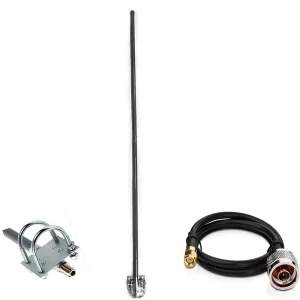
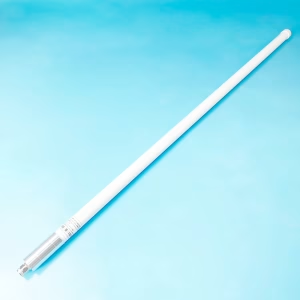
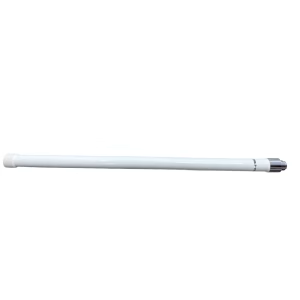
全向天線

頻率

獲得

尺寸

中號一個ter一個

1420-1530中號Hz

2d

F1 X 15公分

FerG一個ss

1420-1530中號Hz

2d

F1.3 X 12公分

FerG一個ss

1370-1450中號Hz

2d

F1.3 X 16公分

FerG一個ss

1420-1530中號Hz

2d

F4.1 X 2.6c

ABS

902-928中號Hz

2d

F1 X 15公分

FerG一個ss

902-928中號Hz

2d

F1.3 X 17公分

FerG一個ss

840-845中號Hz

2d

F1.3 X 16公分

FerG一個ss

806-826中號Hz

2d

F3.8 ×25公分

FerG一個ss

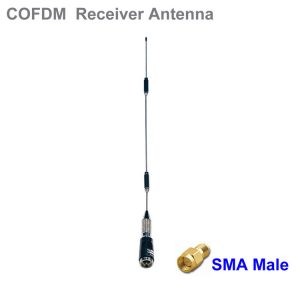
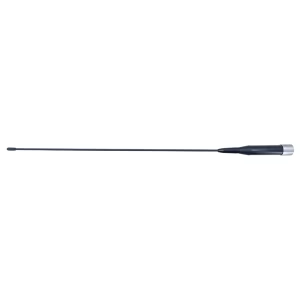
全向減震彈簧天線

頻率

獲得

尺寸

中號一個ter一個

1420-1530中號Hz

3d

F1.6 X 25公分

FerG一個ss

1420-1530中號Hz

4d

F1.6 X 35公分

FerG一個ss

1370-1450中號Hz

5d

F1.6 X 50公分

FerG一個ss

1370-1450中號Hz

6d

F1.6 X 60公分

FerG一個ss

802-926中號Hz

4d

F1.6 X 55公分

FerG一個ss

566-678中號Hz

4d

F1.6 X 70公分

FerG一個ss

634-674中號Hz

6d

F2 X 120公分

FerG一個ss

512-562中號Hz

6d

F1.4 X 140公分

FerG一個ss

806-826中號Hz

2d

F3.8 X 25公分

FerG一個ss

全向性柔性鵝頸天線

頻率

獲得

尺寸

中號一個ter一個

566-678中號Hz

1d

F1.3 ×28公分

FerG一個ss

566-803中號Hz

2+1分貝

3+1d

F1.6 ×60公分

FerG一個ss

806-826中號Hz

2d

F1.3 ×36公分

FerG一個ss

703-803中號Hz

4.5d

F1.3 ×47公分

FerG一個ss

1420-1530中號Hz

2d

F1.3 X 25公分

FerG一個ss

1420-1530中號Hz

3d

F1.3 ×31公分

FerG一個ss

1350-1450中號Hz

4d

F1.3 ×60公分

FerG一個ss

1370-1450中號Hz

5d

F1.6 ×50公分

FerG一個ss

1370-1450中號Hz

6d

F1.6 ×60公分

FerG一個ss

802-926中號Hz

4d

F1.6 X 55公分

FerG一個ss

566-678中號Hz

4d

F1.6 ×70公分

FerG一個ss

634-674中號Hz

6d

F2 ×120厘米

FerG一個ss

512-562中號Hz

6d

F1.4 X 140厘米

FerG一個ss

806-826中號Hz

2d

F3.8 ×25公分

FerG一個ss

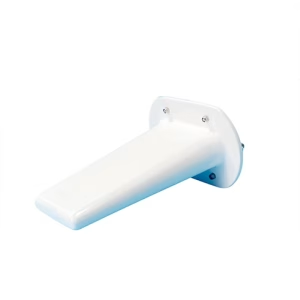
機載刀片天線模型

頻率

獲得

尺寸

材料

1420-1530兆赫

2分貝

2.7 X 2.4 ×12公分

3-證明ABS

1420-1530兆赫

2分貝

11.6 X 8 ×15.5厘米

玻璃纖維

1350-1470兆赫

4分貝

9.2 X 4.2 X 32.5厘米

3-證明ABS

1350-1470兆赫

6分貝

9.2 X 4.2 ×48公分

3-證明ABS

566-678兆赫

1分貝

9.2 X 4.2 ×16公分

3-證明ABS

566-678兆赫

1分貝

11.6 X 8 ×15.5厘米

玻璃纖維

840-845兆赫

1分貝

9.2 X 4.2 ×16公分

3-證明ABS

840-845兆赫

1分貝

11.6 X 8 ×15.5厘米

玻璃纖維

240-320兆赫

2分貝

9.2 X 4.2 ×16公分

玻璃纖維

3-證明ABS: 高品質ABS, 防水的, 防塵、耐腐蝕

  1. 無人機 天線頻率增益和長度

Antenna Classification in UAV Wireless Video Transmission

In UAV wireless video transmission and telemetry systems, antennas play a critical role in determining transmission distance, 訊號穩定性, anti-interference performance, 和整體可靠性. Antennas can be classified based on different standards:


1. By Radiation Pattern

  • Omnidirectional Antennas

    • Radiate signals evenly in 360° on the horizontal plane.

    • Advantage: Maintain stable links while the UAV is moving and changing orientation.

    • Common Use: UAV airborne side, handheld ground controllers.

    • Examples: Whip antennas, fiberglass omnidirectional antennas.

  • 定向天線

    • Concentrate energy in a specific direction for higher gain and longer transmission range.

    • Advantage: Excellent for long-distance transmission and point-to-point communication.

    • Drawback: Require alignment toward the UAV.

    • Common Use: Ground stations and fixed receivers.

    • Examples: 八木天線, panel antennas, parabolic antennas.


2. By Application Scenario (Deployment Location)

  • Airborne UAV Antennas

    • 輕的, 袖珍的, 抗振動, often omnidirectional to ensure stable connectivity in flight.

    • Examples: Small whip antennas, patch antennas, embedded PCB antennas.

  • Ground Station Antennas

    • Less weight restriction, can use large high-gain directional antennas to extend transmission distance.

    • Examples: 八木天線, fiberglass antennas, high-gain panel antennas.


3. By Structure and Design

  • Fiberglass Antennas

    • Encased in fiberglass for waterproofing, wind resistance, and corrosion protection.

    • Often omnidirectional, suitable for outdoor fixed stations or vehicle-mounted bases.

  • 八木天線

    • Classic directional antennas with gain up to 8–15 dBi.

    • Ideal for long-range UAV video reception at ground stations.

  • Whip Antennas

    • Slim, rod-shaped, typically omnidirectional.

    • Rugged and durable, used for vehicle-mounted ground stations.

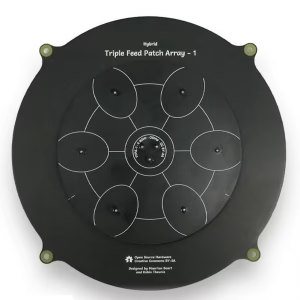
  • Patch Antennas

    • 袖珍的, 輕的, easy to integrate into UAV fuselage or electronics.

    • Suitable for onboard applications with short to medium-range communication.


4. By Operating Frequency

  • 2.4 GHz Antennas: Common for UAV remote control signals and short-range WiFi-based video links.

  • 5.8 GHz Antennas: Popular for HD video transmission with higher bandwidth, though weaker in penetration.

  • 900 兆赫 / 1.2 GHz Antennas: Effective for long-range control and video, with stronger anti-obstacle performance.

  • 700–800 MHz Antennas: Widely used in COFDM/OFDM video links for long-range and strong penetration capability.


5. By Polarization

  • Linear Polarization: Typical for whip antennas and Yagi antennas.

  • Circular Polarization: Reduces signal fading caused by UAV attitude changes, common in FPV video systems.


Summary
在無人機無線傳輸中, antenna selection depends on:

  • Deployment location (airborne vs. 地面),

  • 傳輸距離 (short/medium vs. 遠距離),

  • 環境 (城市的, 鄉村的, 多山),

  • 行動性 (fixed ground base vs. 車載式).

  • Airborne UAV → Lightweight omnidirectional whip or patch antennas.

  • Fixed Ground Station → High-gain Yagi or panel directional antennas.

  • Vehicle Ground Station → Fiberglass omnidirectional or whip antennas.