





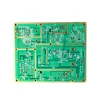
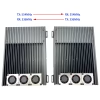
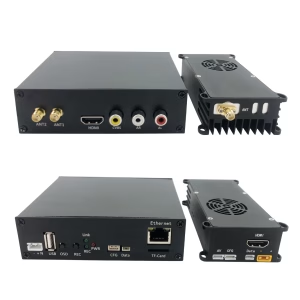
IP MESH networking radio FHSS video data transceiver for UAVs, ロボット工学, tactical communication systems, 長距離, 安全な, low-latency wireless links.
IP MESH Networking Radio FHSS Video Data Transceiver (300mW PA, Long-Range 22km Wireless Link)
目次
概要
ザ・ IP MESH ネットワーキング無線 FHSS ビデオ データ トランシーバー プロレベルです wireless video and data communication system designed for UAVs, ロボット工学, and remote control (ラジコン) アプリケーション. を装備 300mW power amplifier (PA), it delivers a robust, 安定した, and low-latency link for IP Ethernet cameras, ensuring high-quality video and control data transmission over distances up to 22km 見通し (ロス).
This compact and powerful FHSS-based (周波数ホッピング スペクトラム拡散) transceiver is engineered to resist interference and provide secure, real-time two-way communication even in challenging RF environments. サポートします ポイントツーポイント, ポイントツーマルチポイント, そして Mesh network configurations, に最適です industrial drones, 自動運転車, and tactical communications.
特徴
-
Integrated 300mW PA (Power Amplifier) for extended range and strong signal stability.
-
Dual-frequency operation: 566–678 MHz and 1420–1530 MHz for redundancy and anti-interference.
-
FHSS technology enables intelligent frequency hopping to avoid congested bands.
-
OFDM modulation with adaptive QPSK/16QAM/64QAM ensures efficient data throughput.
-
双方向 100 Mbps transmission rate, supporting both video and RC control data simultaneously.
-
AES128暗号化 for secure communication.
-
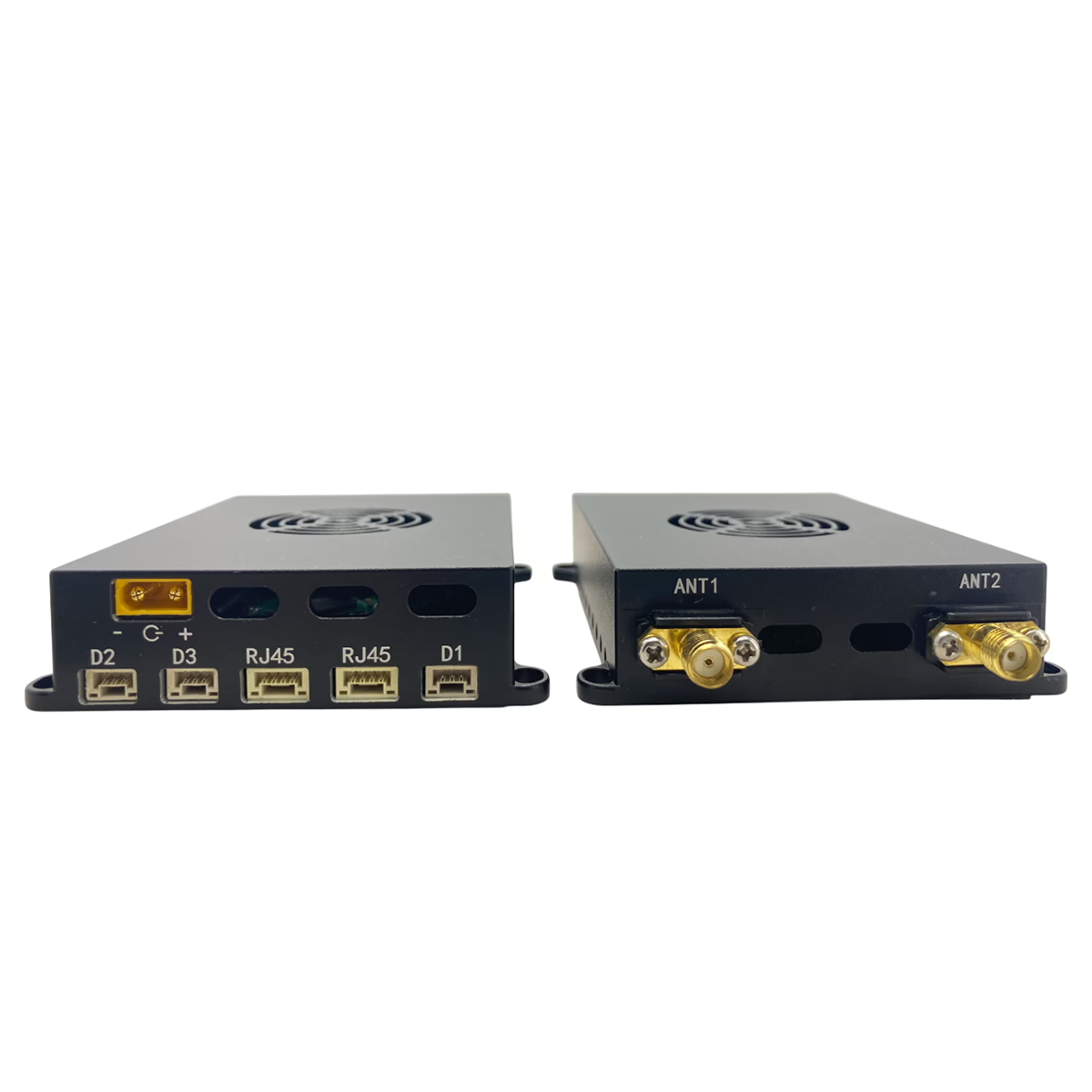
2x RJ45 Ethernet ports for IP video/data, 1x RS232 serial port, 1x Sbus serial port and 1x TTL serial port.
-
Compact and lightweight design (83.7×61×19 mm; <140 グラム) for easy drone integration.
-
Web UI management interface for intuitive setup and monitoring.
-
Industrial-grade durability, operating from -40 °C to +85 ℃.
-
Supports dual antennas (2T2R MiMo) for enhanced transmission stability and range.
-
Multiple bandwidth modes: 1.4 MHzから 40 MHz configurable.
-
メッシュ, ポイントツーポイント, and Point-to-Multipoint topologies supported.
仕様
| パラメータ | 詳細 |
|---|---|
| モデル | Vcan1806-300mW |
| Power Amplifier | 300 mW (×2) |
| 周波数帯域 | 566–678 MHz & 1420–1530MHz |
| 変調 | QPSK / 16QAM / 64QAM adaptive |
| 帯域幅オプション | 1.4 / 3 / 5 / 10 / 20 / 40 メガヘルツ |
| Max Data Rate | 100 Mbps |
| 伝送距離 | まで 22 キロ (air-to-ground LOS) |
| 暗号化 | AES128 |
| ネットワーキングモード | P2P, P2MP, メッシュ |
| Ethernet Ports | 3 ×RJ45 (PH1.25 mm 4 ピン) |
| シリアルポート | 1 × RS232, 1 × TTL control port |
| Antenna Connectors | SMA (主要 + Aux) |
| 電源 | 12 ~ 18 V (XT30PW-Mコネクタ) |
| 感度 | -95 dBm @ 20 メガヘルツ |
| 動作温度 | -40 ℃~ +85 ℃ |
| サイズ / 重量 | 83.7 × 61 × 19 ミリ / < 140 グラム |
アプリケーション
-
UAV / Drone video & telemetry link – Ideal for long-range IP camera streaming and RC control.
-
Robotics and autonomous systems – Enables secure and reliable communication among multiple robots.
-
Emergency rescue & 法執行機関 – Rapid deployment wireless command link for real-time situational awareness.
-
Vehicle or vessel monitoring – Supports wireless IP cameras for surveillance or data streaming.
-
工業検査 – Wireless video and data control for remote monitoring in harsh environments.
-
Defense and tactical operations – Mesh-based, アンチジャミング, encrypted links for mission-critical use.
オプションのカスタマイズ
We understand each deployment has unique requirements. ザ・ Vcan1806 FHSS MESH Transceiver can be customized with the following options:
-
Power Amplifier Choices: 300 mW, 2 W, 5 W, または 10 W.
-
ネットワークモード: P2P or MESH (までサポートします 64 ノード).
-
インターフェース構成: Additional serial ports (RS485/RS422) or GPIO for extended control.
-
周波数帯域のカスタマイズ: Configurable per regional regulations (300–6000MHz).
-
Housing and Cooling: Standard aluminum case or IP67 waterproof enclosure.
-
Video Input Integration: Compatible with H.264/H.265 encoder modules for HDMI, の, またはSDI入力.
-
アンテナオプション: Omnidirectional or directional long-range antennas (fiberglass or panel).
Typical Network Configurations
-
Vcan1806-P2P:
-
Point-to-point connection (例えば, UAV ↔ Ground Station).
-
まで 64 nodes sharing 100 Mbps.
-
-
Vcan1806-MESH:
-
Multi-node Mesh network (まで 32 ノード).
-
2-hop communication with shared 50–100 Mbps throughput.
-
Self-healing routing ensures network reliability.
-
よくある質問
Q: Can mesh networks be separated by changing the AES key?
A: はい. Mesh networks can be isolated by using different AES encryption keys, ensuring that only devices with the same key can join and communicate within a given network. 加えて, network separation can also be achieved through IP addressing (例えば, assigning devices to different subnets), providing another layer of logical isolation.
Q: What is the lowest frequency you can offer, and what is the bandwidth at that frequency?
A: The lowest frequency available for our mesh system is in the 566–678 MHz band. At this frequency range, the total available bandwidth is 112 メガヘルツ.
Q: My situation is the following: I have multiple clients, each buying 5 products with IP mesh drone transceivers inside. For each customer, の 5 radios must communicate with each other in a mesh network, but there should be no cross-talk between different customers. How can this be achieved?
A:This requirement can be easily supported through network segmentation and encryption isolation. For each customer, の 5 devices can be assigned to a separate network group using either different IP configurations and/or different AES encryption keys. This ensures that each set of devices forms an independent mesh network.
Even if devices from different customers are configured with the same IP address range, they will still not be able to join or communicate within the same network unless they share the same AES key. The AES encryption acts as a security boundary, preventing unauthorized devices from accessing video or data streams from another customer’s network.
要約すれば, isolation between different clients is achieved through a combination of IP separation and strong AES encryption, ensuring secure and independent mesh operation for each customer.
Q: The setup may include a drone (end node), a drone acting as an airborne repeater, a ground controller operated in the field, a ground repeater, and a command/monitoring station in a vehicle. Can this be supported with a 5-node mesh system?
A: This type of deployment requires a true mesh networking system.
Because your scenario involves multiple moving and distributed nodes (airborne drone, airborne relay, ground controller, ground relay, and mobile command vehicle), each node needs to be able to dynamically route and relay data through multiple paths. A star topology system with a central node is not suitable for this use case, since all communication must pass through a fixed center point and cannot support flexible multi-hop relay between peers.
対照的に, a mesh system allows all 5 modules to interconnect dynamically, enabling direct or multi-hop communication between any nodes in the network. This provides the flexibility, redundancy, and range extension required for your described operational environment.

Q: Can I change the AES encryption key whenever I want, or is it fixed from the factory?
A: The AES encryption key is user-configurable and can be changed at any time. It is not fixed at the factory.
Users can update the AES key as needed to enhance security or to reconfigure network grouping. Once the key is changed, only devices using the same updated key will be able to join and communicate within the same network.
Q: I have many network devices besides IP cameras. They are connected to a switch, and the switch output will go to the radio module. Is this supported?
A: はい, this configuration is fully supported. Our wireless link is based on IP packet transmission, so it is transparent to higher-layer network traffic. In addition to IP cameras, you can connect any IP-based device to the switch, and all devices will be carried over the wireless link.
From the user’s perspective, the system behaves like an extension of a standard Local Area Network (LAN). 接続したら, you can access and manage different devices using their individual IP addresses, just as you would in a wired network environment.
Q1: Can the Vcan1806 support ground-to-ground communication in dense urban areas?
A1: Ground-level long-range transmission in high-density areas is challenging due to signal blockage. We recommend using a repeater or elevated relay station to achieve up to 5 km範囲.
第2四半期: How does the dual-frequency system enhance stability?
A2: The transceiver uses both 1.4 GHzと 600 MHz bands simultaneously. If interference occurs on one frequency, the other maintains the connection. Combined with FHSS, it automatically hops to the cleanest frequency for continuous transmission.
Q3: What is the maximum throughput for dual-band operation?
A3: The system supports up to 100 Mbps bidirectional throughput, suitable for HD video, テレメトリー, and RC control simultaneously.
Q4: How can I access and configure the device?
A4: The web UI management interface is accessible through any Ethernet port. Default login credentials:
ユーザー名: 管理者
パスワード: 管理者
Q5: Can it be integrated with third-party IP cameras?
A5: はい. It supports all standard IP Ethernet cameras. For HDMI/SDI/AV sources, an additional H.265 encoder module が必要です.
Q6: What are the advantages of FHSS compared to fixed-frequency radios?
A6: FHSS dynamically hops across multiple frequencies, reducing interference and interception risks, ensuring stable and secure links for professional UAV and tactical use.
Q7: Is it suitable for drone swarm communication?
A7: 絶対に. で Mesh mode, まで 32 drones or nodes can form an intelligent network where each node acts as both a transmitter and a relay, ideal for swarm coordination and telemetry sharing.
Q8: Can you provide waterproof or ruggedized versions?
A8: はい, IP67-rated enclosures are available for field operations requiring dustproof, 防水, or fogproof protection.
Q9: Is the transmission digital or analog?
A9: The transmission is デジタル. Our system uses digital COFDM modulation to ensure stable and high-quality image transmission.
Q10: 映像信号を送信する場合, パケットが転送中に失われた場合, does the receiver notice and ask the transmitter to resend the lost packet?
A10: いいえ. Our system uses transparent transmission — the transmitter sends data as it is generated and stops when there is no data. If the network is interrupted or the signal is weak, some data may be lost. The lost packets are not stored or resent, because retransmitting outdated data is meaningless for real-time video transmission.
ザ・ Vcan1806 300mW IP MESH Networking Radio FHSS Video Data Transceiver is a powerful and flexible long-range solution for ワイヤレスビデオ, テレメトリー, and control communication. Whether used in drones, ロボット工学, or industrial systems, それは保証します 安全な, 耐干渉性, and low-latency connectivity over extended distances. With optional power amplifiers up to 10 W and multiple network configurations, it’s the ideal choice for demanding wireless IP camera and control applications.





iVcan.com –
We’ve been using the Vcan1806 300mW IP MESH FHSS Video Data Transceiver for our UAV and robotics projects, そしてそのパフォーマンスは素晴らしかった. The long-range connectivity and stable video transmission even in interference-prone environments are impressive. The dual-frequency and FHSS technology ensure a reliable link, while the low latency makes it perfect for real-time control and HD video. The web interface is intuitive, and integration with our IP cameras was seamless. A truly professional, 安全な, and high-quality wireless solution!