





Mesh Radios AT Commands Manual
The AT Command may have a little different for different model/version, this AT command document is a basic description of the AT command for your reference.
Suitable the below models of Mesh Version.
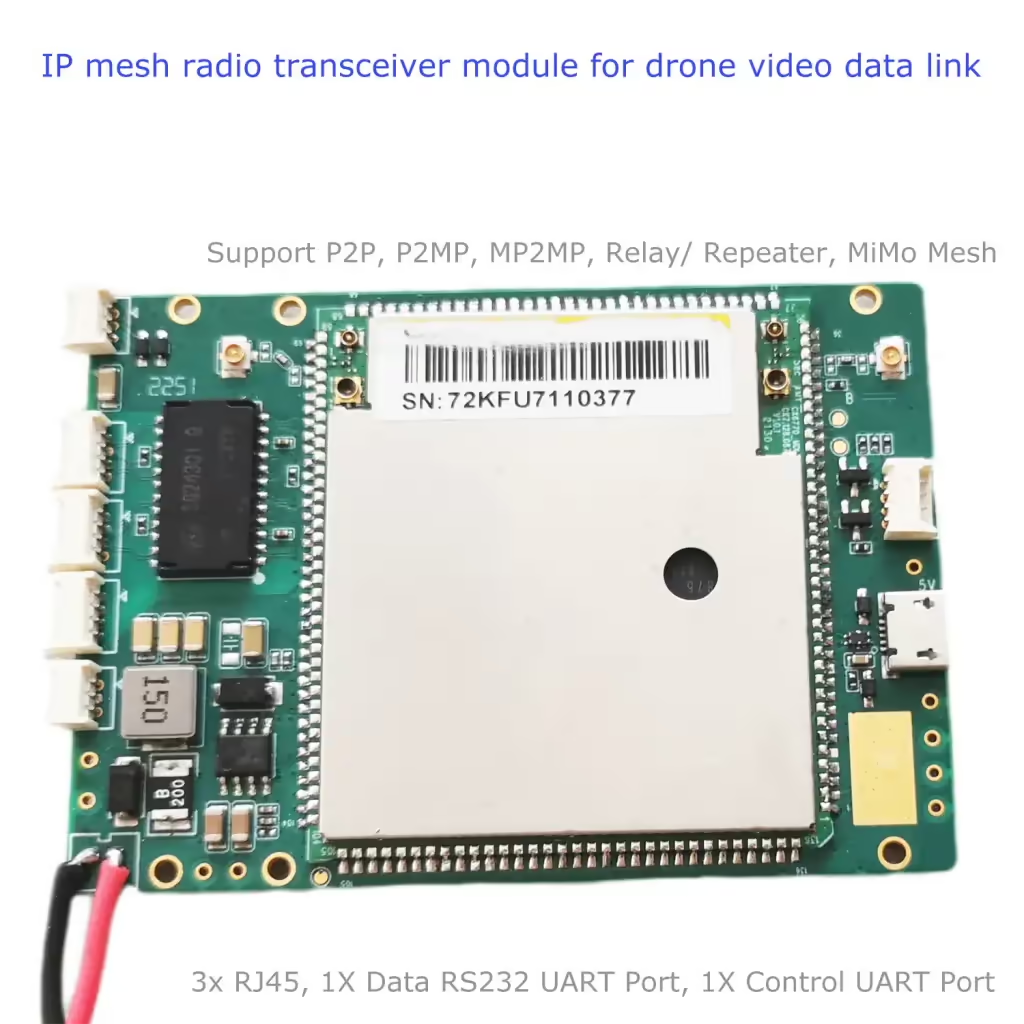
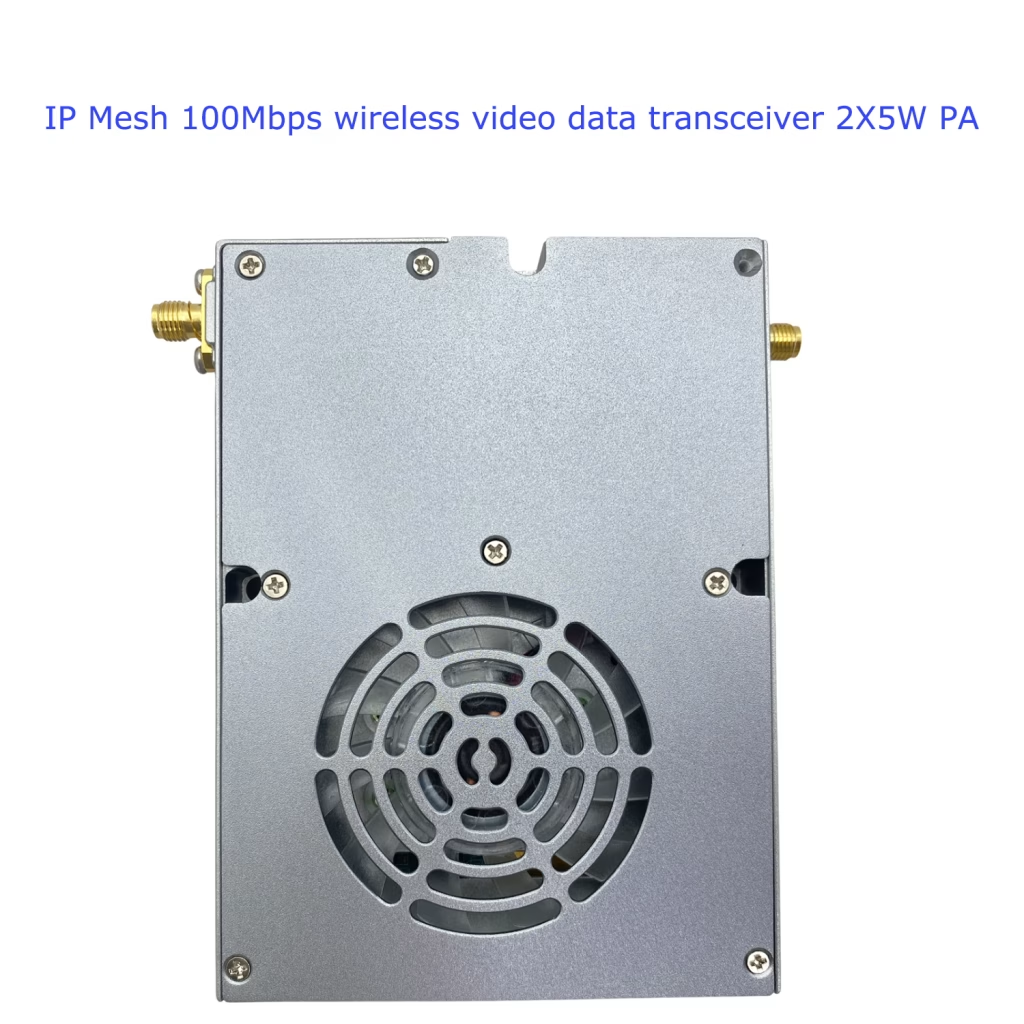
目次
1.AT+CFUN: Wireless link enable switch configuration
| 指示 | Possible response(s) |
| AT+CFUN=[<fun>[,<rst>]] | |
| AT+CFUN? | +CFUN:<fun> |
| AT+CFUN=? | +CFUN:(list of supported<fun>s),(list of support<rst>s) |
説明
Run the command to set the MT’s <fun> function level, full functinality is the highest level, minimum Functionality is the minimum level, there is a user-defined level between the highest and lowest levels, の < RST > parameter is valid if the user defines the level.
Final result code
わかりました
Successful
ERROR or +CME ERROR: <err>
Command performing failed
Defined values
<fun>: integer type
0: Minimum Functionality
1: Full functionality
<rst>: integer type
0: do not reset the MT before setting it to <fun> power level.
Example
AT+CFUN=1<CR>
<CR><LF>わかりました<CR><LF>
AT+CFUN?<CR>
<CR><LF>+CFUN:1<CR><LF>
<CR><LF>わかりました<CR><LF>
AT+CFUN=?<CR>
<CR><LF>+CFUN:(0~1)<CR><LF>
<CR><LF>わかりました<CR><LF>
2.AT+CMEE: Indicates that the AT command is abnormal
| 指示 | Possible response(s) |
| AT+CMEE=[<n>] | |
| AT+CMEE? | +CMEE:<n> |
| AT+CMEE=? | +CMEE:(list of supported<n>s) |
説明
Run this command to enable or disable the format of the final ERROR report. When MT is turned on, the format of the ERROR report is +CME ERROR:<err> instead of general ERROR.However, if the ERROR is caused by invalid parameter values or syntax errors, the ERROR is normally reported as well.
Final result code
わかりました
Successful
ERROR or +CME ERROR: <err>
Command performing failed
Defined values
<n>: integer type
0: disable +CME ERROR:<err> result code and use ERROR instead
1: enable +CME ERROR:<err> result code and use numeric <err> 価値.
2: enable +CME ERROR:<err> result code and use verbose <err> 価値.
Example
AT+CMEE=1<CR>
<CR><LF>わかりました<CR><LF>
AT+CMEE?<CR>
<CR><LF>+CMEE:1<CR><LF>
<CR><LF>わかりました<CR><LF>
AT+CMEE=?
<CR><LF>+CMEE:(0-2)<CR><LF>
<CR><LF>わかりました<CR><LF>
3.AT^DACS: access status
| 指示 | Possible response(s) |
| AT^DACS=<n> | |
| AT^DACS? | ^DACS: <n>,<州> |
| AT^DACS=? | ^DACS: (list of supported <n>s) |
説明
The DACSI: <州> command is used to set the status of the DACSI: <州> report. The status of the DACSI: <州> report is reported by default when the DACSI: <州> is started.Active reporting When this function is enabled, the UE proactively reports the access status indicator after successful access.After the network of the main control node is successfully deployed, the main control node is successfully connected.
Query commands are used to query the status of the current reporting switch and access status.
Test commands are used to test whether the command is supported and query the value range of <n> パラメータ.
Final result code
わかりました
Successful
ERROR or +CME ERROR: <err>
Command performing failed
Defined values
<n>: integer type: indicates the status of the proactively reported switch
0: shut down
1: 開ける
2: queries the current access status
<州>: integer type, indicating the access status
Zero: no access
1: have access
Example
AT^DACS=1<CR><LF>
<CR><LF>^DACSI: 0<CR><LF>
<CR><LF>わかりました<CR><LF>
<CR><LF>^DACSI: 1<CR><LF>
AT^DACS?<CR><LF>
< CR > < LF > ^ DACS: 1, 1 < CR > < LF >
<CR><LF>わかりました<CR><LF>
AT^DACS=?<CR><LF>
<CR><LF>^DACS: (0-2)<CR><LF>
<CR><LF>わかりました<CR><LF>
4.AT^DRPC: Connected wireless parameters take effect in real time
| 指示 | Possible response(s) |
| AT^DRPC=<freq>[,帯域幅] [,<cellid>] | |
| AT^DRPC? | ^DRPC: (<freq>,<帯域幅>), (<scellfreq>,< scellBandwidth >), cellid |
| AT^DRPC=? | ^DRPC: (list of supported <freq>s), (list of supported <帯域幅>s), (list of supported <cellid>s) |
説明
Run commands to set parameters in the access state.
Query commands are used to query the current parameter Settings.
Test commands are used to test whether the command is supported and the range of query parameters.
注記: If CA is supported, cellid must be set and cannot be empty.If CA is not supported, cellid cannot be set.
For the default preset frequency points, see the appendix. The preset frequency points must be in the preset frequency points list. If they are not in the list, setting failure is displayed.
Final result code
わかりました
Successful
ERROR or +CME ERROR: <err>
Command performing failed
Defined values
<freq>: integer type, indicating the point frequency, in the unit of 100KHz
(5660-6780, 14200-15300)
<帯域幅>: integer type: indicates the bandwidth
Zero: 1.4 M
1: 3M
2: 5M
3: 10M
4: 15M(サポートされていません)
5: 20M
<cellid> integer type , Physical cell id
0: Pcell primary cell
1: Scell second cell
Other value reserved.
Example
The AT ^ DRPC = 14300,3,0 < CR > < LF >
<CR><LF>わかりました<CR><LF>
AT^DRPC?<CR><LF>
< CR > < LF > ^ DRPC: (14300, 3), 0655 (35), そして 0 < CR > < LF >
<CR><LF>わかりました<CR><LF>
The AT ^ DRPC = 14300,5,1 < CR > < LF >
AT^DRPC?<CR><LF>
< CR > < LF > ^ DRPC (14300, 3), (14600, 3), 1 < CR > < LF >
<CR><LF>わかりました<CR><LF>
AT^DRPC=?<CR><LF>
<CR><LF>^DRPC:( 5660-6780, 14200-15300),(0-5) ,(0-1)<CR><LF>
<CR><LF>わかりました<CR><LF>
5.AT^DRPS: Disconnected wireless parameter configuration
| 指示 | Possible response(s) |
| AT^DRPS=<freq>,<帯域幅>,<力>[,<cellid>] | |
| AT^DRPS? | ^DRPS: (<freq>,<帯域幅>,<力>), (<scellfreq>,< scellPower >),cellid |
| AT^DRPS=? | ^DRPS: (list of supported <freq>s), (list of supported <帯域幅>s, (list of supported <力>s, (list of supported <cellid>s) |
説明
The command is used to save the parameters to NVRAM, which will take effect after the flight.
Query commands are used to query the current NVRAM parameter Settings.
Test commands are used to test whether the command is supported and the range of query parameters.
注記: If CA is supported, cellid must be set and cannot be empty.If CA is not supported, cellid cannot be set.
For the default preset frequency points, see the appendix. The preset frequency points must be in the preset frequency points list. If they are not in the list, setting failure is displayed
Final result code
わかりました
Successful
ERROR or +CME ERROR: <err>
Command performing failed
Defined values
<freq>: integer type, indicating the point frequency, in the unit of 100KHz
(5660-6780, 14200-15300)
<帯域幅>: integer type: indicates the bandwidth
Zero: 1.4 M
1: 3M
2: 5M
3: 10M
4: 15M(サポートされていません)
5: 20M
<力>: “整数” タイプ, indicating power, in dBm, からの範囲 “-40” に “40”
<cellid> integer type , Physical cell id
0: Pcell primary cell
1: Scell second cell
Other value reserved.
Example
The AT ^ DRPS = 14300, 3, ’40 “, 0 < CR > < LF >
<CR><LF>わかりました<CR><LF>
AT^DRPS?<CR><LF>
< CR > < LF > ^ DRPS: (14300, 3, ’40 “), (0655, 35, “15”), そして 0 < CR > < LF >
<CR><LF>わかりました<CR><LF>
The AT ^ DRPS = 14300, 5, 10 “, “1 < CR > < LF >
<CR><LF>わかりました<CR><LF>
AT^DRPS?<CR><LF>
< CR > < LF > ^ DRPS (14300, 3, ’40 “), (14500, 3, “10”), 1 < CR > < LF >
<CR><LF>わかりました<CR><LF>
AT^DRPS=?<CR><LF>
< CR > < LF > ^ DRPS: (5660-6780, 14200-15300), (0 に 5), (” – “~ 40” 40 “), (0-1) < CR > < LF >
<CR><LF>わかりました<CR><LF>
6.AT^DRPR: Wireless parameter reporting
| 指示 | Possible response(s) |
| AT^DRPR=<n> | |
| AT^DRPR? | ^DRPR: <n> |
| AT^DRPR=? | ^DRPR: (list of supported <n>s) |
説明
Run the following command to set local wireless parameters for reporting ^DRPRI: <cell_index>,<earfcn>,<cell_id>,<NodeFlag>,<IPV4 address>,<SN >,<索引>,<rssi>,<pathloss>,<rsrp>,<snr>,<距離>,<tx_power>,<rx_throughput_total_tbs>,<rx_tb_error_per>,<max_data_per _second >, < tx_mcs >, < tx_rb_num >, < rx_mcs >, < rx_rb_num >, < wide_cqi >, < ri >, < rx_tb_error_percent_total >, < max_snr >, < minr > switch state, The initial startup is disabled by default.
Query commands are used to query the current parameter Settings.
Test commands are used to test whether the command is supported and the range of query parameters.
Final result code
わかりました
Successful
ERROR or +CME ERROR: <err>
Command performing failed
Defined values
<n>: integer type: indicates the status of the proactively reported switch
0: shut down
1: 開ける
2: queries the reported value
<cell_index>: INTEGER type, indicating primary cell or secondary cell
Zero: Pcell (Main area)
1: Scell (auxiliary cell)
<earfcn>: integer type
<cell_id>: integer type
< NodeFlag >: integer type, which identifies whether the neighboring one-hop node is a one-way node
0: dual-pass node
1: single-pass node
<IPアドレス> String type. The value consists of four groups of digits (0-255) separated by periods (.) in the format of A1.A2.A3.A3.A4.
<SN>: indicates a one-hop neighbor node. The value is a 7-digit hexadecimal number ranging from 0000000 to FFFFFFF
<索引>: integer type, indicating the port index number
1: ポート 1
2: ポート 2
< rSSI >: string type, dBmの, rSSI measurement of port 1 and port 2 on a hop adjacent node, 形式 “±value”(を除外する “0”)
“-141” に “-44”: indicates the RSSI measurement value
“+ 32767” : invalid values
<pathloss>: integer type, pathloss value,dBmの
0 に 191: road damage
32767: invalid values
< RSRP >: string type, dBmの, RSRP measurement value, 形式 “±value”(を除外する “0”)
“-141” に “-44”: RSRP measurement value
“+ 32767” : invalid values
< SNR >: string type,SNR measurement value. 形式: “±value”(を除外する “0”)
“-50” に “+50”: SNR measurement value
“+ 32767” : invalid values
< 距離 >: integer type, distance from the peer node, メートル単位で, 範囲 [0, 5000]
< tx_power >:string type, transmission power sent by this node to each one-hop neighbor node, in dBm, in the format of “±value”(を除外する “0”).
“-50” に “+50”: indicates the transmitted power
“+ 32767” : invalid values
< rx_throughput_total_tbs > : integer type, receives the throughput information, the total size of TB in the reporting period, the unit of Byte, the range of [0120000]
< rx_tb_error_per >: INTEGER type, receiving Bler structure, percentage of error bits in the reporting period, range from 0 に 100
< max_datA_per_second >: integer type: indicates the theoretical peak rate when the packet is filled.
< tx_MCS >: integer type specifies the instantaneous MCS of the last data sent within the reporting period. The value ranges from 0 に 29.
<tx_rb_num>: integer type specifies the instantaneous rb_num of the last data sent within the reporting period. The value ranges from 6,100.
< rx_MCS >: integer type specifies the last instantaneous MCS received from a neighboring node in the reporting period. The value ranges from 0 に 29.
<rx_rb_num>: integer type specifies the instantaneous rb_num of a neighboring node received for the last time in the reporting period. The value ranges from 6,100.
< wiDE_CQI >: integer type, indicating the received broadband CQI of the neighboring node. The value ranges from 1 に 15, and the average value is reported within a period
<ri>: integer type, rank ri with neighboring nodes. The value range is [1,2]. Ri =2 indicates that MIMO is enabled.
< rx_tb_percent_total >: integer type, after entering the connection state, receive the cumulative bit error rate corresponding to the neighboring node data, 範囲 [0,100]
<max_snr>: integer type, the maximum SNR in 1000ms of the two antennas corresponding to the data received from the adjacent node. The value range is [-40,40].
<minr>: integer type, the minimum SNR in 1000ms for the two antennas corresponding to the data received from adjacent nodes, [-40,40]
Example
AT^DRPR=1<CR><LF>
<CR><LF>わかりました<CR><LF>
AT^DRPR?<CR><LF>
<CR><LF>^DRPR: 1<CR><LF>
<CR><LF>わかりました<CR><LF>
<CR><LF>^DRPRI: 0,1,1000,16, “192.168.1.13”, 4020096, “- 46”, 20, “60”, “195”, “0”, 4000, “- 36”, 10000000500000,10,1,15,3,15 < CR > < LF >
< CR > < LF > ^ DRPRI: 1, 2100 dec, “192.168.1.13”, 4020096, “106”, 115, “100”, “194”, “+ 20, 4000,” – 36 “, 10000000500000,10,2, 15,3,15 < CR > < LF > the AT ^ DRPR =?<CR><LF>
<CR><LF>^DRPR: (0-2)<CR><LF>
<CR><LF>わかりました<CR><LF>
7.AT^DAOCNDI: user frequency band configuration
| 指示 | Possible response(s) |
| AT^DAOCNDI=<band_bitmap> [,<scell_band_bitmap>] | |
| AT^DAOCNDI? | ^DAOCNDI: <band_bitmap> , <scell_band_bitmap> |
| AT^DAOCNDI=? |
説明
This command is used to set the working frequency band of the AD hoc network communication device.
Query commands are used to query information about the working frequency band of AD hoc communication devices.
Test commands are used to test whether the command is supported.
注記: If CA is supported, scell_band_bitmap must be set.If CA is not supported, scell_band_bitmap cannot be set.
Final result code
わかりました
Successful
ERROR or +CME ERROR: <err>
Command performing failed
Defined values
<band_bitmap>: string type(without double quotes),in hexadecimal format, the rightmost bit is the least significant bit (LSB/bit0).
Bit0: (reserved)
Bit2: 1.4g band: [1420,1530]メガヘルツ, corresponding to band66
Bit3: (reserved)
Bit4: (reserved)
Bit5: (reserved)
Bit6: (reserved)
Bit7: (reserved)
Bit8: (reserved)
Bit9: (reserved)
Bit10: 600M band: [566,678] メガヘルツ, corresponding to Band71
<scell_band_bitmap>: string type(without double quotes),in hexadecimal format, the right most bit is the least significant bit (LSB/bit0).
Bit0: (reserved)
Bit2: 1.4g band: [1420,1530]メガヘルツ, corresponding to band66
Bit3: (reserved)
Bit4: (reserved)
Bit5: (reserved)
Bit6: (reserved)
Bit7: (reserved)
Bit8: (reserved)
Bit9: (reserved)
Bit10: 600M band: [566,678] メガヘルツ, corresponding to Band71
Example
AT^DAOCNDI=04<CR><LF>// Set pcell band as 1.4g <CR><LF>わかりました<CR><LF>
AT^DAOCNDI?<CR><LF>
<CR><LF>^DAOCNDI: 04<CR><LF>
<CR><LF>わかりました<CR><LF>
AT^DAOCNDI=?<CR><LF>
<CR><LF>わかりました<CR><LF>
8.AT^DAPI: Access key configuration
| 指示 | Possible response(s) |
| そして^どこ=<password_id> | |
| AT^DAPI? | ^DAPI: <password_id> |
| そして^どこ=? |
説明
Setting commands are used to set the PASSWORD ID of the AD hoc network device.
Query commands are used to query the PASSWORD ID of the AD hoc network device.
Test commands are used to test whether the command is supported.
Final result code
わかりました
Successful
ERROR or +CME ERROR: <err>
Command performing failed
Defined values
<password_id>: string type, in HEX format
The length of the input parameter configuration must be even.
Example
The AT ^ fbfa DAPI = “30313233” < CR > < LF >
<CR><LF>わかりました<CR><LF>
AT^DAPI?<CR><LF>
< CR > < LF > ^ DAPI: “30313233 fbfa” < CR > < LF >
<CR><LF>わかりました<CR><LF>
そして^どこ=?<CR><LF>
<CR><LF>わかりました<CR><LF>
9.AT^DIPAN: Query the SN list of all reachable nodes
| 指示 | Possible response(s) |
| AT^DIPAN=<n> | ^DIPAN: <メートル>[,<SN_1>[,SN_2>,…[,<SN_m>]]] |
| AT^DIPAN? | ^DIPAN: <n> |
| AT^DIPAN=? | ^DIPAN: (list of supported <n>s) |
説明
Run this command to enable or disable active SN reporting for reachable nodes.This function is enabled by default. If this function is enabled, the current reachable node information will be reported once.Actively to open, the current of node information is changed, modem active reporting ^ DIPANI: < メートル > [,, < SN_1 > [, SN_2 >,… [, < SN_m >]]].
Query commands are used to query the status of the reporting switch.
Test commands are used to test whether the command is supported and query the value range of <n>.
Final result code
わかりました
Successful
ERROR or +CME ERROR: <err>
Command performing failed
Unsolicited result code
^DIPANI: <メートル>[,< SN_1>, [,SN_2>,…[,<SN_m>]]]
Defined values
<n>: integer type: indicates the status of the proactively reported switch
0: shut down
1: 開ける
2: Queries information about the current reachable nodes
<メートル>: integer type, indicating the number of reachable nodes
<SN>: a hexadecimal number of 7 digits ranging from 0000000 to FFFFFFF
Example
AT^DIPAN=1<CR><LF>
<CR><LF>^DIPAN: 0<CR><LF>
<CR><LF>わかりました<CR><LF>
<CR><LF>^DIPANI: 1, A020001<><CR><LF>
<CR><LF>^DIPANI:2, A020001, A021201<><CR><LF>
AT^DIPAN?<CR><LF>
<CR><LF>^DIPAN: 1<CR><LF>
<CR><LF>わかりました<CR><LF>
AT^DIPAN=?<CR><LF>
<CR><LF>^DIPAN: (0-2)<CR><LF>
<CR><LF>わかりました<CR><LF>
10.AT^DUBR: Com-uart baud rate configuration
| 指示 | Possible response(s) |
| AT^DUBR=<rate> | |
| AT^DUBR? | ^DUBR: <rate> |
| AT^DUBR=? | ^DUBR: (list of supported <rate>s) |
説明
Run this command to set the baud rate parameters of the COM-UART port.
Query commands are used to query the current parameter Settings.
Test commands are used to test whether the command is supported and the range of query parameters.
Final result code
わかりました
Successful
ERROR or +CME ERROR: <err>
Command performing failed
Defined values
<rate>: integer type, indicating the baud rate of the UART port. The values are as follows:
1200: 1200 バイト/秒
2400: 2400 バイト/秒
4800: 4800 バイト/秒
9600: 9600 バイト/秒
19200: 19200 バイト/秒
28800: 28800 バイト/秒
38400: 38400 バイト/秒
57600: 57600 バイト/秒
76800: 76800 バイト/秒
115200: 115200 バイト/秒
Example
AT^DUBR=57600<CR>
<CR><LF>わかりました<CR><LF>
AT^DUBR?<CR><LF>
<CR><LF>^DUBR: 57600<CR><LF>
<CR><LF>わかりました<CR><LF>
AT^DUBR=?<CR>
< CR > < LF > ^ DUBR: (1200240 0480 0960 0192 00288 00384 00576 00768 00115 200) < CR > < LF >
<CR><LF>わかりました<CR><LF>
11.AT^DSONRIRPT: Switch of route information reporting
| 指示 | Possible response(s) |
| AT^DSONRIRPT=<operation_type> | ^DSONRIRPT: <routeinfotype>,<destSN>,<ホップ>,<nextSN> |
| AT^DSONRIRPT=? | (list of supported <operation_type>s) |
説明
Run these commands to enable or disable the active route report function or query the current route information.When the route information reporting switch is enabled, the terminal reports ^DSONRIRPTI: < routeInfoType >,<destSN>,<ホップ>,<nextSN> whenever the route information changes.
Test commands are used to test whether the command is supported and query the value range of <operation_type>
Final result code
わかりました
Successful.
ERROR or +CME ERROR: <err>
Command performing failed.
Unsolicited result code
^DSONRIRPTI: <routeinfotype>,<destSN>,<ホップ>,<nextSN>
this unsolicited result code is returned when the route information changed.
Defined values
<operation_type>: integer type, which identifies the type of operation to be performed
0: Close route info report Disables active route information reporting
1: Open route info Report Enables active route information reporting
2: Query route info Queries routing information
< routeInfoType > : integer type, indicating the type of the route information
0: indicates a dynamic routing table. Routing algorithms are generated
1: static routing table, which is manually configured and generated
<destSN> : indicates the SN of the destination node. The value ranges from 0000000 to FFFFFFF, for example, 4020006.
<nextSN> : indicates the SN of the next hop node. The value is a 7-digit hexadecimal number ranging from 0000000 to FFFFFFF, for example, 4020006.
<ホップ>: integer type, indicating the number of hops
Example
AT^DSONRIRPT=?<CR>
<CR><LF>^DSONRIRPT: (0-2)<CR><LF>
<CR><LF>わかりました<CR><LF>
AT^DSONRIRPT=1<CR>
<CR><LF>わかりました<CR><LF>
< CR > < LF > ^ DSONRIRPTI: 0, 4134567412345 < CR > < LF >
AT^DSONRIRPT=2<CR>
< CR > < LF > ^ DSONRIRPT: 0, 4134567412345 < CR > < LF >
<CR><LF>わかりました<CR><LF>
12.AT^DSONRICFG: fixed route management configuration
| 指示 | Possible response(s) |
| AT^DSONRICFG=<Op>,<DstSN>,<NxtSN> | |
| AT^DSONRICFG=? | (list of supported <Op>s) |
説明
ザ・ <DstSN> parameter is used as the identifier of each route record. つまり, if the same <DstSN> route record already exists when you add a route record, the original record will be overwritten. If the same <DstSN> route record does not exist when you delete a route record, the deletion is ignored and success is displayed.Added routing entries to support saving in NVRAM.
Test commands are used to test whether the command is supported and query the range of the <Op> パラメータ
注記: Add each route entry to a destination node. You can only set the number of next hop nodes to 1.
Final result code
わかりました
Successful.
ERROR or +CME ERROR: <err>
Command performing failed.
Defined values
<Op>: INTEGER type, which identifies the operation type to be performed
0: Adds a route record
1: deletes a route record
2: Deletes the entire static routing table. In this operation, delete all routes and restart the static routes or save the original static routes
3: Deletes the entire static routing table. After the restart, static routes are empty
<DstSN>: indicates the SN of the destination node.The SN of the destination node is a 7-digit hexadecimal number ranging from 0000000 to FFFFFFF, for example, 4020006.
<NxtSN>: indicates the SN of the next hop node. The value is a 7-digit hexadecimal number ranging from 0000000 to FFFFFFF, for example, 4020006.
Example
The AT ^ DSONRICFG = 0400001401210 < CR >
<CR><LF>わかりました<CR><LF>
AT^DSONRICFG=1, 4002001<CR>
<CR><LF>わかりました<CR><LF>
AT^DSONRICFG=?<CR>
<CR><LF>^DSONRICFG: (0-3)<CR><LF>
<CR><LF>わかりました<CR><LF>
13.AT^DSONMIRPT: Reports information about the logical main control node
| 指示 | Possible response(s) |
| AT^DSONMIRPT=<n> | ^DSONMIRPT: <MstrSN> |
| AT^DSONMIRPT? | ^DSONMIRPT: <n> |
| AT^DSONMIRPT=? | (list of supported <Op>s) |
説明
Run commands to enable or disable the active information reporting function of the main control node or query the information about the current main control node.When the main control node information reporting switch is turned on, the terminal reports ^DSONMIRPTI: <MstrSN> whenever the main control node information changes.
Query commands are used to query the status of active information reporting on the current main control node.
Test commands are used to test whether the command is supported and query the range of the <Op> パラメータ
Final result code
わかりました
Successful.
ERROR or +CME ERROR: <err>
Command performing failed.
Unsolicited result code
^DSONMIRPTI: <MstrSN>
this unsolicited result code is returned when the master node information changed.
Defined values
<n>: integer type, which identifies the operation type
0: Disables the active information reporting function of the main control node
1: Enable the active information reporting function of the main control node
2: Queries information about the current main control node
< MstrSN>: indicates the SN of the main control node. The value is a 7-digit hexadecimal number ranging from 0000000 to FFFFFFF, for example, 4020006.
Example
AT^DSONMIRPT?<CR>
<CR><LF>^DSONMIRPT: 0<CR><LF>
<CR><LF>わかりました<CR><LF>
AT^DSONMIRPT=1<CR>
<CR><LF>わかりました<CR><LF>
<CR><LF>^DSONMIRPTI: 4023456<CR><LF>
AT^DSONMIRPT=2<CR>
<CR><LF>^DSONMIRPT: 4023456<CR><LF>
<CR><LF>わかりました<CR><LF>
AT^DSONMIRPT=?<CR>
<CR><LF>^DSONMIRPT: (0-2)<CR><LF>
<CR><LF>わかりました<CR><LF>
14.AT^DSONIPNN: Query the IP address of the network node
| 指示 | Possible response(s) |
| AT^DSONIPNN=<モード> | ^DSONIPNN: <番号>,<RecvMsgAll>[,<SN1> [,SN2>,…[,<SNm>]] When Mode=3 ^DSONIPNN: <番号>,<RecvMsgAll> [,<SN1>,<IPAddr1> [, SN2 >, < IPAddr2 >,… [,<SNm>,<IPAddrm>]]] |
| AT^DSONIPNN? | ^DSONIPNN: <モード> |
| AT^DSONIPNN=? | ^DSONIPNN: (list of supported <モード>s) |
説明
Run these commands to enable or disable active node information reporting.When the reporting switch is turned on, the terminal reports ^DSONIPNNI: <番号>,<RecvMsgAll>[,<SN1> [,SN2>…[,<SNm>]] whenever the network node information changes in the entire network.
Query commands are used to query the status of active node reporting.
Test commands are used to test whether the command is supported and the range of query parameters.
When mode is 0 または 1, the parameters need to be stored in NVRAM, which will take effect after the flight.
Final result code
わかりました
Successful
ERROR or +CME ERROR: <err>
Command performing failed
Unsolicited result code
^DSONIPNNI: <番号>,<RecvMsgAll>[ ,<SN1> [,SN2>,…[,<SNm>]]]
Defined values
<モード>: integer type: indicates the status of the switch that is proactively reported
0: shut down
1: 開ける
2: queries the information about the current nodes on the network
3: Query the IP address and SN of the current node on the network
<番号>: integer type, which indicates the number of nodes in the network
<RecvMsgAll> : integer type, indicating whether the information of the entire network is collected (SIB1 messages may be segmted, and the reported information needs to be indicated)
0: Not collected
1: Collect everything
<SN>: indicates the SN of the network node. The value is a hexadecimal number ranging from 0000000 to FFFFFFF, for example, 4020006
<IPAddr >: indicates the IPV4 address. The value consists of four groups of digits (0-255) separated by periods (.) in the format of A1.A2.A3.A3.A4.
Example
AT^DSONIPNN?<CR><LF>
<CR><LF>^DSONIPNN: 0<CR><LF>
<CR><LF>わかりました<CR><LF>
AT^DSONIPNN=1<CR><LF>
<CR><LF>わかりました<CR><LF>
<CR><LF>^DSONIPNNI: 1, 1, A023456<><CR><LF>
<CR><LF>^DSONIPNNI: 2, 1, A023456, A120345<><CR><LF>
AT^DSONIPNN=3<CR><LF>
<CR><LF>^DSONIPNN: 2, 1<CR><LF>
A023456, 170.168.1.56 < CR > < LF >
A120345, 170.168.1.45 < CR > < LF >
AT^DSONIPNN=?<CR><LF>
<CR><LF>^DSONIPNN: (0-3)<CR><LF>
<CR><LF>わかりました<CR><LF>
15.AT^DSONNMF: subnet merge control switch
| 指示 | Possible response(s) |
| AT^DSONNMF=<fun> | |
| AT^DSONNMF? | ^DSONNMF: <fun> |
| AT^DSONNMF=? | ^DSONNMF: (list of supported <fun>s) |
説明
Run this command to enable or disable the subnet merging function.
Query commands are used to query whether the subnet merge function is enabled.
The set parameters are stored in NVRAM and take effect after they are saved in and out of flight.
Final result code
わかりました
Successful
ERROR or +CME ERROR: <err>
Command performing failed
Defined values
<fun>: INTEGER type, which indicates whether the subnet merging function is enabled or disabled. 範囲: 0: disabled.1: 開ける.
Example
AT^DSONNMF=1<CR>
<CR><LF>わかりました<CR><LF>
AT^DSONNMF?<CR>
<CR><LF>^DSONNMF: 1<CR><LF>
<CR><LF>わかりました<CR><LF>
AT^DSONNMF=?<CR>
<CR><LF>^DSONNMF: (0-1)<CR><LF>
<CR><LF>わかりました<CR><LF>
16.AT^DSONNST: network stability time
| 指示 | Possible response(s) |
| AT^DSONNST=<時間> | |
| AT^DSONNST=? | ^DSONNST: <時間> |
| AT^DSONNST? |
説明
Run this command to set the step for stabilizing a subnet. The actual time for stabilizing a subnet is 15 秒.
Query commands are used to query the current step size.
Test commands are used to test whether the command is supported.
The set parameters are stored in NVRAM and take effect after they are saved in and out of flight.The default save step in Nvram is 4, which means the subnet stability time is 60 秒.
Final result code
わかりました
Successful
ERROR or +CME ERROR: <err>
Command performing failed
Defined values
<時間>: INTEGER type indicates the step of the subnet stability time. The unit is 15 秒. If the value is set to 1, the value is 15 秒, and if the value is set to 2, the value is 30 秒, 等々.
Example
AT^DSONNST=1<CR><LF>
<CR><LF>わかりました<CR><LF>
AT^DSONNST=?<CR><LF>
<CR><LF>^DSONNST: 1<CR><LF>
<CR><LF>わかりました<CR><LF>
AT^DSONNST?<CR><LF>
<CR><LF>わかりました<CR><LF>
17.AT^DSONSDA: indicates the destination address of the Com-uart data transmission.
| 指示 | Possible response(s) |
| AT^DSONSDA=<IPV4 address> | |
| AT^DSONSDA? | ^DSONSDA: <IPV4 address> |
| AT^DSONSDA=? |
説明
Setting commands are used to set the destination ADDRESS of com-UART packets.
Query command To query the packet address of the current COM-uART port.
Test commands are used to test whether the command is supported.
Final result code
わかりました
Successful.
ERROR or +CME ERROR: <err>
Command performing failed.
Defined values
<IPV4 address> String type. Only IPV4 addresses are supported
Example
The AT ^ DSONSDA = “192.168.1.20” < CR > < LF >
<CR><LF>わかりました<CR><LF>
AT^DSONSDA?<CR><LF>
< CR > < LF > ^ DSONSDA: “192.168.1.20” < CR > < LF >
<CR><LF>わかりました<CR><LF>
AT^DSONSDA=?<CR><LF>
<CR><LF>わかりました<CR><LF>
18.AT^DCIAC: encryption algorithm selection
| 指示 | Possible response(s) |
| AT^DCIAC=<arith> | |
| AT^DCIAC? | ^DCIAC: <arith> |
| AT^DCIAC=? | ^DCIAC: (list of supported <arith>s) |
説明
Run these commands to set the encryption and security algorithms. The Settings take effect for inbound and outbound flights.
Query commands are used to query the current parameter Settings.
Test commands are used to test whether the command is supported and the range of query parameters.
注記: The network node algorithm is based on the network node. The user-configured algorithm will adjust itself during the access process.
Final result code
わかりました
Successful
ERROR or +CME ERROR: <err>
Command performing failed
Defined values
<arith>: integer type: indicates the encryption and completion algorithm. The value range is as follows:
0: none ciphering and integrality
1: SNOW3G
2: AES
3: ZUC
Example
AT^DCIAC=2<CR>
<CR><LF>わかりました<CR><LF>
AT^DCIAC?<CR><LF>
<CR><LF>^DCIAC: 2<CR><LF>
<CR><LF>わかりました<CR><LF>
AT^DCIAC=?<CR>
<CR><LF>^DCIAC: (0-3) <CR><LF>
<CR><LF>わかりました<CR><LF>
19.AT^DSONSFTP: Fixed Tx power configuration
| 指示 | Possible response(s) |
| AT^DSONSFTP=<モード>[,<力>[,<cellid>]] | |
| AT^DSONSFTP? | ^DSONSFTP: <モード>,<pcellpower>[,<scellpower>,cellid] |
| AT^DSONSFTP=? | ^DSONSFTP: (list of supported < モード>s), (list of supported < 力>s) [, (list of supported < cellid>s)] |
説明
This command is used to enable or disable the fixed power setting. The fixed power enabling switch takes effect immediately. The switch is saved to NVRAM and disabled by default.When turned on, the switch allows the user to set fixed power, which takes effect immediately and is saved to NVRAM.
Query commands are used to query the current NVRAM parameter Settings.
Test commands are used to test whether the command is supported and the range of query parameters.
Final result code
わかりました
Successful
ERROR or +CME ERROR: <err>
Command performing failed
Defined values
<モード>: INTEGER type: indicates the control status of the fixed power switch configured by the user
0: shut down
1: 開ける
<力>: integer type: specifies the fixed transmission power of a node, expressed in dBm. The value ranges from -40 に 40. If the value exceeds the maximum value supported by the terminal, the value is the maximum value supported by the terminal.
<cellid> integer type , Physical cell id
0: Pcell primary cell
1: Scell second cell
Other value reserved.
Example
The AT ^ DSONSFTP = 1, “- 10”, 0 < CR > < LF >
<CR><LF>わかりました<CR><LF>
AT^DSONSFTP?<CR><LF>
< CR > < LF > 1, “10”, “0”, 0 < CR > < LF >
<CR><LF>わかりました<CR><LF>
AT^DSONSFTP=?<CR><LF>
< CR > < LF > ^ DSONSFTP: (0-1), “- 40”, “40”, (0-1) < CR > < LF >
<CR><LF>わかりました<CR><LF>
AT^DSONSFTP=0<CR><LF>
<CR><LF>わかりました<CR><LF>
AT^DSONSFTP?<CR><LF>
< CR > < LF > 0, “10”, “0”, 0 < CR > < LF >
<CR><LF>わかりました<CR><LF>
The AT ^ DSONSFTP = 1, “- 10” < CR > < LF >
<CR><LF>わかりました<CR><LF>
AT^DSONSFTP?<CR><LF>
< CR > < LF > 0, “10” < CR > < LF >
<CR><LF>わかりました<CR><LF>
20.AT^DSONSNA: Node movement attribute configuration
| 指示 | Possible response(s) |
| AT^DSONSNA=<MobilityType> | |
| AT^DSONSNA? | ^DSONSNA: <MobilityType> |
| AT^DSONSNA=? | ^DSONSNA: (list of supported < MobilityAttribute >s) |
説明
Run this command to set the node attributes of the device. The mobility attribute is used to set whether the node is a mobile node or a non-mobile node.
Query commands are used to query the properties of the current controller.Stored in NVRAM for in-and-out flight.
Test commands are used to test whether the command is supported
NOTE1: If it is an unmovable product model, failure is returned when the node attribute is set to move.If the product model is mobile, you can set the node to be mobile or fixed.
NOTE2: non-mobile nodes serve as backbone routing trunks.
Final result code
わかりました
Successful
ERROR or +CME ERROR: <err>
Command performing failed
Defined values
< MobilityType >: integer type, indicating whether the node attribute is moved or fixed;
0: fixed
1: 携帯
Example
AT^DSONSNA=1<CR><LF>
<CR><LF>わかりました<CR><LF>
AT^DSONSNA=?<CR><LF>
<CR><LF>^DSONSNA: 1<CR><LF>
<CR><LF>わかりました<CR><LF>
AT^DSONSNA=?<CR>
<CR><LF>^DSONSNA: (0-1)<CR><LF>
<CR><LF>わかりました<CR><LF>
21.AT^DSONSBR: set the operating frequency range
| 指示 | Possible response(s) |
| The AT ^ DSONSBR = < バンド >, < earfcn_start >, < earfcn_end > [, < バンド >, < earfcn_start >, < earfcn_end > [, < バンド >, < earfcn_start >, < earfcn_end >]…]. | |
| AT^DSONSBR? | ^ DSONSBR: < バンド >, < earfcn_start >, < earfcn_end > [, < バンド >, < earfcn_start >, < earfcn_end > [, < バンド >, < earfcn_start >, < earfcn_end >]…]. |
| AT^DSONSBR=? | ^DSONSBR: <バンド>,(list of supported <earfcn>s), <バンド>,(list of supported <earfcn>s),… |
説明
These commands are used to configure the frequency range of each sub-band, save the configuration to NVRAM, and take effect in and out flight.
Query commands are used to query the configurations of subband ranges.
Test commands are used to test whether the command is supported and the allowed frequency range of each subband.
注記:
1) This setting is overridden. If only one frequency band is set, the node is considered to support only one frequency band.
2) Ensure that the frequency band set by this command overlaps with that set by AT^DAOCNDI. If not, set AT^DAOCNDI before the restart. さもないと, the frequency band set by sub-frequency band is supported.
3) Ensure that the preset frequency point information of the current bandwidth supported by the node is included in the subband range (set by AT^DSONPFCFG); さもないと, the node will select the center frequency point supporting the subband range as the preset frequency point, and the supported bandwidth may change.
Final result code
わかりました
Successful
ERROR or +CME ERROR: <err>
Command performing failed
Defined values
<バンド>: integer type, subband number
64: BAND64 (reserved)
65: BAND65 (reserved)
66: BAND66
67: BAND67 (reserved)
68: BAND68 (reserved)
69: BAND69 (reserved)
46: BAND46 (reserved)
71: BAND71
< EARfCN_start >: integer type, starting frequency number. The value range is related to the subband and must not be greater than < EARfCN_end >
BAND64: (予約済み)
BAND65: (予約済み)
BAND66: 14200-15300
BAND67: (予約済み)
BAND68: (予約済み)
BAND69: (予約済み)
BAND46 :(reserved)
BAND71:5660-6780
< EARfCN_end >: integer type, indicating the end frequency. The value range is related to the subband and cannot be smaller than <earfcn_start>
BAND64 :(reserved)
BAND65 :(reserved)
BAND66: 14200-15300
BAND67 :(reserved)
BAND68 :(reserved)
BAND69 :(reserved)
BAND46 :(reserved)
BAND71:5660-6780
Example
The AT ^ DSONSBR = 66142, 00148, 00 < CR > < LF >
<CR><LF>わかりました<CR><LF>
AT^DSONSBR?<CR><LF>
< CR > < LF > ^ DSONSBR: 66142 00148 0 < CR > < LF >
<CR><LF>わかりました<CR><LF>
AT^DSONSBR=?<CR><LF>
<CR><LF>^DSONSBR: 66,(14200-15299), <CR><LF>
<CR><LF>わかりました<CR><LF>
22.AT^DFHC: Frequency hopping switch control
| 指示 | Possible response(s) |
| AT^DFHC=<n> | |
| AT^DFHC? | ^DFHC: <n> |
| AT^DFHC=? | ^DFHC: (list of supported <n>s) |
説明
Run commands to set frequency hopping parameters and save them to NVRAM. The Settings take effect immediately.
Query commands are used to query the current parameter Settings.
Test commands are used to test whether the command is supported and the range of query parameters.
Final result code
わかりました
Successful
ERROR or +CME ERROR: <err>
Command performing failed
Defined values
<n>: integer type, indicating the frequency hopping function setting
0: Disables the frequency hopping function
1: Enable the frequency hopping function
Example
AT^DFHC=0<CR><LF>
<CR><LF>わかりました<CR><LF>
AT^DFHC?<CR><LF>
<CR><LF>^DFHC:0<CR><LF>
<CR><LF>わかりました<CR><LF>
AT^DFHC=?<CR><LF>
<CR><LF>^DFHC: (0-1)<CR><LF>
<CR><LF>わかりました<CR><LF>
23.AT^DSONTFT: TFT rule table configuration for different services
| 指示 | Possible response(s) |
| AT^DSONTFT=<op_type>,<data_pri> [,<packet filter identifier>,<evaluation precedence index> [,<source address and subnet mask> [,<protocol number (ipv4) / next header (ipv6)> [,<destination port range> [,<source port range> [,<ipsec security parameter index (spi)> [,<type of service (tos) (ipv4) and mask / traffic class (ipv6) and mask> [,<flow label (ipv6)>[,<方向>]]]]]]]]]] | |
| AT^DSONTFT? | [^DSONTFT: < data_pri>,<packet filter identifier>,<evaluation precedence index>,<source address and subnet mask>,<protocol number (ipv4) / next header (ipv6)>,<destination port range>,<source port range>,<ipsec security parameter index (spi)>,<type of service (tos) (ipv4) and mask / traffic class (ipv6) and mask>,<flow label (ipv6)>] [<CR><LF>^DSONTFT: < data_pri>,<packet filter identifier>,<evaluation precedence index>,<source address and subnet mask>,<protocol number (ipv4) / next header (ipv6)>,<destination port range>,<source port range>,<ipsec security parameter index (spi)>,<type of service (tos) (ipv4) and mask / traffic class (ipv6) and mask>,<flow label (ipv6)> […]] |
| AT^DSONTFT=? | ^DSONTFT: (list of supported <op_type>s), (list of supported <data_pri>s), (list of supported <packet filter identifier>s),(list of supported <evaluation precedence index>s),(list of supported <source address and subnet mask>s),(list of supported <protocol number (ipv4) / next header (ipv6)>s),(list of supported <destination port range>s),(list of supported <source port range>s),(list of supported <ipsec security parameter index (spi)>s),(list of supported <type of service (tos) (ipv4) and mask / traffic class (ipv6) and mask>s),(list of supported <flow label (ipv6)>s) [<CR><LF>^DSONTFT: …] |
説明
Setting commands are used to delete, セット, and update the TFT in the MT. 現在, only IPv4 TFT parameters are supported.<data_pri> indicates the service priority that meets the TFT filtering configuration. It determines the data bearer where the TFT to be set resides.<op_type> indicates the operation type. To customize TFT Settings, you can run AT^DSONTFT=1, XXX, XXX…Set custom TFT rules one by one, and then run AT^DSONTFT=2, XXX to make the previous custom TFT rules take effect. 注記: The previous custom TFT rules take effect only after you run AT^DSONTFT=2, XXX.
To customize TFT rules, you need to configure them before AT+CFUN=1. 設定後, the TFT rules will not reset when you fly in and out again. The previous configuration will be cleared only when you power on and off again.
The read command returns the current settings for all Packet Filters for each defined Bearer.
The test command returns values supported as a compound value. In current version, only IPv6(IP type) サポートされています.
Final result code
わかりました
Successful
ERROR or +CME ERROR: <err>
Command performing failed
Defined values
<op_type>: integer type, speifies the operation type.
0: Delete All Customized (All Default and Dedicated Bearers)
1: Set Customized TFT Packet filter
2: Update Customized TFT already set
<data_pri>: INTEGER type,specifies each TFT’s priority matched with the same priority Bearer. Indicates the data carrying priority. The value ranges from 1 に 3. A smaller value indicates a higher priority
<packet filter identifier>: integer type,TFT id
1-16: Valid range of TFT ID.
<evaluation precedence index>: integer type
0-255: Valid range of index
<source address and subnet mask>: string type(without double quotes),Consists of dot-separated numeric parameters on the form ‘a1.a2.a3.a4.m1.m2.m3.m4’, for IPv4 and ‘a1.a2.a3.a4.a5.a6.a7.a8.a9.a10.a11.a12.a13.a14.a15.a16.m1.m2.m3.m4.m5.m6.m7.m8.m9.m10.m11.m12.m13.m14.m15.m16’, for IPv6.
0-255.
<protocol number (ipv4) / next header (ipv6)>: integer type
0-255: Valid range of parameters
<destination port range>: string type(without double quotes),Consists of dot-separated numeric parameters on the form ‘f.t’.
0-65535: Valid range of each number
<source port range>: string type(without double quotes),Consists of dot-separated numeric parameters on the form ‘f.t’.
0-65535: Valid range of each number
<ipsec security parameter index (spi)>: string type(without double quotes),Hexadecimal parameter
00000000 – FFFFFFFF: Valid range
<type of service (tos) (ipv4) and mask / traffic class (ipv6) and mask>: string type(without double quotes),Dot-separated numeric parameters on the form ‘t.m’.
0-255.
<flow label (ipv6)>: string type(without double quotes),Hexadecimal parameter,valid for IPv6 only.
0000 – FFFF
<方向>: integer type,speifies the transmission direction in which the packet filter shall be applied.
0: Pre-release 7 TFT filter (see 3GPP TS 24.008 [8], テーブル 10.5.162)
1: the Uplink
2: ダウンリンク
3: Birectional (上 & ダウンリンク) (Default if omitted)
Implementation
Optional
Example
The AT ^ DSONTFT = 1, 1, 0, 1.2.3.4.5.6.7.8.9.10.11.12.13.14.15.16.1.2.3.4.5.6.7.8.9.10.11.12.13.14.15.16,,1.1 6, 2.2, 1.3, そして 1 < CR >
<CR><LF>わかりました<CR><LF>
The AT ^ DSONTFT = 2, 1 < CR >
<CR><LF>わかりました<CR><LF>
AT^DSONTFT?<CR>
<CR><LF>^DSONTFT: 1,2,1,0, ,1.1 1.2.3.4.5.6.7.8.9.10.11.12.13.14.15.16.1.2.3.4.5.6.7.8.9.10.11.12.13.14.15.165, 6, 2.2, 1.3, そして 1 < CR > < LF > ^ DSONTFT: 2,2,1,0, ,1.1 1.2.3.4.5.6.7.8.9.10.11.12.13.14.15.16.1.2.3.4.5.6.7.8.9.10.11.12.13.14.15.165, 6, 2.2, 2.3, そして 1 < CR > < LF > ^ DSONTFT: 3,2,1,0 1.2.3.4.5.6.7.8.9.10.11.12.13.14.15.16.1.2.3.4.5.6.7.8.9.10.11.12.13.14.15.165,,1.1 6, 2.2, 3.3, そして 1 < CR > < LF >
<CR><LF>わかりました<CR><LF>
AT^DSONTFT=?<CR>
^DSONTFT: (0-2), (1-3), (1-16), (0-255), (‘ a1.a2.a3.a4.a5.a6.a7.a8.a9.a10.a11.a12.a13.a14.a15.a16.m1.m2.m3.m4.m5.m6.m7.m8.m9.m10.m11.m12.m13.m14.m15.m16’),(0-255), (0-65535).(0-65535),(0-65535).(0-65535),(0x00000000-0xFFFFFFFF),(0-255).(0-255),(0x00000-0xFFFFF),(0-3)<CR><LF>
<CR><LF><CR><LF>わかりました<CR><LF>
24.AT^DSONMOC: Channel measurement switch configuration
| 指示 | Possible response(s) |
| AT^DSONMOC=<価値> | |
| AT^DSONMOC? | ^DSONMOC: <価値> |
| AT^DSONMOC=? | ^DSONMOC: (list of supported <価値>s) |
説明
Run commands to set measurement objects.
Query commands are used to query measurement objects.
The set parameters are stored in NVRAM and take effect after they are saved in and out of flight.
Final result code
わかりました
Successful
ERROR or +CME ERROR: <err>
Command performing failed
Defined values
<価値>: INTEGER type: indicates the type of the measurement object.
0: detects only frequency points under the current bandwidth.
1: detects the frequency points of all bandwidths currently supported;
Example
AT^DSONMOC=1<CR>
<CR><LF>わかりました<CR><LF>
AT^DSONMOC?<CR>
<CR><LF>^DSONMOC: 1<CR><LF>
<CR><LF>わかりました<CR><LF>
AT^DSONMOC=?<CR>
<CR><LF>^DSONMOC: (0-1)<CR><LF>
<CR><LF>わかりました<CR><LF>
25.AT^DSONSMFL: Network node scale configuration
| 指示 | Possible response(s) |
| AT^DSONSMFL=<価値> | |
| AT^DSONSMFL? | ^DSONSMFL: <価値> |
| AT^DSONSMFL=? | ^DSONSMFL: (list of supported <価値>s) |
説明
Run this command to set the maximum number of nodes on a subnetwork.
Query commands are used to query the maximum number of nodes on a subnetwork.
The set parameters are stored in NVRAM and take effect after they are saved in and out of flight.
Final result code
わかりました
Successful
ERROR or +CME ERROR: <err>
Command performing failed
Defined values
<価値>: integer type, which indicates the maximum number of nodes.
0: 32.
1: indicates 16.
2: indicates eight.
3: indicates four.
Example
AT^DSONSMFL=1<CR>
<CR><LF>わかりました<CR><LF>
AT^DSONSMFL?<CR>
<CR><LF>^DSONSMFL: 1<CR><LF>
<CR><LF>わかりました<CR><LF>
AT^DSONSMFL=?<CR>
<CR><LF>^DSONSOMFL: (0-3)<CR><LF>
<CR><LF>わかりました<CR><LF>
26.AT^DSONSCAP: MIMO and CA feature selection configuration switch
| 指示 | Possible response(s) |
| AT^DSONSCAP=<モード>[,<タイプ>] | |
| AT^DSONSCAP? | ^DSONSCAP: <モード>,<タイプ> |
| AT^DSONSCAP=? | ^DSONSCAP: (list of supported <モード>s), (list of supported <タイプ>s) |
説明
Setting commands are used to enable or disable THE CA MIMO capability.Incoming and outgoing flight Settings take effect;When type is 1, you can set the full network capability only after the node is connected to the network.When Type is 0, there is no restriction on the setting time.
Query commands are used to query the status of the CA MIMO capability.
The test command returns the supported <モード>,<タイプ> values;
Final result code
わかりました
Successful
ERROR or +CME ERROR: <err>
Command performing failed
Defined values
<モード>: integer type, the type of operation to be performed
0: CA MIMO is not supported
1: CA is supported (reserved)
2: Supports MIMO
3: CA+MIMO(reserved)
<タイプ>:integer type, which limits the operation to the whole network or the local node
0: changes the local node
1: Change the whole network
Example
The AT ^ DSONSCAP = 1, 0 < CR >
<CR><LF>わかりました<CR><LF>
AT^ DSONSCAP?<CR>
< CR > < LF > ^ DSONSCAP: 1, 0 < CR > < LF >
<CR><LF>わかりました<CR><LF>
AT^DSONSCAP=?<CR>
<CR><LF>^DSONSCAP: (0-3) ,(0-1)<CR><LF>
<CR><LF>わかりました<CR><LF>
27.AT^DSONPFCFG: preset frequency point list configuration
| 指示 | Possible response(s) |
| The AT ^ DSONPFCFG = < モード > [, < Freq1 > [, < BandWidthBit1 >] [, < Freq2 > [, < BandWidthBit2 >]]… [, < Freqn > [, < BandWidthBitn >]]]] | |
| AT^DSONPFCFG? | ^DSONPFCFG: <totalNum>[, (< Freq1>,<BandWidthBit1>)]… [, (<Freqn>,<BandWidthBitn>)] |
| AT^DSONPFCFG=? | ^DSONPFCFG: (list of supported <モード>s) |
説明
Setting commands are used to add, delete, or clear the prememory frequency points.The set frequency points are saved in NVRAM, which will take effect after entering and leaving flight.
Query commands are used to query information about all pre-stored frequency points in NVRAM.
Test whether the command is supported and query the parameter value range.
注記: When adding the prestored frequency point, ensure that the frequency band is within the range supported by the node (can be changed through AT^DAOCNDI and AT^DSONSBR); さもないと, an error will be returned.
Final result code
わかりました
Successful.
ERROR or +CME ERROR: <err>
Command performing failed.
Defined values
<モード>: integer type, which identifies the operation type to be performed
0: adds the prememory frequency point
1: deletes the prememory frequency points
2: Clear all prestorage frequency points
<totalNum>: total number of pre-stored frequency points
<周波数>: frequency information
<BandWidthBit> : when a certain frequency point is added, the bandwidth information corresponding to the frequency point is represented by bitmap, どこ:
Bit0: indicates whether it belongs to 1.4m
Bit1: indicates whether it belongs to 3M
Bit2: indicates whether it belongs to 5M
Bit3: indicates whether it is 10M
Bit4: Indicates whether it belongs to 15M
Bit5: indicates whether it belongs to 20M
If a frequency point belongs to multiple bandwidths, the corresponding bits are set to 1
Example
The AT ^ DSONPFCFG = 0, 51600, 47579, 00,47 < CR >
<CR><LF>わかりました<CR><LF>
AT^DSONPFCFG?<CR>
^DSONPFCFG: 15, 51600,47,52050,47,52500,47,52950,47,53400,47,53850, 47543, 00, 47547, 50, 47552, 00, 47556, 50, 47561, 00, 50, 47565 47570, 00, 47574 50, 47579, 00,47 < CR > < LF >
<CR><LF>わかりました<CR><LF>
AT^DSONPFCFG=?<CR>
<CR><LF>^DSONPFCFG: (0-2) <CR><LF>
<CR><LF>わかりました<CR><LF>
28.AT^DSONMWLS: Whitelist switch configuration
| 指示 | Possible response(s) |
| AT^DSONMWLS=<モード> | |
| AT^DSONMWLS? | ^DSONMWLS: <モード> |
| AT^DSONMWLS=? | ^DSONMWLS: (list of supported <モード>s) |
説明
Setting commands are used to enable or disable the MAC address whitelist function.It can be set only after the node is connected to the network, and takes effect after entering and leaving the flight;Before changing the enabling status, ensure that the enabling status of the entire network is consistent. さもないと, the enabling status fails.
Query commands are used to query the status of the MAC address whitelist function.
Test commands return supported <モード> values;
Final result code
わかりました
Successful
ERROR or +CME ERROR: <err>
Command performing failed
Defined values
<モード>: integer type, the type of operation to be performed
0: Disables the MAC address whitelist function
1: Enables the MAC address whitelist function
Example
AT^DSONMWLS=1<CR>
<CR><LF>わかりました<CR><LF>
AT^DSONMWLS?<CR>
^DSONMWLS: 1
<CR><LF>わかりました<CR><LF>
AT^DSONMWLS=?<CR>
^DSONMWLS: (0-1)
<CR><LF>わかりました<CR><LF>
29.AT^DSONMWLM: Whitelist list configuration
| 指示 | Possible response(s) |
| AT^DSONMWLM=<モード>[,<MacAddr1>[,<MacAddr2>] …[,<MacAddrn>]]] | |
| AT^DSONMWLM? | ^ DSONMWLM: < totalNum >, < n > [, < MacAddr1 > [, < MacAddr2 >]… [, < MacAddrn >]] [< CR > < LF > ^ DSONMWLM: < totalNum >, < n >, < MacAddr1 > [, < MacAddr2 >]… [, < MacAddrn >] […]] |
| AT^DSONMWLM=? |
説明
Setting commands are used to add or delete records from the MAC address whitelist. A maximum of 16 records can be added or deleted at a time. A maximum of 32 records can be saved in the MAC address whitelist.The setting takes effect immediately.You can change the whitelist only after the whitelist switch is turned on. さもないと, failure is returned.
If the whitelist check is not enabled, the whitelist operation fails.
Query commands are used to query all records in the CURRENT MAC address whitelist.
Test whether the command return supports the command;
Final result code
わかりました
Successful
ERROR or +CME ERROR: <err>
Command performing failed
Defined values
<モード>: integer type, the type of operation to be performed
0: Adds records to the MAC address whitelist
1: Deletes the MAC address whitelist
2: Deletes all records from the MAC address whitelist
<totalNum>: indicates the total number of MAC addresses in the whitelist
<n>: indicates the number of MAC addresses returned by this message
ザ・ < MacAddr > : MAC address
Example
The AT ^ DSONMWLM = 0, “00:01:00:12:23:34”, “00:01:02:12:34:56 < CR >”
<CR><LF>わかりました<CR><LF>
AT^DSONMWLM?<CR>
^ DSONMWLM: 2, 2, “00:01:00:12:23:34”, “00:01:02:12:34:56”
<CR><LF>わかりました<CR><LF>
AT^DSONMWLM =?<CR>
<CR><LF>わかりました<CR><LF>
30.AT^MACCFG: private MAC address configuration
| 指示 | Possible response(s) |
| AT^MACCFG =<selif>[,<mac addresss>] | |
| AT^MACCFG? | ^ MACCFG: < 0 >, < mac_address > ^ MACCFG: < 1 >, < mac_address > |
| AT^MACCFG =? | ^MACCFG: (list of supported < selif >s) |
説明
Run this command to set the MAC address (note that after setting AT^ MACCFG =0, you need to manually restart the system).
Query commands are used to query the MAC address of the current module.
Test commands are used to test whether the command is supported and the range of query parameters.
| 応答 | result |
| わかりました | Successful |
| ERROR or +CME ERROR: <err> | Command performing failed |
Defined values
< selif >: integer of default or configed by at command
0:default mac address
1:at config mac address
[,<mac addresss>]: MAC address
もし < selif > は 0, the MAC address is not set
もし < selif > は 1, MAC address needs to be set
Example
The AT ^ MACCFG = 0
<CR><LF>わかりました<CR><LF>
The AT ^ MACCFG = 1, “CA. 01.00.00:1 b: 7”
<CR><LF>わかりました<CR><LF>
AT^MACCFG?<CR><LF>
< CR > < LF > ^ MACCFG: 1, “CA. 01.00.00:1 b: 7” < CR > < LF >
<CR><LF>わかりました<CR><LF>
AT^MACCFG =?<CR><LF>
MACCFG: (0-1), [hex MAC address]<CR><LF>
<CR><LF>わかりました<CR><LF>
31.AT^DSONCTX: Continuous wireless signal transmitting
| 指示 | Possible response(s) |
| AT^DSONCTX =<モード>[,<freq >,<帯域幅>,<力>,<tx_mode>,< single_tone >[,<modu_type>]] | |
| AT^DSONCTX? | ^DSONCTX: <モード>[,<freq >,<帯域幅>,<力>,<tx_mode>,<single_tone>[,<modu_type>]] |
| AT^DSONCTX=? | ^DSONCTX: (list of supported <モード>s), (list of supported <freq>s),(list of supported <帯域幅>s), (list of supported < 力 >s) ,(list of supported < tx_mode >s), (list of supported < single_tone>s), (list of supported < modu_type>s) |
説明
This instruction is used to indicate whether the node is enabled with the function of long hair. After the function is enabled, the node will continuously send and be full in the time domain and frequency domain of each sub-frame.The command takes effect after being reset.
Final result code
わかりました
Successful
ERROR or +CME ERROR: <err>
Command performing failed
Defined values
<モード> : integer type, the type of operation to be performed:
0: Turn off long hair function;
1: Enable the function of long hair;
<freq>: integer type, representing the point frequency in 100KHz. Refer to the instruction AT^DSONSBR for the range
<帯域幅>: INTEGER type: indicates the bandwidth. For the modulation mode, only 10M\20M is supported. For the single tone mode, 1.4m \3M\5M\10M\20M is supported
Zero: 1.4 M
1: 3M
2: 5M
3: 10M
4: 15M(サポートされていません)
5: 20M
<力>: integer Type: indicates the power, expressed in dBm. The value ranges from -40 に 40. If the power exceeds the maximum value supported by the terminal, the value is the maximum value supported by the terminal.
< tx_mode >:integer type, indicating the sending mode:
0: single antenna;
1: double antenna transmission;
< single_TONE >:integer type, indicating whether it is a single tone. If it is a single tone, modu_type is not set:
0: not monophonic;
1: monophonic;
<modu_type >:integer type, indicating the modulation mode:
QPSK; 0:
16 QAM.
“4 qam;
Example
The AT ^ DSONCTX = 0, 5, 1145 “23”, 0, 0, < CR >
<CR><LF>わかりました<CR><LF>
AT^DSONCTX?<CR>
^ DSONCTX: 1, 14500, 5, “23”, 0, 0
<CR><LF>わかりました<CR><LF>
AT^DSONCTX=0<CR>
<CR><LF>わかりました<CR><LF>
AT^DSONCTX =?<CR>
^ DSONCTX: (0 そして 1), (14200-15300566-6780), (0 に 5),
(” – “~ 40” 40 “), (0-1), (0-1), (0, 2)
<CR><LF>わかりました<CR><LF>
32.AT^ELFUN: ELog function configuration
| 指示 | Possible response(s) |
| AT^ELFUN=<モード> | |
| AT^ELFUN? | ^ELFUN : <モード> |
| AT^ELFUN=? | ^ELFUN : (list of supported <モード>s) |
説明
Run commands to switch on or off the Elog module.
Query commands are used to query the status of the Elog switch.
Test commands are used to test whether the command is supported and the range of query parameters.
| 応答 | result |
| わかりました | Successful |
| ERROR or +CME ERROR: <err> | Command performing failed |
Defined values
< モード >: integer type
0: Close ELOG Module
1: Open ELOG Module
Example
AT^ ELFUN =0<CR><LF>
<CR><LF>わかりました<CR><LF>
AT^ ELFUN?<CR><LF>
<CR><LF>^ ELFUN:0<CR><LF>
<CR><LF>わかりました<CR><LF>
AT^ ELFUN =?<CR><LF>
<CR><LF>^ ELFUN: (0-1)<CR><LF>
<CR><LF>わかりました<CR><LF>
33.AT^APLFUN: APLog function configuration
| 指示 | Possible response(s) |
| AT^APLFUN =<n> | |
| AT^APLFUN? | ^APLFUN: <n> |
| AT^APLFUN =? | ^APLFUN: (list of supported <n>s) |
説明
Run this command to enable the AP LOG function.
Final result code
わかりました
Successful
ERROR or +CME ERROR: <err>
Command performing failed
Defined values
<n>: integer type, which indicates the fast frequency hopping function setting
0: Disables the AP LOG function
1: Enable the AP LOG function
Example
AT^APLFUN=0<CR><LF>
<CR><LF>わかりました<CR><LF>
AT^APLFUN?<CR><LF>
<CR><LF>^APLFUN:0<CR><LF>
<CR><LF>わかりました<CR><LF>
AT^ APLFUN=?<CR><LF>
<CR><LF>^APLFUN(0-1)<CR><LF>
<CR><LF>わかりました<CR><LF>
34.AT^NETIFCFG: indicates the device IP address
| 指示 | Possible response(s) |
| AT^ NETIFCFG =<selif>,<master_ip address>[,<sub_ip addresss>] | |
| AT^ NETIFCFG? | ^ NETIFCFG: < 0 >, < ip_address >, < ip_address > ^ NETIFCFG: < 1 >, < ip_address >, < ip_address > |
| AT^ NETIFCFG =? | ^ NETIFCFG: (list of supported < selif >s) |
説明
Run this command to set the IP addresses of the primary and secondary modules.
Query commands are used to query the IP address of the current module.
Test commands are used to test whether the command is supported and the range of query parameters.
| 応答 | result |
| わかりました | Successful |
| ERROR or +CME ERROR: <err> | Command performing failed |
Defined values
< selif >: integer of the selected network card type
0:RNDIS
1:RJ45
< master_IP address > string of network card interface’s IP address, host IP address
< ub_IP addresSS > string of network card interface’s IP address, the IP address of the slave machine
Example
The AT ^ NETIFCFG = 0, “192.168.43.128”
<CR><LF>わかりました<CR><LF>
AT^NETIFCFG?<CR><LF>
< CR > < LF > ^ NETIFCFG: 0, “192.168.43.128” < CR > < LF >
<CR><LF>わかりました<CR><LF>
AT^NETIFCFG =?<CR><LF>
<CR><LF>^NETIFCFG: (0-1)<CR><LF>
<CR><LF>わかりました<CR><LF>
35. AT^DSSMTP: Set Slave Max Tx Power
| 指示 | Possible response(s) |
| AT^DSSMTP=<力>[,<scell_po wer>] | |
| AT^DSSMTP? | ^DSSMTP: <力>,<scellpower> |
| AT^DSSMTP=? |
説明
Execute commands to save parameters to NVRAM, and once saved, the entry and exit flights will take effect. The query command is used to query the parameter settings in the current NVRAM.
The test command is used to test whether the command is supported and the range of values for the query parameters. Compatible with dual CC settings under single CC conditions.
| 応答 | result |
| わかりました | Successful |
| ERROR or +CME ERROR: <err> | Command performing failed |
Defined values
<力>: “整数” タイプ, from the maximum transmission power of node pcell in dBm, からの範囲 “-40” to the “マックスパワー” set in the file system. The maximum MaxPower value can be configured as 50, and if it exceeds the maximum supported by the terminal, an ERROR will be returned. Can the power range be determined by AT ^ DRPS=? obtain.
<scellpower>: “整数” タイプ, from the maximum transmission power of node secll in dBm, からの範囲 “-40” に “MaxPower set in the file system”. The maximum MaxPower value can be configured as 50, and if it exceeds the maximum supported by the terminal, an ERROR will be returned. Can the power range be determined by AT ^ DRPS=? obtain.
Example
AT^DSSMTP =”-10″,”0″<CR><LF>
<CR><LF>わかりました<CR><LF> AT^DSSMTP?<CR><LF>
<CR><LF>”-10″,”0″<CR><LF>
<CR><LF>わかりました<CR><LF> AT^DRPS=?<CR><LF>
<CR><LF>わかりました<CR><LF>
What is Mesh Radios?
Mesh radios are wireless communication devices that are part of a mesh network, where each radio (or node) connects directly to others, creating a decentralized and self-healing network.
Key Features of Mesh Radios:
- Peer-to-peer communication: Each device can communicate with others without relying on a central hub.
- 自己修復: If one node fails or is out of range, data automatically routes through other nodes.
- Extended range: Nodes relay data for each other, extending the network far beyond the range of a single device.
- スケーラビリティ: Adding more devices generally improves the network’s reliability and coverage.
使用例:
- Emergency response (disaster zones, wildfires)
- Military and tactical operations
- Off-grid communication (hiking, camping, remote areas)
- Smart cities and IoT networks
- Amateur radio and community networks
質問する
ご回答をありがとうございました。 ✨