





LNA, PA, and BDA refer to key components in wireless communication systems: IL Low-Noise Amplifier (LNA) amplifies weak incoming signals with minimal noise, IL Amplificatore di potenza (PA) increases the power of signals for transmission, e il Bi-Directional Amplifier (BDA) boosts and extends the range of wireless signals, often by combining LNA and PA functionalities into a single device. A BDA can act as a half-duplex repeater or a full-duplex system, depending on its design and the use of separate transmit and receive frequencies or bandpass filters to isolate signals.
Here’s a clear explanation of the differences between LNAs, Non, and BDAs:
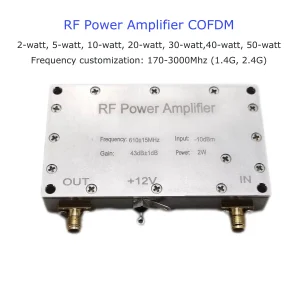
Amplificatore di potenza PA
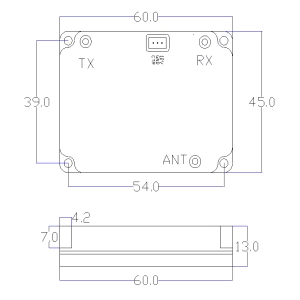
Amplificatore di potenza PA
Modulo front-end RF TDD 2W banda L con PA, LNA & Interruttore T/R ad alta velocità (1100–1500 MHz)
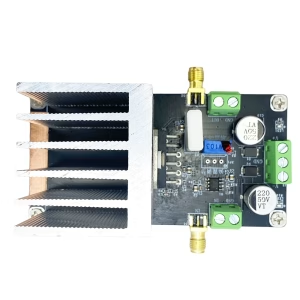
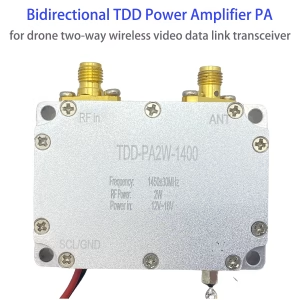
Amplificatore di potenza PA
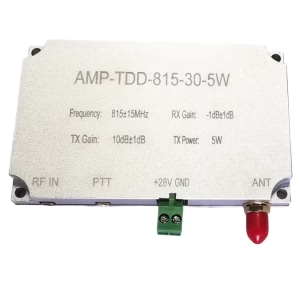
Amplificatore di potenza PA
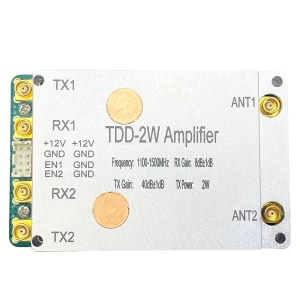
Amplificatore di potenza PA

Amplificatore di potenza PA
50 amplificatore di potenza watt 320Mhz per trasmettitore COFDM 50WPA 305-335Mhz

Amplificatore di potenza PA
Amplificatore di potenza PA
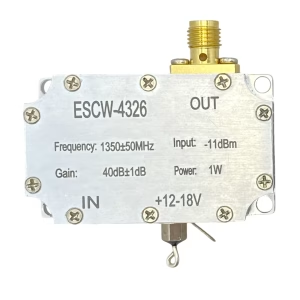
1Amplificatore di potenza WPA da 1 watt ESCW-4326 MCX SMA RF 12-18 V 1300-1400 MHz

Amplificatore di potenza PA
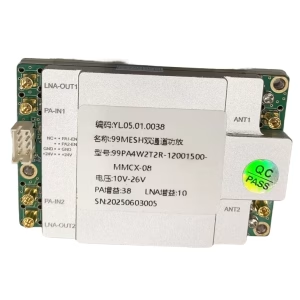
Amplificatore di potenza PA

Amplificatore di potenza PA
Sommario
1. LNA (Low-Noise Amplifier)
- Scopo: To amplify very weak received signals while adding as little noise as possible. Its primary goal is sensitivity.
- Posizione: First active component nel receiver chain, directly after the receive antenna.
- Key Performance Indicators (KPIs):
- Figura di rumore (NF): Crucially low (typically 0.3 dB to 3 dB). Measures added noise.
- Guadagno: Sufficient to overcome noise from later stages (typically 15-30 dB).
- Linearità: Important to handle potential strong interferers without distortion.
- Direzionalità: Unidirectional (Receive only).
- Design Focus: Ultra-low noise transistor selection, circuit topology for minimal noise, stabilità, sufficient gain.
- Applicazioni: Receiver front-ends in smartphones, base stations, ricevitori satellitari, GPS, radar receivers, radio telescopes, WiFi routers.
2. PA (Amplificatore di potenza)
- Scopo: To amplify processed signals to a high power level suitable for efficient transmission over the air. Its primary goal is potenza in uscita.
- Posizione: Last active component nel transmitter chain, directly before the transmit antenna.
- Key Performance Indicators (KPIs):
- Potenza in uscita: Crucially high (milliwatts to kilowatts+). Measured as saturated power (Pₛₐₜ) or power at specific linearity points (e.g., P₁dB).
- Efficienza: High DC-to-RF power conversion (critical for battery life & Calore). Measured as Power Added Efficiency (PAE) or Drain Efficiency.
- Linearità: Extremely important for modern complex modulations (QAM, OFDM). Measured by ACPR/ACLR, EVM. Often requires techniques like Digital Pre-Distortion (DPD).
- Guadagno: Sufficient to reach required output power from the driver stage.
- Direzionalità: Unidirectional (Transmit only).
- Design Focus: Power handling, thermal management, efficienza, linearità (often requiring trade-offs), stabilità.
- Applicazioni: Transmitter final stages in smartphones, base stations, broadcast transmitters, radar transmitters, walkie-talkies, microwave links.
3. BDA (Bi-Directional Amplifier) / Ripetitore / Signal Booster
- Scopo: To simultaneously amplify signals in both directions (uplink and downlink), primarily to extend coverage into areas with weak signal (e.g., edifici, tunnel).
- Posizione: UN standalone system placed between a “donor antenna” (pointing towards the source signal) e un “service antenna” (covering the target area).
- Key Performance Indicators (KPIs):
- Uplink Gain & Downlink Gain: Amplification for each direction. Must be carefully set.
- Figura di rumore (NF): Primarily impacts the downlink (ricevere) sensitivity of the overall system.
- Potenza in uscita: Primarily impacts the collegamento in salita (trasmettere) coverage capability.
- Isolamento: THE MOST CRITICAL KPI. Isolation between donor and service ports, and between internal Tx/Rx paths MUST be significantly higher than the system gain (Uplink Gain + Downlink Gain) to prevent oscillation/feedback.
- Direzionalità: Bidirezionale (Simultaneous Rx and Tx).
- Internal Structure: Essentially contains:
- UN LNA for the downlink path (receiving signal from the service area and amplifying it cleanly towards the donor antenna/base station).
- UN PA for the uplink path (amplifying signals received from the donor antenna/base station for transmission into the service area).
- UN Duplexer O Circulators to provide the essential isolation between the Tx and Rx paths/frequencies.
- Design Focus: Achieving high isolation, gain balance between uplink/downlink, system stability, noise figure (downlink), potenza in uscita (collegamento in salita), filtraggio.
- Applicazioni: In-building coverage systems (DAS), subway/tunnel coverage, rural signal extension, filling coverage gaps in large facilities (aeroporti, malls).
Summary of Key Differences:
| Caratteristica | LNA (Low-Noise Amplifier) | PA (Amplificatore di potenza) | BDA (Bi-Directional Amplifier) |
|---|---|---|---|
| Primary Role | Boost weak Rx signals (Sensibilità) | Boost Tx signals (Potenza in uscita) | Extend Coverage (Bidirectional Relay) |
| Posizione | Front-end of Receiver | Back-end of Transmitter | Standalone System (Between Antennas) |
| Critical KPI | Figura a basso rumore (NF) | High Output Power & Efficienza | High Isolation & Balanced Gain |
| Direction | Unidirectional (Rx Only) | Unidirectional (Tx Only) | Bidirezionale (Rx & Tx Simult.) |
| Livello del segnale | Very Low (µV – mV range) | Molto alto (Watts+) | Moderare (Amplifies both levels) |
| Core Design | Minimize Added Noise | Maximize Power & Efficienza | Isolamento, Gain Control, System Stability |
| Contains | – | – | LNA (Downlink) + PA (Collegamento in salita) + Duplexer/Circulator |
In Simple Terms:
- LNA: Listens carefully to faint whispers (weak received signals) without adding static (rumore).
- PA: Shouts loudly (high-power transmission) so the message can travel far.
- BDA: Hears the faint whispers from one area, amplifies them cleanly, and re-shouts them clearly into another area where the original shout couldn’t reach, and vice-versa. It’s a relay station containing both a careful listener (LNA) and a powerful shouter (PA), kept from interfering with itself by special isolators.
Amplificatore di potenza PA
Amplificatore di potenza PA
Modulo front-end RF TDD 2W banda L con PA, LNA & Interruttore T/R ad alta velocità (1100–1500 MHz)
Amplificatore di potenza PA
Amplificatore di potenza PA
Amplificatore di potenza PA
Amplificatore di potenza PA
50 amplificatore di potenza watt 320Mhz per trasmettitore COFDM 50WPA 305-335Mhz
Amplificatore di potenza PA
Amplificatore di potenza PA
1Amplificatore di potenza WPA da 1 watt ESCW-4326 MCX SMA RF 12-18 V 1300-1400 MHz
Amplificatore di potenza PA
Amplificatore di potenza PA
Amplificatore di potenza PA
Fai una domanda
Grazie per la risposta. ✨