





Lors de la sélection d’une solution de transmission sans fil pour drones ou drones, customers often ask about OFDM vs COFDM, Pixhawk telemetry integration, and performance in obstructed environments. Here we answer the most common questions.
Table des matières
Q1: Can TX900 be modified to use COFDM technology?
UN: Non, TX900 is based on OFDM with TDD (Duplex à répartition temporelle). Il est optimisé pour low-latency video and bidirectional telemetry and cannot be converted to COFDM.
T2: Why consider COFDM instead of OFDM?
COFDM is preferred when NLOS performance est critique, such as in zones urbaines, terrain montagneux, or obstructed environments. Its advantages include:
- Fort diffraction and multipath resistance
- Reliable video transmission in harsh RF conditions
- High stability in challenging environments
T3: OFDM vs COFDM – Key Differences
| Fonctionnalité | OFDM (TX900) | COFDM |
|---|---|---|
| System Complexity | Faible | Plus haut |
| Latency | Faible (contrôle en temps réel) | Slightly higher |
| Best Environment | LA / Semi-LOS | NLOS / Obstructed |
| Données + Vidéo | Bidirectional telemetry & vidéo HD | Video-centric; telemetry may need adaptation |
| Duplex | TDD | Usually FDD |
T4: COFDM Solutions for UAVs
If COFDM is needed, nous recommandons:
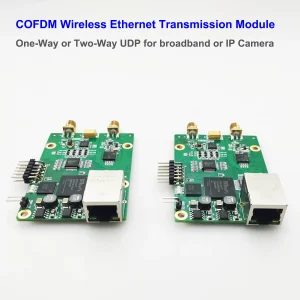
Vcan1886 Mini COFDM Module
- FDD-based COFDM transmission
- Vidéo + data over Ethernet (RJ45)
- Suitable for NLOS environments
View Product
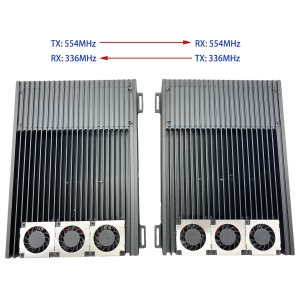
Customized High-Power COFDM Options:
- 300–500 MHz COFDM IP RJ45 Transceiver, 10 En PA
View Product - 336–554 MHz COFDM IP FDD Transceiver, 5 En PA
View Product
Remarques:
- Larger/heavier enclosures – less suitable for small UAVs
- RS232 data output only; Pixhawk requires RS232-to-TTL conversion
Q5: How to choose between TX900 (OFDM) and COFDM?
Choose TX900 (OFDM) si:
- LOS or lightly obstructed environment
- Low-latency video and telemetry is required
- UAV size and weight are limited
Choose COFDM si:
- NLOS or harsh environment
- Diffraction and multipath resistance are critical
- Slightly larger hardware is acceptable
Q6: Integrating COFDM with Pixhawk
- RS232-to-TTL conversion may be needed
- Integration requires planning due to limited data ports
- Works best when NLOS reliability is more important than minimal latency
Conclusion:
TX900 OFDM modules are ideal for lightweight UAVs in LOS conditions, livrer low-latency video and telemetry. COFDM solutions provide better NLOS performance, but may require larger hardware and additional integration effort for Pixhawk telemetry.

Bidirectional Two-Ways

Transmission vidéo sans fil
300-500Émetteur-récepteur Mhz COFDM IP RJ45 avec antenne filtre PA 10W
Transmission de robots
Poser une question
Merci pour votre réponse. ✨