





When selecting a wireless transmission solution for drones or UAVs, customers often ask about OFDM frente a COFDM, Pixhawk telemetry integration, and performance in obstructed environments. Here we answer the most common questions.
Tabla de contenido
Q1: Can TX900 be modified to use COFDM technology?
UN: No, TX900 is based on OFDM with TDD (Dúplex por división de tiempo). It is optimized for low-latency video and bidirectional telemetry and cannot be converted to COFDM.
Q2: Why consider COFDM instead of OFDM?
COFDM is preferred when Rendimiento NLOS es critico, such as in áreas urbanas, terreno montañoso, or obstructed environments. Its advantages include:
- Fuerte diffraction and multipath resistance
- Reliable video transmission in harsh RF conditions
- High stability in challenging environments
Q3: OFDM vs COFDM – Key Differences
| Característica | OFDM (TX900) | COFDM |
|---|---|---|
| System Complexity | Bajo | Más alto |
| Estado latente | Bajo (control en tiempo real) | Ligeramente más alto |
| Best Environment | LOS / Semi-LOS | NLOS / Obstructed |
| Datos + Vídeo | Bidirectional telemetry & Vídeo de alta definición | Video-centric; telemetry may need adaptation |
| Dúplex | TDD | Usually FDD |
Q4: COFDM Solutions for UAVs
If COFDM is needed, recomendamos:
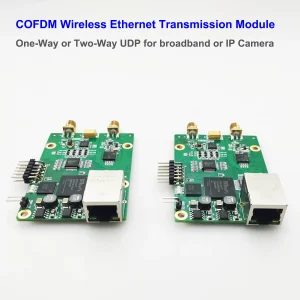
Vcan1886 Mini COFDM Module
- FDD-based COFDM transmission
- Vídeo + data over Ethernet (RJ45)
- Suitable for NLOS environments
View Product
Customized High-Power COFDM Options:
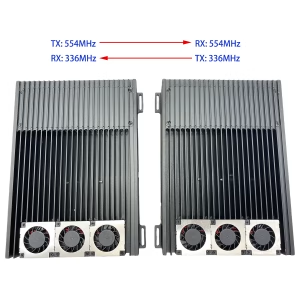
- 300–500 MHz COFDM IP RJ45 Transceiver, 10 Interfaz de usuario de administración de dispositivos web para ver y modificar la transmisión de enlace de datos de video inalámbrico para la cámara IP UAV
View Product - 336–554 MHz COFDM IP FDD Transceiver, 5 Interfaz de usuario de administración de dispositivos web para ver y modificar la transmisión de enlace de datos de video inalámbrico para la cámara IP UAV
View Product
Notas:
- Larger/heavier enclosures – less suitable for small UAVs
- RS232 data output only; Pixhawk requires RS232-to-TTL conversion
Q5: How to choose between TX900 (OFDM) and COFDM?
Choose TX900 (OFDM) if:
- LOS or lightly obstructed environment
- Low-latency video and telemetry is required
- UAV size and weight are limited
Choose COFDM if:
- NLOS or harsh environment
- Diffraction and multipath resistance are critical
- Slightly larger hardware is acceptable
Q6: Integrating COFDM with Pixhawk
- RS232-to-TTL conversion may be needed
- Integration requires planning due to limited data ports
- Works best when NLOS reliability is more important than minimal latency
Conclusión:
TX900 OFDM modules are ideal for lightweight UAVs in LOS conditions, entregando low-latency video and telemetry. COFDM solutions provide better NLOS performance, but may require larger hardware and additional integration effort for Pixhawk telemetry.

Bidireccional bidireccional

Inalámbrica de transmisión de vídeo
300-500Transceptor Mhz COFDM IP RJ45 con antena con filtro PA de 10W
Haz una pregunta
Gracias por tu respuesta. ✨