





Comparaison des caméras thermiques LWIR 640 × 512 non refroidies: Exigence du client vs. Mini Series Module
Table des matières
Introduction
Récemment, a customer inquired about a compact thermal imaging module with the following key parameters:
Résolution: 640×512
Fréquence d'images: 60fps
Lentille: 9.1mm athermal fixed-focus
Champ de vision (H×V): 48.7°×38.6°
Spectral range: 8-14μm
Thermal sensitivity (NETD): <50MK
Sortie vidéo: CVBS (NTSC)
Tension de fonctionnement: 4.5–18V
Température de fonctionnement: -40°C~+80°C
Dimensions: 25.8×25.8×28mm
Poids: 38g
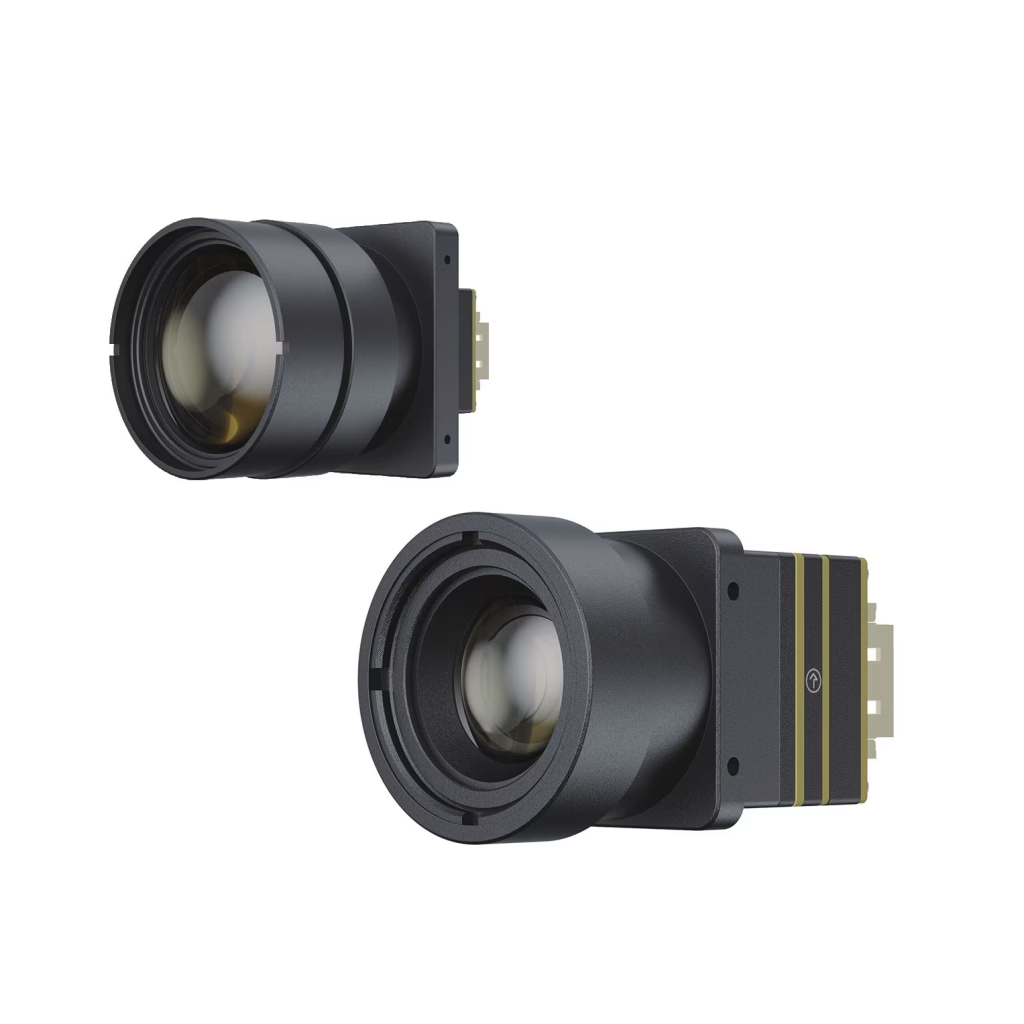
This request perfectly aligns with our Thermal Module (Mini Series) line — a family of ultra-compact uncooled LWIR camera cores. Below is a detailed comparison between the customer’s requirements and our Mini-640-CVBS modèle.
1. Specification Comparison
| Paramètre | Exigence du client | Vcan2170 (Mini-640-CVBS) | Result |
|---|---|---|---|
| Type de détecteur | Uncooled (unspecified) | Vanadium Oxide (VOx) uncooled FPA | ✅ Match |
| Résolution | 640×512 | 640×512 | ✅ Match |
| Pas de pixels | 12µm | 12µm | ✅ Match |
| Gamme spectrale | 8-14μm | 8-14μm | ✅ Match |
| Lentille | 9.1mm athermal fixed-focus | 9.1mm / 13mm F1.0 athermal | ✅ Match |
| Champ de vision (Champ de vision) | 48.7°×38.6° | 45.9°×36.9° | ⚠️ Slight difference |
| Fréquence d'images / Refresh Rate | 60fps / 25Hz | 50fps | ⚠️ Slightly lower |
| Sensibilité thermique (NETD) | <50MK | ≤40mK @ F1.0 | ✅ Better |
| Traitement d'images | NUC, 3DNR, DDE | NUC, 2D/3DNR, DDE | ✅ Match |
| Mode d'affichage | White Hot | 18 color palettes (includes White Hot) | ✅ More options |
| Sortie vidéo | CVBS (NTSC) | CVBS / USB2.0 | ✅ Match (more flexible) |
| Alimentation | 4.5–18V | 4.5–20V | ✅ Match |
| Consommation d'énergie | — | <0.75W | ✅ Low power |
| Dimensions | 25.8×25.8×28mm | 17.3×17.3×35.6mm | ⚠️ Different structure |
| Poids | 38g | 21g (without lens) | ⚠️ Lighter |
| Operating Temperature | -40°C~+80°C | -40°C~+70°C | ⚠️ 10°C lower upper limit |
| Detection / Recognition / ID Range | 1.1km / 250m / 170m | Not specified | ⚠️ Depends on lens |
| Depth of Field | 1.69m–∞ | Not specified | ⚠️ Not defined |
| Système de télévision | NTSC | CVBS output ( PAL or NTSC ) | ✅ Match |
2. Summary of Compatibility
| Catégorie | Compatibilité | Commentaires |
|---|---|---|
| Core Imaging Performance | ✅ Fully compatible | Same resolution, pixel pitch, sensitivity |
| Optical Lens / Champ de vision | ✅ Nearly identical | FOV difference <3° |
| Signal & Interface d'alimentation | ✅ Compatible | CVBS and USB output, wide voltage range |
| Image Algorithms | ✅ Enhanced | 18 palettes, NUC + 3DNR + DDE |
| Mechanical Size / Poids | ⚠️ Different | Mini Series smaller and lighter |
| Environmental Tolerance | ⚠️ Slight difference | Operates up to +70°C (contre. +80°C) |
| Fréquence d'images | ⚠️ 50fps vs 60fps | Minor gap for fast motion scenes |
3. Technical Evaluation
le Mini-640-CVBS module meets or exceeds most of the customer’s core performance indicators.
C'est 12μm uncooled VOx sensor, ≤40mK thermal sensitivity, et F1.0 athermal lens ensure high-quality thermal imaging even under harsh environmental conditions.
The only parameters that differ slightly are:
- Fréquence d'images: 50fps (instead of 60fps)
- Température de fonctionnement: +70°C (instead of +80°C)
- Physical size: Smaller footprint, longer length
These variations are typically negligible for UAV, sécurité, and inspection applications.
4. Recommended Applications
- drone / Drone Thermal Imaging
- Léger et compact, ideal for airborne integration.
- Sécurité et surveillance
- Detects human or vehicle heat signatures in total darkness.
- Inspection industrielle
- Used for electrical fault detection and equipment monitoring.
- Lutte contre les incendies / Chercher & Sauvetage
- Locates hotspots or victims through smoke or fog.
- Observation extérieure et de la faune
- Clear thermal visibility in night or low-light conditions.
5. FAQ
1. What does “Athermal Lens” mean?
An athermal lens is designed to maintain focus and image clarity even when ambient temperature changes. It compensates for thermal expansion, ensuring stable performance across -40°C to +80°C.
2. Why is the refresh rate only 25Hz instead of 60Hz?
Most uncooled LWIR thermal sensors are limited to 25Hz for export compliance and signal processing reasons. Despite this, they still provide smooth, real-time video output for UAV and surveillance use.
3. Can this module output HDMI or IP video instead of CVBS?
This version supports analog CVBS output. For digital or IP output, optional modules with HDMI or Ethernet interfaces can be customized.
4. Is this module suitable for drone integration?
Oui. With its lightweight 38g design, wide voltage input (4.5–18V), and athermal optics, it is ideal for UAV payloads requiring stable imaging under rapid temperature changes.
5. What is the detection distance of 1.1km based on?
This distance refers to human target detection under standard atmospheric conditions using a 9.1mm lens. Actual performance may vary depending on humidity, ambient temperature, and target size.
6. Conclusion
le Mini-640-CVBS Thermal Module offers excellent compatibility with the customer’s specified requirements.
Il livre high thermal sensitivity, low power consumption, et flexible interfaces in a miniaturisé, conception robuste.
With its robust VOx detector and athermal optics, it’s a perfect fit for drones, portable imaging devices, and security systems.
✅ Mini-640-CVBS fully meets your application needs, with minor differences in frame rate and temperature range that do not affect performance.
Poser une question
Merci pour votre réponse. ✨