





Inhaltsverzeichnis
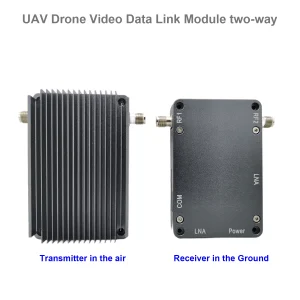
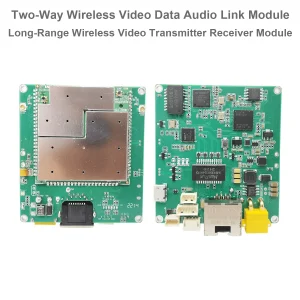
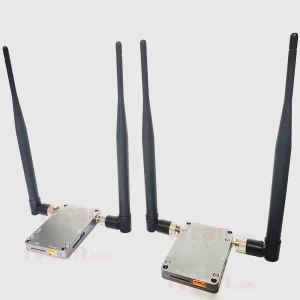
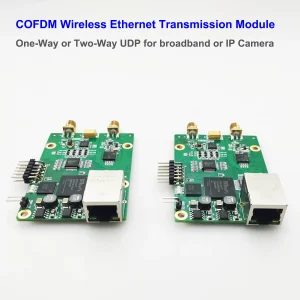
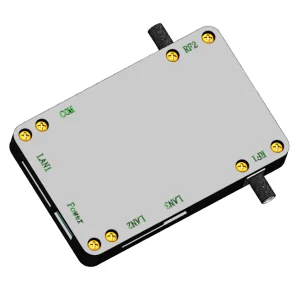
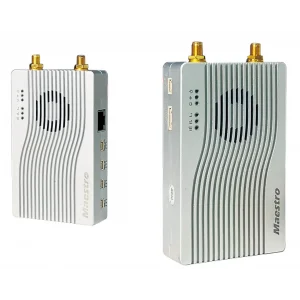
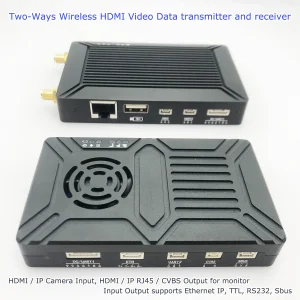
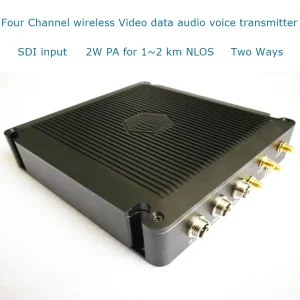
Two-Way Wireless Video Data Transceiver for UAV Relay Applications
In modern UAV (Unbemanntes Luftfahrzeug) Systeme, wireless video and data transmission plays a critical role in ensuring real-time situational awareness, command control, and feedback. Traditional COFDM or TDD-based transmitters are typically used in point-to-point communication. aber, as mission distances increase and terrain becomes complex, the need for relay transmission between drones becomes essential.

Mit unserem two-way COFDM wireless video data transceiver, UAV relay can be easily implemented — without changing the base system structure. All that’s required is one additional transceiver, and by adjusting the time slot ratio from 1:4 nach 2:3, full-duplex two-way relay communication can be achieved.
Key Concept: Two-Way Transmission and Time Slot Adjustment
Our COFDM-based system operates on a TDD (Zeitduplex) mechanism, meaning the same frequency band alternates between transmit and receive time slots.
In a traditional single-link system, A 1:4 time slot ratio is used — one slot for uplink (video/data from UAV to ground) and four slots for downlink control or feedback.
For UAV relay applications, we adjust the slot ratio to 2:3, enabling both drones to transmit and receive alternately within the same frequency band.
This method allows:
- Drone A to send video/data to Drone B (Relais)
- Drone B to forward data to the ground control station
- Ground control to send command data back via Drone B to Drone A
All achieved in a synchronisiert, Geringe Latenz time slot cycle.
Technical Advantages
- Simple Hardware Upgrade
You only need to add one transceiver module as a relay node. No additional frequency allocation or complicated RF synchronization is required. - Geringe Wartezeit, High Stability
Thanks to COFDM modulation and precise TDD slot control, latency remains under 50Frau, even in relay operation. - Frequency Efficiency
Both UAVs share the same frequency channel, eliminating the need for multiple RF bands and minimizing interference. - Bi-Directional Transmission
Unlike one-way analog transmitters, the two-way transceiver supports simultaneous video + Daten + Kontrolle Übertragung. - Adaptive for Various Applications
Ideal für long-range drones, relay stations, mountain terrain, maritime patrol, oder Notfallreaktion where direct LOS (Sichtlinie) is unavailable.
System Example
Szenario:
A drone flies behind a mountain ridge where direct communication with the ground station is lost.
Lösung:
Place another drone in the air to serve as a relay.
Konfiguration:
- Bodenkontrollstation (GCS): Two-way COFDM transceiver
- UAV1: Two-way transceiver (Relay Node)
- UAV2: Two-way transceiver (Frontline Node)
Time Slot Setup:
- Original: 1 Uplink : 4 Downlink (Standard)
- Relay Mode: 2 Uplink : 3 Downlink (balanced bidirectional flow)
Result:
UAV2 sends video to UAV1 → UAV1 forwards to GCS → GCS sends command → UAV1 relays back to UAV2 — all within one synchronized TDD frame.
Technische Parameter (Beispiel)
| Parameter | Description |
|---|---|
| Frequenzbereich | 200MHz–6GHz customizable |
| Modulation | COFDM, QPSK/16QAM/64QAM |
| Duplex Mode | TDD (Einstellbar 1:4 oder 2:3 slot) |
| Latency | <50Frau (end-to-end) |
| Videoformat | H.265/H.264 up to 1080P |
| Datenschnittstelle | UART / Ethernet |
| Transmission Distance | Up to 50km (LOS) or relay-extended |
| Leistung | 10W amplifier optional for long-range |
| Anwendung | UAV relay, Militär, Rettung, Inspektion |
Anwendungsszenarien
- Drone Relay for Long-Distance FPV
- Emergency Communication Extension
- Mountain or Forest Surveillance
- Maritime and Offshore Operations
- Temporary Network Relay in Field Missions
FAQ
Q1: Can I use different frequencies for uplink and downlink?
EIN: It’s not necessary. The system uses TDD on the same frequency, alternating time slots between send and receive. FDD models support set different frequencies for uplink and downlink.
Q2: What hardware do I need to add a relay function?
EIN: Just one extra two-way transceiver module configured as a relay node.
Q3: How do I configure the time slot ratio?
EIN: It can be modified in firmware or configuration software — change from 1:4 nach 2:3 for two-way relay mode.
Q4: Will latency increase in relay mode?
EIN: Only slightly. The system’s OFDM frame design keeps total delay under 50ms even with one relay hop.
F5: Can multiple relays be added for extended range?
EIN: Ja, multi-hop relay is supported by chaining additional transceivers, though timing synchronization must be maintained.
Abschluss
By simply adding one more transceiver und adjusting the time slot ratio, UAVs can form a reliable two-way relay network that extends range, maintains low latency, and enables full bidirectional communication. This flexible design ensures mission success in complex terrains or beyond-visual-line-of-sight operations — all while keeping hardware integration simple and efficient.
Bidirektional und bidirektional
Bidirektional und bidirektional

Bidirektional und bidirektional

Bidirektional und bidirektional
Video Transmitter

Robot Transmission
Stelle eine Frage
Vielen Dank für deine Antwort. ✨