




適用於 UAV 無人機網路的長距離 SDR 網狀無線電 500 千米
目錄
概觀
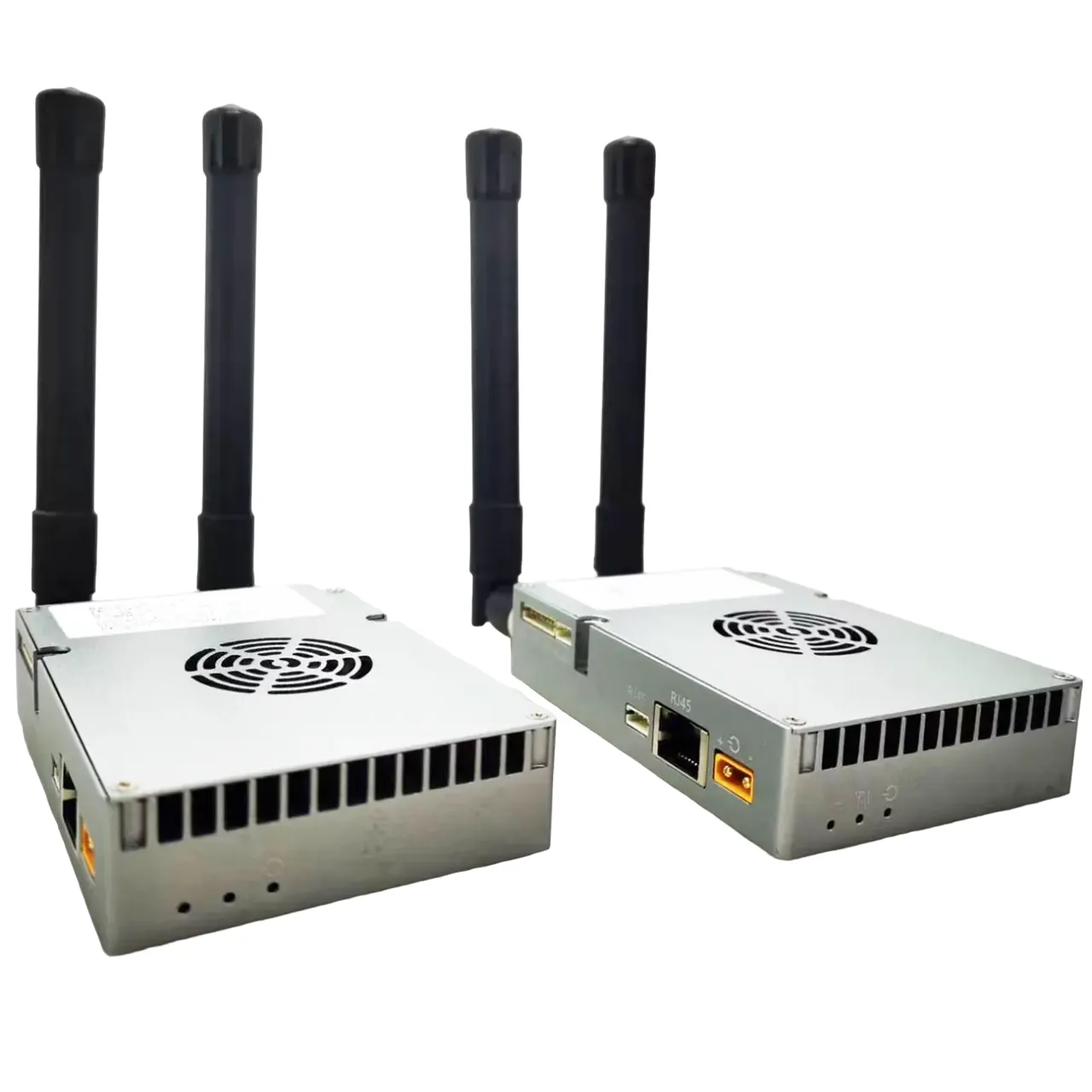
This is a software-defined radio (特別提款權)-based wireless communication module designed for advanced Mesh networking applications. Built on a flexible FPGA architecture, it enables dynamic, self-organizing networks with high reliability, long transmission distances, 抗干擾能力強.
This device supports multi-node, multi-hop Mesh networking, allowing seamless communication across complex environments without relying on fixed infrastructure. By integrating high-power RF amplifiers, it can be configured for a wide range of transmission distances—from short-range urban deployment to ultra-long-range communication up to 500 在最佳條件下公里.
With support for multiple frequency bands, adjustable bandwidth, intelligent frequency selection, 和 AES256 加密, it is suitable for mission-critical applications requiring secure, 穩定的, and long-distance wireless communication.
特徵
1. Advanced Mesh Networking
- Supports self-organizing Mesh topology
- Multi-node networking (取決於 256 節點)
- Multi-hop communication (1 to unlimited hops)
- Automatic route optimization
2. Flexible Output Power Options
- Multiple RF output levels available: 27 dBm的 0.5W¯¯ / 30 dBm的 1W¯¯ / 33 dBm的 2W¯¯ / 35 dBm的 3W¯¯ / 37 dBm的 5W¯¯ / 40 dBm的 10W¯¯ / 46 dBm的 40W¯¯
- Adjustable based on range and power requirements
3. Ultra-Long Range Transmission
- Maximum transmission distance up to 500 千米
- Software-configurable distance limits
- Dedicated long-range enhancement mode
4. Configurable Bandwidth
- Supported bandwidth options: 1.25 兆赫 / 2.5 兆赫 / 5 兆赫 / 10 兆赫 / 20 兆赫
- Optimized balance between throughput and range
5. Multi-Band Frequency Support
Customizable frequency bands:
|
中心頻率 |
頻率範圍 (兆赫) |
| 655 | 635~675 |
| 805 | 790~820 |
| 1350 | 1300~1400 |
| 1400 | 1350~1450 |
| 1475 | 1420~1530 |
| 1685 | 1660~1710 |
| 2250 | 2200~2300 |
| 2450 | 2400~2500 |
6. 高數據吞吐量
- 取決於 40 Mbps吞吐量 在 10 km mode (20 MHz帶寬)
- 自適應調製 (MCS0–MCS8 optional)
7. 智能頻率選擇
Through real-time spectrum sensing and monitoring across the full band, nodes dynamically and intelligently select and adjust their operating frequencies from a preset list according to the local electronic environment and interference conditions, achieving intelligent dynamic frequency-agile networking (or heterogeneous frequency networking) for effective automatic interference avoidance / 反懲罰.
- Real-time spectrum scanning
- Automatic frequency switching
- Interference avoidance
- Dynamic heterogeneous networking
8. Strong Anti-Interference Capability
- Maintains stable communication when interference <15%
- Suitable for complex electromagnetic environments
9. 安全通訊
- AES256 encryption for air interface
- Ensures data confidentiality and integrity
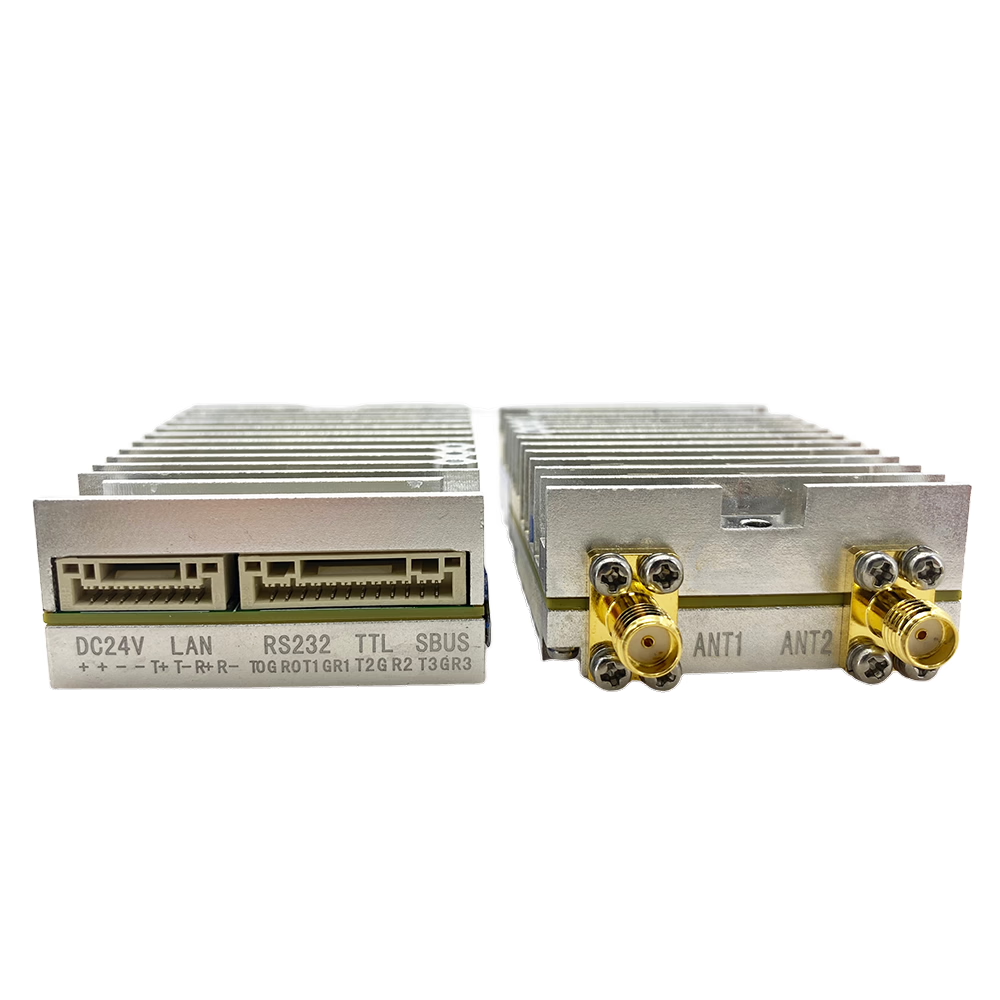
10. Rich Interface Options
- 取決於 2 以太網端口 (10/100中號)
- 取決於 4 串口: 2 ×RS232 / 1 × 3.3V TTL / 1 × 總線 (可選的)
11. Industrial Design
- IP20 (室內的) and IP65 (戶外的) versions available
- 工作溫度範圍寬: -40°C 至 +55°C
- High reliability for harsh environments
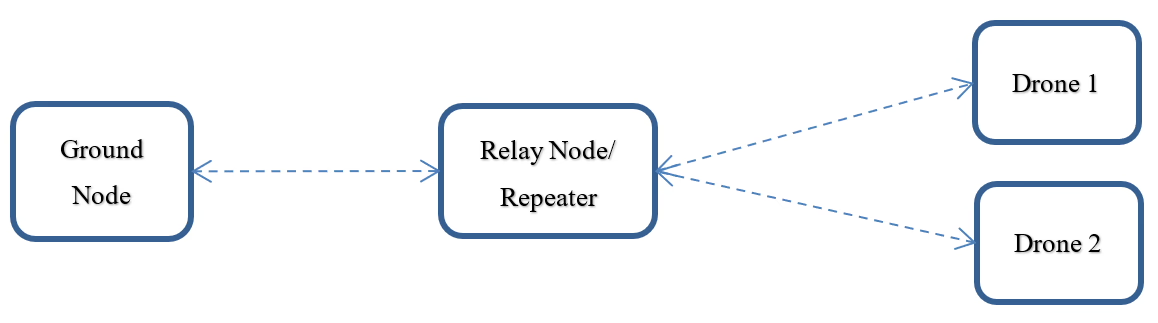
Typical Application and Ratings
| 模型 | 發送
功率 (dBm的) |
供應
電壓 (V) |
馬克斯
功率 (W¯¯) |
支持
功率 (W¯¯) |
數據
接口 |
範圍
Extension (分貝) |
推薦的
距離 (千米) |
|---|---|---|---|---|---|---|---|
| 2201-27 | 27 ±3 | 9–30 | 8 ±2 | 4.5 ±1 | 1 × LAN + 2 ×RS232 + 1 ×TTL + 1 × 總線 | 2 | ≤30 |
| 2201-30 | 30 ±3 | 20–28 | 15 ±5 | 5 ±1 | 2 × LAN + 2 ×RS232 + 1 × TTL/SBUS | 2 | 30–50 |
| 2201-33 | 33 ±3 | 24–30 | 20 ±5 | 5 ±1 | 2 × LAN + 2 ×RS232 + 1 ×TTL + 1 × 總線 | 1 | 50–75 |
| 2201-35 | 35 ±3 | 24–28 | 35 ±8 | 5 ±1 | 2 × LAN + 2 ×RS232 + 1 × TTL/SBUS | 1 | 75–100 |
| 2201-37 | 37 ±3 | 24–28 | 45 ±10 | 6 ±1 | 2 × LAN + 2 ×RS232 + 1 × TTL/SBUS | 1 | 100–150 |
| 2201-40 | 40 ±3 | 24–28 | 80 ±20 | 7 ±1 | 2 × LAN + 2 ×RS232 + 1 × TTL/SBUS | 1 | 150–250 |
| 2201-46 | 46 ±3 | 24–28 | 220 ±50 | 10 ±2 | 2 × LAN + 2 ×RS232 + 1 × TTL/SBUS | 1 | 250–500 |
環境條件
-
儲存溫度: -40°C 至 +85°C
-
工作溫度: -40°C 至 +55°C
-
濕度: 5%–95%
天線 & RF Considerations
-
Each antenna port must not receive signals >10 dBm when active, otherwise permanent damage may occur.
-
Recommended minimum distance between module antennas is greater than the device port spacing; ideally, module antennas should be spaced >2 meters apart.
-
Continuous operation requires proper heat dissipation:
-
CPU/core temperature ≤100°C
-
Casing temperature ≤80°C
-
發射功率
-
Measured at room temperature, 同 24V電源, in normal transmission mode.
-
<33 dBm series: Uses DCDC conversion for low-voltage power to the PA; voltage fluctuations do not affect maximum output power.
-
≥33 dBm series: PA voltage follows supply voltage. Increasing supply above 24V to the allowed upper limit (see typical rating table) 將要:
-
Increase system power consumption by 10–25%
-
Increase max transmit power by ~0.1 dB for 33 dBm units, ~0.3–1 dB for >33 dBm units
-
-
推薦: For efficiency and heat management, use 24V supply.
電源
-
Do not operate the device above the allowed supply voltage limit.
能量消耗
-
最大功率: Measured at room temperature, 24V電源, normal transmission mode; actual usage may be 92–95% of max.
-
Standby Power: Measured at room temperature, 24V電源; represents power consumption when connected but idle.
數據接口
-
LAN: 10/100 Mbps
-
RS232: Up to 115200 bps
-
TTL: 3.3 V level, up to 460800 bps
-
TTL/SBUS: Only one selectable at factory
Extended Range Mode
-
Boosts rated maximum output by 1–2 dB to achieve longer range.
-
Increases system power consumption by 10–30%.
-
Proper heat dissipation is required; PA linearity may degrade, MCS8 and MCS7 may not be supported.
-
注意: Outdoor IP65 models do not support extended range mode.
Recommended Use Distance
-
視線, interference-free conditions, 1.4 GHz band:
-
Sky-side: 2 dBi omnidirectional antenna
-
Ground-side: 5 dBi omnidirectional antenna
-
-
Can reliably stream 2–4 Mbps video on a single channel
Bandwidth sensitivity rate table:
| 20兆赫
帶寬 |
MCS | 0 | 1 | 2 | 3 | 4 | 5 | 6 | 7 | 8 (可選的) |
| Single antenna sensitivity (dBm的) | -101 | -98 | -95 | -92 | -88 | -86 | -83 | -80 | -77 | |
| Dual-antenna sensitivity (dBm的) | -104 | -101 | -98 | -95 | -91 | -89 | -86 | -83 | -80 | |
| 信噪比 (分貝) | -8 | -5 | -2 | 4 | 7 | 10 | 13 | 16 | 19 | |
| UDP Packet Injection
(Mbps) |
10KM distance mode | 1.5 | 3.2 | 6.4 | 13 | 20 | 26 | 33 | 40 | 47 |
| 30KM distance mode | 1.4 | 2.9 | 5.9 | 12 | 18 | 24 | 31 | 37 | 43 | |
| 50KM distance mode | 1.3 | 2.7 | 5.5 | 11 | 17 | 22 | 28 | 34 | 40 | |
| 100KM distance mode | 1.1 | 2.4 | 4.7 | 9.6 | 14 | 19 | 24 | 29 | 34 | |
| 150KM distance mode | 0.9 | 1.9 | 4.0 | 8.3 | 12 | 16 | 21 | 25 | 29 | |
| 200KM distance mode | 0.8 | 1.7 | 3.6 | 7.4 | 11 | 14 | 18 | 22 | 26 | |
| 250KM distance mode | 0.7 | 1.5 | 3.2 | 6.6 | 10 | 13 | 16 | 20 | 23 | |
| 300KM distance mode | 0.6 | 1.4 | 2.9 | 6.0 | 9.1 | 12 | 15 | 18 | 21 | |
| 400KM distance mode | 0.5 | 1.1 | 2.4 | 5.0 | 7.6 | 10 | 12 | 15 | 18 | |
| 500KM distance mode | 0.4 | 1.0 | 2.1 | 4.3 | 6.6 | 8.8 | 11 | 13 | 15 |
產品規格
一般參數
-
建築: 軟體無線電 (特別提款權)
-
聯網: 網 (自組織)
-
最大節點數: 256
-
Max Hops: 無限
-
加密: UAV/UGV/車身攝像頭/隱藏裝置
射頻性能
-
頻段: 635 兆赫 – 2500 兆赫 (定制)
-
信道帶寬: 1.25–20 MHz
-
輸出功率: 27–46 dBm (model dependent)
-
靈敏度:
-
取決於 -104 dBm的 (雙天線)
-
-
SNR範圍: -8 DB到 19 分貝
Transmission Performance
-
最大範圍: 500 千米 (視線)
-
吞吐量:
-
取決於 40 Mbps的 (10 km mode, 20 MHz帶寬)
-
-
Adaptive data rate depending on:
-
距離
-
帶寬
-
環境
-
電源
-
輸入電壓:
-
9–30V or 20–28V (model dependent)
-
-
最大功耗:
-
8W to 220W depending on output power
-
-
Standby Power:
-
4.5W to 10W
-
接口
-
以太網絡: 1 要么 2 端口 (10/100 Mbps的)
-
連續劇:
-
RS232 (取決於 115200 波特率)
-
TTL (取決於 460800 波特率)
-
系統總線 (可選的)
-
環境的
-
工作溫度: -40°C 至 +55°C
-
儲存溫度: -40°C 至 +85°C
-
濕度: 5%–95%
機械的
-
重量: 0.065 kg to 4 公斤
-
RF連接器:
-
SMA-K (標準)
-
氮鉀 (IP65 version)
-
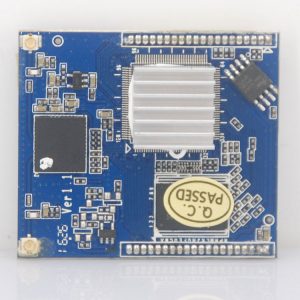
Interface parameters and indicator lights
應用
1. 無人機 & 無人機通信
-
Long-range video transmission
-
Command and control links
-
Swarm drone networking
2. 機器人技術 & Autonomous Systems
-
Multi-robot coordination
-
Remote control and telemetry
-
工業自動化
3. 緊急情況 & 公安
-
Disaster recovery communication
-
Temporary network deployment
-
搜救行動
4. 軍事 & 防禦
-
Tactical Mesh communication
-
Secure battlefield networking
-
Mobile command systems
5. 工業物聯網
-
遠程監視
-
Smart grid communication
-
Oil, 氣體, and mining operations
6. 智慧城市
-
Infrastructure monitoring
-
Traffic management systems
-
Surveillance networks
自定義選項
This model supports extensive customization to meet specific project requirements:
1. 頻率自定義
-
Select specific frequency bands based on regulatory and environmental needs
2. Output Power Configuration
-
Choose appropriate RF power level (27–46 dBm)
-
Optimize for range vs. 能量消耗
3. 帶寬配置
-
Narrowband for long distance
-
Wideband for high throughput
4. Distance Limitation
-
Software-configurable distance limits:
-
10 千米
-
50 千米
-
500 千米
-
5. 網絡拓撲
-
Node count configuration (2–256 nodes)
-
Hop count configuration (1 to unlimited)
6. Interface Selection
-
LAN port quantity
-
Serial interface types (TTL/SBUS selection)
7. 保護水平
-
IP20 for indoor use
-
IP65 for outdoor deployment
8. Mechanical Design
-
With or without heat sink
-
Custom cable lengths (IP65 versions)
常問問題 (常見問題解答)
Q1: 最大傳輸距離是多少?
It supports up to 500 km transmission under ideal line-of-sight conditions with proper antenna configuration and minimal interference.
Q2: Can the frequency be changed by the user?
沒有. The frequency band is fixed at the factory and cannot be modified by end users.
Q3: What is Mesh networking and why is it useful?
Mesh networking allows devices to connect dynamically and relay data through multiple nodes. This improves reliability, extends coverage, and eliminates the need for centralized infrastructure.
Q4: How many devices can be connected in one network?
The system supports up to 256 nodes in a single Mesh network.
Q5: Does it support encryption?
是, the device supports AES256 encryption to ensure secure data transmission.
Q6: What is the difference between IP20 and IP65 versions?
-
IP20: Indoor use, basic protection
-
IP65: Outdoor use, dustproof and waterproof
Q7: What affects transmission distance?
Several factors influence range:
-
Antenna type and gain
-
Output power level
-
頻寬設定
-
Environmental interference
-
Line-of-sight conditions
Q8: What is the recommended cooling requirement?
The device requires proper heat dissipation:
-
Core temperature ≤ 100°C
-
Case temperature ≤ 80°C
Q9: Can it handle interference?
是, the system can maintain stable communication when interference is below 15%, thanks to intelligent frequency selection.
Q10: What is the difference between bandwidth options?
Lower bandwidth:
-
Longer range
-
Lower data rate
更高的帶寬:
-
更高的吞吐量
-
射程較短



評測
沒有評分.