






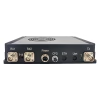
Radio siatkowe dalekiego zasięgu SDR dla sieci dronów UAV
Spis treści
Przegląd
This is a software-defined radio (SDR)-based wireless communication module designed for advanced Mesh networking applications. Built on a flexible FPGA architecture, it enables dynamic, self-organizing networks with high reliability, long transmission distances, i silne zdolności przeciwzakłóceniowe.
This device supports multi-node, multi-hop Mesh networking, allowing seamless communication across complex environments without relying on fixed infrastructure. By integrating high-power RF amplifiers, it can be configured for a wide range of transmission distances—from short-range urban deployment to ultra-long-range communication under optimal conditions.
With support for multiple frequency bands, adjustable bandwidth, intelligent frequency selection, and AES256 encryption, it is suitable for mission-critical applications requiring secure, stabilny, and long-distance wireless communication.
Cechy
1. Advanced Mesh Networking
- Supports self-organizing Mesh topology
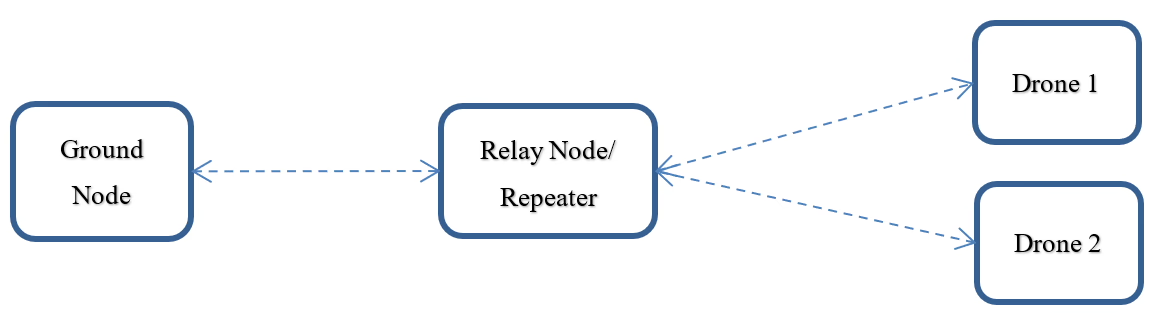
- Sieć wielowęzłowa (aż do 256 węzły)
- Multi-hop communication (1 to unlimited hops)
- Automatic route optimization
2. Flexible Output Power Options
- Multiple RF output levels available: 27 dBm 0.5W / 30 dBm 1W / 33 dBm 2W / 35 dBm 3W / 37 dBm 5W / 40 dBm 10W / 46 dBm 40W
- Adjustable based on range and power requirements
3. Ultra-Long Range Transmission
- Maximum transmission distance
- Software-configurable distance limits
- Dedicated long-range enhancement mode
4. Configurable Bandwidth
- Supported bandwidth options: 1.25 MHz / 2.5 MHz / 5 MHz / 10 MHz / 20 MHz
- Optimized balance between throughput and range
5. Multi-Band Frequency Support
Customizable frequency bands:
|
Częstotliwość środkowa |
Zakres częstotliwości (MHz) |
| 655 | 635~675 |
| 805 | 790~820 |
| 1350 | 1300~1400 |
| 1400 | 1350~1450 |
| 1475 | 1420~1530 |
| 1685 | 1660~1710 |
| 2250 | 2200~2300 |
| 2450 | 2400~2500 |
6. High Data Throughput
- Aż do 40 Przepustowość Mb/s W 10 km mode (20 Szerokość pasma MHz)
- Modulacja adaptacyjna (MCS0–MCS8 optional)
7. Intelligent Frequency Selection
Through real-time spectrum sensing and monitoring across the full band, nodes dynamically and intelligently select and adjust their operating frequencies from a preset list according to the local electronic environment and interference conditions, achieving intelligent dynamic frequency-agile networking (or heterogeneous frequency networking) for effective automatic interference avoidance / anti-jamming.
- Real-time spectrum scanning
- Automatic frequency switching
- Interference avoidance
- Dynamic heterogeneous networking
8. Strong Anti-Interference Capability
- Maintains stable communication when interference <15%
- Suitable for complex electromagnetic environments
9. Bezpieczna komunikacja
- AES256 encryption for air interface
- Ensures data confidentiality and integrity
10. Rich Interface Options
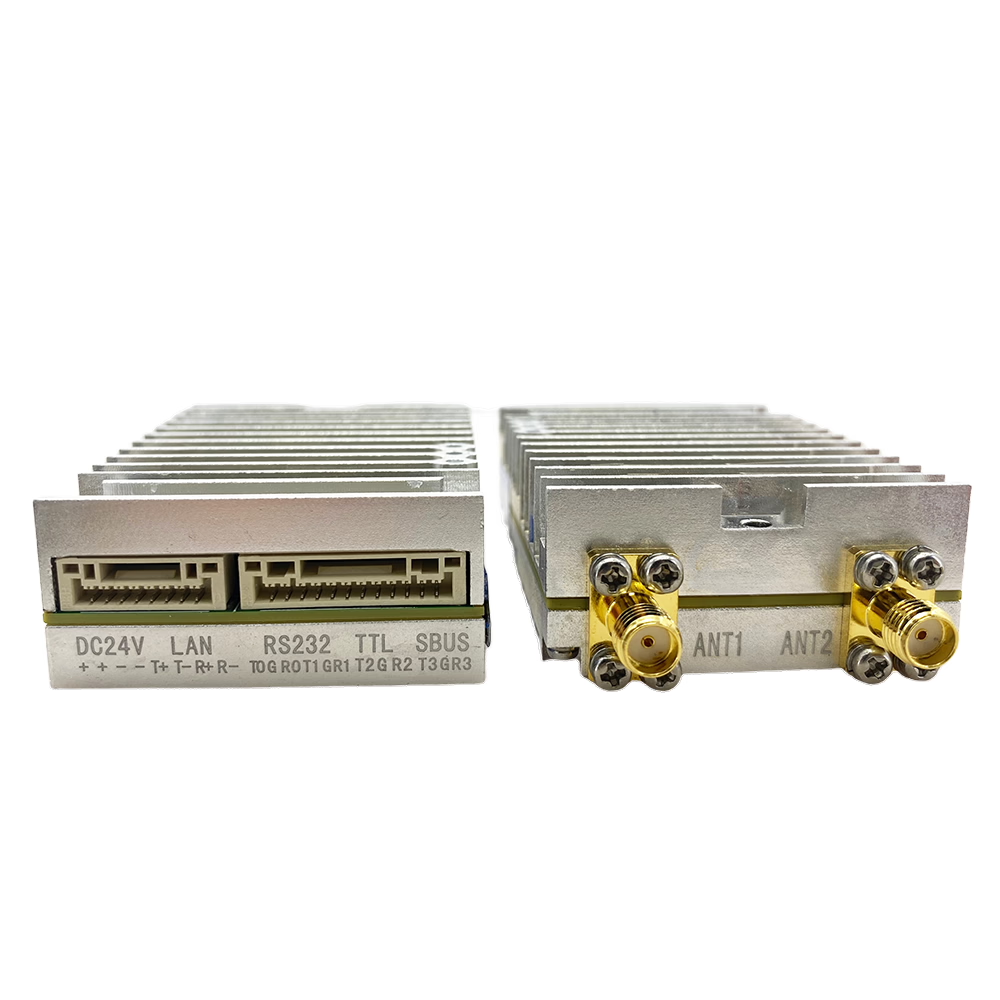
- Aż do 2 Ethernet ports (10/100M)
- Aż do 4 serial ports: 2 × RS232 / 1 × 3.3V TTL / 1 × SBUS (opcjonalny)
11. Industrial Design
- IP20 (indoor) and IP65 (plenerowy) versions available
- Szeroki zakres temperatur pracy: -40°C do +55°C
- High reliability for harsh environments
Typical Application and Ratings
| Model | Przesyłka
Moc (dBm) |
Dostarczać
Woltaż (V) |
Maks
Moc (W) |
Gotowość
Moc (W) |
Dane
Interfejsy |
Zakres
Extension (dB) |
Zalecony
Dystans (km) |
|---|---|---|---|---|---|---|---|
| 2201-27 | 27 ±3 | 9–30 | 8 ±2 | 4.5 ±1 | 1 × LAN + 2 × RS232 + 1 × TTL + 1 × SBUS | 2 | ≤30 |
| 2201-30 | 30 ±3 | 20–28 | 15 ±5 | 5 ±1 | 2 × LAN + 2 × RS232 + 1 × TTL/SBUS | 2 | 30–50 |
| 2201-33 | 33 ±3 | 24–30 | 20 ±5 | 5 ±1 | 2 × LAN + 2 × RS232 + 1 × TTL + 1 × SBUS | 1 | 50–75 |
| 2201-35 | 35 ±3 | 24–28 | 35 ±8 | 5 ±1 | 2 × LAN + 2 × RS232 + 1 × TTL/SBUS | 1 | 75–100 |
| 2201-37 | 37 ±3 | 24–28 | 45 ±10 | 6 ±1 | 2 × LAN + 2 × RS232 + 1 × TTL/SBUS | 1 | 100–150 |
| 2201-40 | 40 ±3 | 24–28 | 80 ±20 | 7 ±1 | 2 × LAN + 2 × RS232 + 1 × TTL/SBUS | 1 | 150–250 |
| 2201-46 | 46 ±3 | 24–28 | 220 ±50 | 10 ±2 | 2 × LAN + 2 × RS232 + 1 × TTL/SBUS | 1 | 250–500 |
Environmental Conditions
-
Temperatura przechowywania: -40°C do +85°C
-
Temperatura pracy: -40°C do +55°C
-
Wilgotność: 5%–95%
Antenna & RF Considerations
-
Each antenna port must not receive signals >10 dBm when active, otherwise permanent damage may occur.
-
Recommended minimum distance between module antennas is greater than the device port spacing; ideally, module antennas should be spaced >2 meters apart.
-
Continuous operation requires proper heat dissipation:
-
CPU/core temperature ≤100°C
-
Casing temperature ≤80°C
-
Moc transmisji
-
Measured at room temperature, z 24Zasilanie V, in normal transmission mode.
-
<33 dBm series: Uses DCDC conversion for low-voltage power to the PA; voltage fluctuations do not affect maximum output power.
-
≥33 dBm series: PA voltage follows supply voltage. Increasing supply above 24V to the allowed upper limit (see typical rating table) will:
-
Increase system power consumption by 10–25%
-
Increase max transmit power by ~0.1 dB for 33 dBm units, ~0.3–1 dB for >33 dBm units
-
-
Zalecenie: For efficiency and heat management, use 24V supply.
Zasilanie
-
Do not operate the device above the allowed supply voltage limit.
Zużycie energii
-
Maximum Power: Measured at room temperature, 24Zasilanie V, normal transmission mode; actual usage may be 92–95% of max.
-
Standby Power: Measured at room temperature, 24Zasilanie V; represents power consumption when connected but idle.
Interfejsy danych
-
LAN: 10/100 Mbps
-
RS232: Up to 115200 bps
-
TTL: 3.3 V level, up to 460800 bps
-
TTL/SBUS: Only one selectable at factory
Extended Range Mode
-
Boosts rated maximum output by 1–2 dB to achieve longer range.
-
Increases system power consumption by 10–30%.
-
Proper heat dissipation is required; PA linearity may degrade, MCS8 and MCS7 may not be supported.
-
Notatka: Outdoor IP65 models do not support extended range mode.
Recommended Use Distance
-
Linia wzroku, interference-free conditions, 1.4 GHz band:
-
Sky-side: 2 dBi omnidirectional antenna
-
Ground-side: 5 dBi omnidirectional antenna
-
-
Can reliably stream 2–4 Mbps video on a single channel
Bandwidth sensitivity rate table:
| 20MHz
pasmo |
MCS | 0 | 1 | 2 | 3 | 4 | 5 | 6 | 7 | 8 (opcjonalny) |
| Single antenna sensitivity (dBm) | -101 | -98 | -95 | -92 | -88 | -86 | -83 | -80 | -77 | |
| Dual-antenna sensitivity (dBm) | -104 | -101 | -98 | -95 | -91 | -89 | -86 | -83 | -80 | |
| Signal-to-noise ratio (dB) | -8 | -5 | -2 | 4 | 7 | 10 | 13 | 16 | 19 | |
| UDP Packet Injection
(Mbps) |
10KM distance mode | 1.5 | 3.2 | 6.4 | 13 | 20 | 26 | 33 | 40 | 47 |
| 30KM distance mode | 1.4 | 2.9 | 5.9 | 12 | 18 | 24 | 31 | 37 | 43 | |
| 50KM distance mode | 1.3 | 2.7 | 5.5 | 11 | 17 | 22 | 28 | 34 | 40 | |
| 100KM distance mode | 1.1 | 2.4 | 4.7 | 9.6 | 14 | 19 | 24 | 29 | 34 | |
| 150KM distance mode | 0.9 | 1.9 | 4.0 | 8.3 | 12 | 16 | 21 | 25 | 29 | |
| 200KM distance mode | 0.8 | 1.7 | 3.6 | 7.4 | 11 | 14 | 18 | 22 | 26 | |
| 250KM distance mode | 0.7 | 1.5 | 3.2 | 6.6 | 10 | 13 | 16 | 20 | 23 | |
| 300KM distance mode | 0.6 | 1.4 | 2.9 | 6.0 | 9.1 | 12 | 15 | 18 | 21 | |
| 400KM distance mode | 0.5 | 1.1 | 2.4 | 5.0 | 7.6 | 10 | 12 | 15 | 18 | |
| 500KM distance mode | 0.4 | 1.0 | 2.1 | 4.3 | 6.6 | 8.8 | 11 | 13 | 15 |
specyfikacje
General Parameters
-
Architecture: Radio definiowane programowo (SDR)
-
Sieć: Oczko (samoorganizowanie się)
-
Maksymalna liczba węzłów: 256
-
Max Hops: Unlimited
-
Szyfrowanie: AES256
RF Performance
-
Pasma częstotliwości: 635 MHz – 2500 MHz (dostosowane)
-
Szerokość pasma kanału: 1.25–20 MHz
-
Moc wyjściowa: 27–46 dBm (model dependent)
-
Wrażliwość:
-
Aż do -104 dBm (dual antenna)
-
-
Zakres SNR: -8 dB to 19 dB
Transmission Performance
-
Max Range: 500 km (linia wzroku)
-
Throughput:
-
Aż do 40 Mb/s (10 km mode, 20 Szerokość pasma MHz)
-
-
Adaptive data rate depending on:
-
Dystans
-
Pasmo
-
Środowisko
-
Zasilanie
-
Napięcie wejściowe:
-
9–30V or 20–28V (model dependent)
-
-
Maksymalne zużycie energii:
-
8W to 220W depending on output power
-
-
Standby Power:
-
4.5W to 10W
-
Interfejsy
-
Ethernet: 1 lub 2 porty (10/100 Mb/s)
-
Seryjny:
-
RS232 (aż do 115200 baud)
-
TTL (aż do 460800 baud)
-
SBUS (opcjonalny)
-
Środowiskowy
-
Temperatura pracy: -40°C do +55°C
-
Temperatura przechowywania: -40°C do +85°C
-
Wilgotność: 5%–95%
Mechaniczny
-
Waga: 0.065 kg to 4 kg
-
Złącza RF:
-
SMA-K (standard)
-
N-K (IP65 version)
-
Interface parameters and indicator lights
Aplikacje
1. UAV & Drone Communication
-
Long-range video transmission
-
Command and control links
-
Swarm drone networking
2. Robotyka & Autonomous Systems
-
Multi-robot coordination
-
Remote control and telemetry
-
Automatyka przemysłowa
3. Emergency & Bezpieczeństwo publiczne
-
Disaster recovery communication
-
Temporary network deployment
-
Akcja poszukiwawczo-ratownicza
4. Wojskowy & Obrona
-
Tactical Mesh communication
-
Secure battlefield networking
-
Mobile command systems
5. Industrial IoT
-
Zdalne monitorowanie
-
Smart grid communication
-
Olej, gaz, and mining operations
6. Smart Cities
-
Infrastructure monitoring
-
Traffic management systems
-
Surveillance networks
Opcje dostosowywania
This model supports extensive customization to meet specific project requirements:
1. Frequency Customization
-
Select specific frequency bands based on regulatory and environmental needs
2. Output Power Configuration
-
Choose appropriate RF power level (27–46 dBm)
-
Optimize for range vs. zużycie energii
3. Konfiguracja przepustowości
-
Narrowband for long distance
-
Wideband for high throughput
4. Distance Limitation
-
Software-configurable distance limits:
-
10 km
-
50 km
-
500 km
-
5. Topologia sieci
-
Node count configuration (2–256 nodes)
-
Hop count configuration (1 to unlimited)
6. Interface Selection
-
LAN port quantity
-
Serial interface types (TTL/SBUS selection)
7. Poziom ochrony
-
IP20 for indoor use
-
IP65 for outdoor deployment
8. Mechanical Design
-
With or without heat sink
-
Custom cable lengths (IP65 versions)
FAQ (Często zadawane pytania)
Pytanie 1: Jaka jest maksymalna odległość transmisji?
It supports up to 500 km transmission under ideal line-of-sight conditions with proper antenna configuration and minimal interference.
Pytanie 2: Can the frequency be changed by the user?
Nie. The frequency band is fixed at the factory and cannot be modified by end users.
Pytanie 3: What is Mesh networking and why is it useful?
Mesh networking allows devices to connect dynamically and relay data through multiple nodes. This improves reliability, extends coverage, and eliminates the need for centralized infrastructure.
Q4: How many devices can be connected in one network?
The system supports up to 256 nodes in a single Mesh network.
Pytanie 5: Does it support encryption?
tak, the device supports AES256 encryption to ensure secure data transmission.
Pytanie 6: What is the difference between IP20 and IP65 versions?
-
IP20: Indoor use, basic protection
-
IP65: Outdoor use, dustproof and waterproof
Q7: What affects transmission distance?
Several factors influence range:
-
Antenna type and gain
-
Output power level
-
Bandwidth setting
-
Environmental interference
-
Warunki na linii wzroku
Pytanie 8: What is the recommended cooling requirement?
The device requires proper heat dissipation:
-
Core temperature ≤ 100°C
-
Case temperature ≤ 80°C
Pytanie 9: Can it handle interference?
tak, the system can maintain stable communication when interference is below 15%, thanks to intelligent frequency selection.
Pytanie 10: What is the difference between bandwidth options?
Lower bandwidth:
-
Longer range
-
Lower data rate
Higher bandwidth:
-
Higher throughput
-
Krótszy zasięg





Recenzje
Nie ma jeszcze żadnych recenzji.