





低雜訊放大器, PA, and BDA refer to key components in wireless communication systems: 這 Low-Noise Amplifier (低雜訊放大器) amplifies weak incoming signals with minimal noise, 這 功率放大器 (PA) increases the power of signals for transmission, 和 Bi-Directional Amplifier (商業發展局) boosts and extends the range of wireless signals, often by combining LNA and PA functionalities into a single device. A BDA can act as a half-duplex repeater or a full-duplex system, depending on its design and the use of separate transmit and receive frequencies or bandpass filters to isolate signals.
Here’s a clear explanation of the differences between LNAs, 不是, and BDAs:
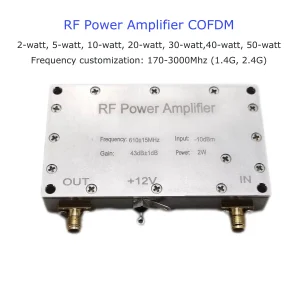
PA Power Amplifier
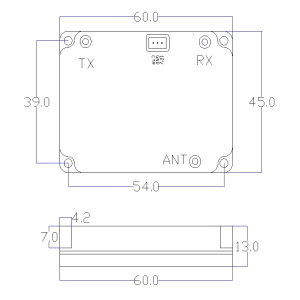
PA Power Amplifier
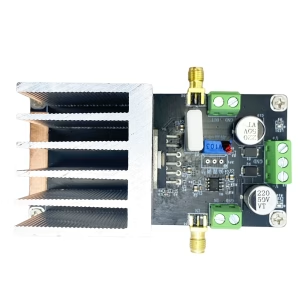
PA Power Amplifier
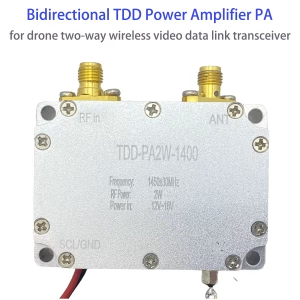
PA Power Amplifier
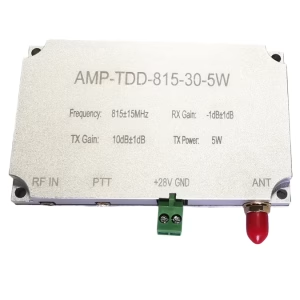
PA Power Amplifier
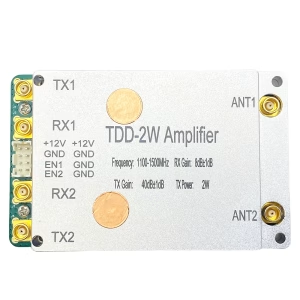
PA Power Amplifier
TDD 2T2R擴大機模組1100-1500MHz | 1300M 2W 5W 10W 30W RF PA 射頻前端模組

PA Power Amplifier

PA Power Amplifier
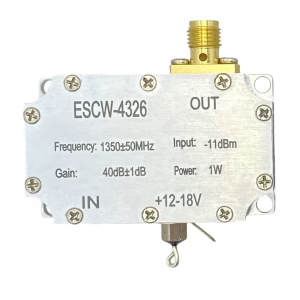
PA Power Amplifier

PA Power Amplifier
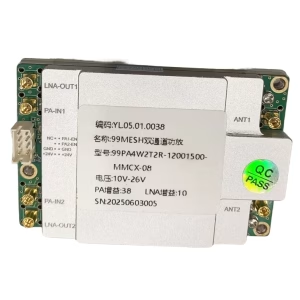
PA Power Amplifier

PA Power Amplifier
Table of Contents
1. 低雜訊放大器 (Low-Noise Amplifier)
- 目的: To amplify very weak received signals while adding as little noise as possible. Its primary goal is 靈敏度.
- 地點: First active component 在 receiver chain, directly after the receive antenna.
- Key Performance Indicators (KPIs):
- 噪音係數 (核因子): Crucially low (通常 0.3 分貝至 3 分貝). Measures added noise.
- 獲得: Sufficient to overcome noise from later stages (通常 15-30 分貝).
- 線性度: Important to handle potential strong interferers without distortion.
- 方向性: 單向 (Receive only).
- 設計重點: Ultra-low noise transistor selection, circuit topology for minimal noise, 穩定, sufficient gain.
- Applications: Receiver front-ends in smartphones, 基地台, 衛星接收器, 全球定位系統, radar receivers, radio telescopes, WiFi routers.
2. PA (功率放大器)
- 目的: To amplify processed signals to a high power level 適合於 efficient transmission over the air. Its primary goal is 輸出功率.
- 地點: Last active component 在 transmitter chain, directly before the transmit antenna.
- Key Performance Indicators (KPIs):
- Output Power: Crucially high (milliwatts to kilowatts+). Measured as saturated power (Pₛₐₜ) or power at specific linearity points (例如, P₁dB).
- 效率: High DC-to-RF power conversion (critical for battery life & 熱). Measured as Power Added Efficiency (PAE) or Drain Efficiency.
- 線性度: Extremely important for modern complex modulations (QAM, OFDM). Measured by ACPR/ACLR, 評估值. Often requires techniques like Digital Pre-Distortion (DPD).
- 獲得: Sufficient to reach required output power from the driver stage.
- 方向性: 單向 (Transmit only).
- 設計重點: 功率處理, 熱管理, 效率, 線性度 (often requiring trade-offs), 穩定.
- Applications: Transmitter final stages in smartphones, 基地台, broadcast transmitters, radar transmitters, walkie-talkies, microwave links.
3. 商業發展局 (Bi-Directional Amplifier) / 中繼器 / Signal Booster
- 目的: To simultaneously amplify signals in both directions (上行鏈路和下行鏈路), primarily to extend coverage into areas with weak signal (例如, 建築物, 隧道).
- 地點: A standalone system placed between a “donor antenna” (pointing towards the source signal) 和一個 “service antenna” (covering the target area).
- Key Performance Indicators (KPIs):
- Uplink Gain & Downlink Gain: Amplification for each direction. Must be carefully set.
- 噪音係數 (核因子): Primarily impacts the 下行鏈路 (收到) sensitivity of the overall system.
- Output Power: Primarily impacts the 上行鏈路 (傳送) coverage capability.
- Isolation: THE MOST CRITICAL KPI. Isolation between donor and service ports, and between internal Tx/Rx paths MUST be significantly higher than the system gain (Uplink Gain + Downlink Gain) to prevent oscillation/feedback.
- 方向性: 雙向 (Simultaneous Rx and Tx).
- Internal Structure: Essentially contains:
- 一個 低雜訊放大器 for the downlink path (receiving signal from the service area and amplifying it cleanly towards the donor antenna/base station).
- A PA for the uplink path (amplifying signals received from the donor antenna/base station for transmission into the service area).
- A Duplexer 或者 Circulators to provide the essential 隔離 between the Tx and Rx paths/frequencies.
- 設計重點: Achieving high isolation, gain balance between uplink/downlink, system stability, noise figure (下行鏈路), 輸出功率 (上行鏈路), 濾.
- Applications: In-building coverage systems (DAS), subway/tunnel coverage, rural signal extension, filling coverage gaps in large facilities (airports, malls).
Summary of Key Differences:
| Feature | 低雜訊放大器 (Low-Noise Amplifier) | PA (功率放大器) | 商業發展局 (Bi-Directional Amplifier) |
|---|---|---|---|
| Primary Role | Boost weak Rx signals (靈敏度) | Boost Tx signals (Output Power) | Extend Coverage (Bidirectional Relay) |
| 地點 | Front-end of Receiver | Back-end of Transmitter | Standalone System (Between Antennas) |
| Critical KPI | 低噪音係數 (核因子) | 高輸出功率 & 效率 | 高隔離度 & Balanced Gain |
| 方向 | 單向 (Rx Only) | 單向 (Tx Only) | 雙向 (接收 & Tx Simult.) |
| 訊號電平 | 非常低 (µV – mV range) | 非常高 (Watts+) | 緩和 (Amplifies both levels) |
| Core Design | Minimize Added Noise | Maximize Power & 效率 | Isolation, 增益控制, System Stability |
| Contains | – | – | 低雜訊放大器 (下行) + PA (上行鏈路) + Duplexer/Circulator |
In Simple Terms:
- 低雜訊放大器: Listens carefully to faint whispers (weak received signals) without adding static (噪音).
- PA: Shouts loudly (high-power transmission) so the message can travel far.
- 商業發展局: Hears the faint whispers from one area, amplifies them cleanly, and re-shouts them clearly into another area where the original shout couldn’t reach, and vice-versa. It’s a relay station containing both a careful listener (低雜訊放大器) and a powerful shouter (PA), kept from interfering with itself by special isolators.
PA Power Amplifier
PA Power Amplifier
PA Power Amplifier
PA Power Amplifier
PA Power Amplifier
PA Power Amplifier
TDD 2T2R擴大機模組1100-1500MHz | 1300M 2W 5W 10W 30W RF PA 射頻前端模組
PA Power Amplifier
PA Power Amplifier
PA Power Amplifier
PA Power Amplifier
PA Power Amplifier
PA Power Amplifier
Ask A Question
感謝你的回應。 ✨