母船 - 無人機系統和地面站之間的溝通和控制
The concept of a mothership-drone system—where a long-range fixed-wing UAV carries and deploys multiple quadcopter sub-drones—has rapidly gained attention in both commercial and defense sectors. This approach combines the endurance and efficiency of fixed-wing platforms with the flexibility and precision of rotary-wing drones, enabling missions that are difficult or impossible to achieve with a single UAV type. 然而, the effectiveness of such systems depends not only on the airborne coordination between mothership and sub-drones, but also on their ability to maintain robust communication and control links with ground stations.
在本文中, we will explore how these systems are connected to ground control stations (GCS), the technologies that ensure reliable communication, and the challenges and solutions involved in building seamless command-and-control networks.

1. The Role of the Ground Control Station
The ground control station acts as the central hub for mission planning, 實時監控, and operator commands. In a mothership-drone system, the GCS must simultaneously manage:
- The fixed-wing mothership UAV’s flight path and telemetry.
- The deployment, 控制, and recovery of multiple quadcopter sub-drones.
- Data transmission from onboard sensors, including video, 遙測, and payload information.
- Network-level coordination to ensure smooth transitions between communication modes.
Because the system involves multiple layers of control—strategic management of the mothership and tactical control of sub-drones—the GCS must be designed to handle multi-channel inputs, 高數據吞吐量, and redundant communication links.
2. Communication Architecture Overview
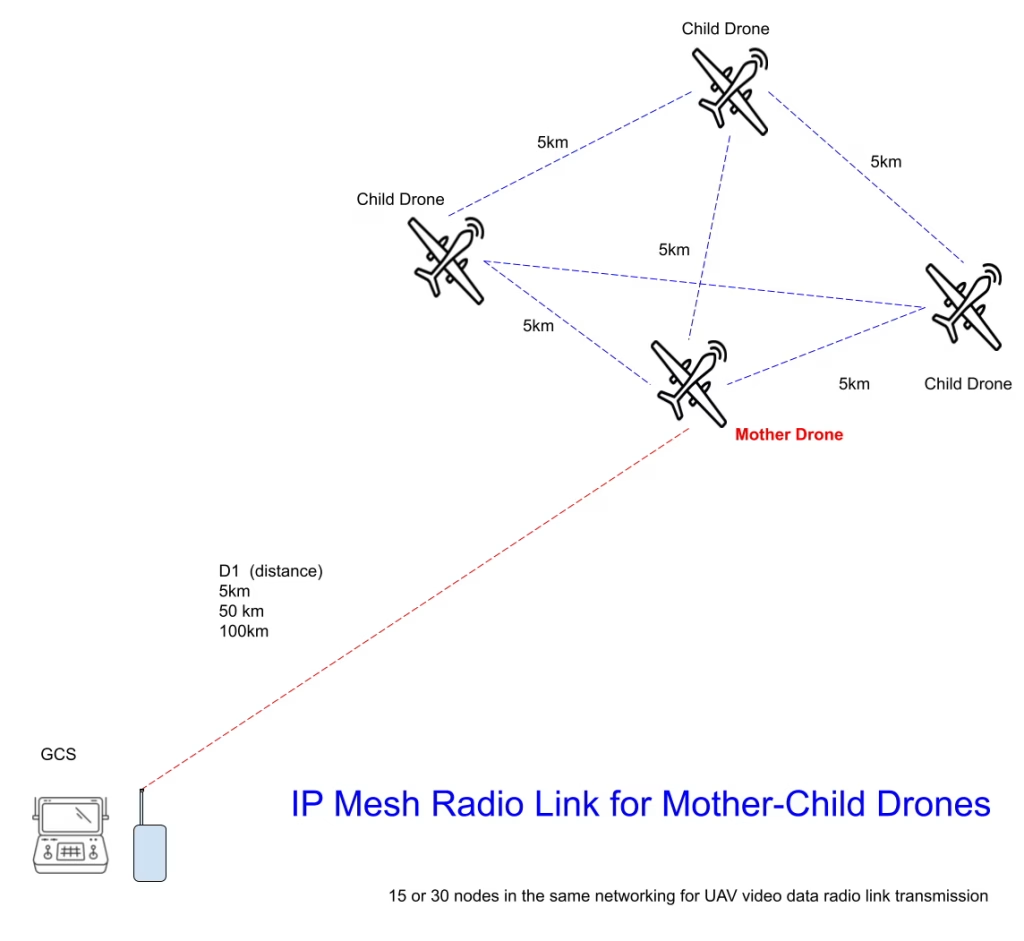
Communication between mothership, sub-drones, and the GCS can be divided into three layers:
- Mothership ↔ Ground Station
The fixed-wing UAV maintains a long-range, high-bandwidth link with the GCS. This link carries telemetry, 命令, 和有效負載數據 (such as HD video or sensor feeds). - Sub-Drones ↔ Mothership
Once deployed, quadcopter sub-drones communicate primarily with the mothership. This ensures that even if they are out of direct range of the GCS, the mothership can act as a relay node. - Sub-Drones ↔ Ground Station (via mothership)
All mission-critical data from the sub-drones—video, environmental sensing, or status updates—are funneled through the mothership and relayed to the GCS. The mothership thus serves as both a carrier and a communications gateway.
This layered structure allows the system to scale: the operator does not need direct line-of-sight to every sub-drone, reducing complexity while extending operational range.
3. Communication Technologies
Several technologies enable stable communication between UAVs and ground stations in this architecture:
- COFDM (編碼正交頻分複用):
Widely used in long-range UAV links, COFDM provides high resistance to interference and multipath fading. It supports real-time transmission of HD video and telemetry with ultra-low latency, making it ideal for mothership-to-GCS links. - Mesh Networking Protocols:
Sub-drones often form an ad hoc mesh network with the mothership. Each node can relay data, ensuring that even if one link is weak, information finds its way back to the mothership and ultimately to the GCS. - 頻率擴散頻譜 (FHSS):
To protect against jamming and maintain reliability in contested environments, FHSS dynamically changes carrier frequencies, minimizing the risk of communication loss. - Dual-band or Multi-band Radios:
The mothership may operate with separate transceivers for long-range command links (例如, 900 MHz或 1.4 GHz 頻段) and high-throughput video links (例如, 2.4 GHz 或 5.8 千兆赫). - Satellite or 4G/5G Backhaul:
For beyond-line-of-sight (布洛斯) 使命, the mothership can connect to the GCS via satellite or cellular networks, turning it into a long-distance airborne communication relay.
4. Control Strategies
Control in a mothership-drone system is distributed but hierarchical:
- GCS as the Command Authority:
Mission objectives, 路線規劃, and high-level control always originate from the ground. - Mothership as a Relay and Supervisor:
The fixed-wing UAV executes commands from the GCS and manages the deployment and recovery of sub-drones. It also processes local data, reducing bandwidth requirements before sending information back to the GCS. - Sub-Drones as Tactical Executors:
The quadcopters carry out tasks such as close-in surveillance, 映射, or target acquisition. They send data to the mothership, which consolidates and transmits it to the GCS.
This hierarchical control structure ensures efficient bandwidth use while maintaining centralized oversight.
5. Redundancy and Fail-Safe Mechanisms
Given the critical nature of communication in drone operations, redundancy is essential:
- Dual Communication Links: Many systems deploy dual COFDM links or combine COFDM with IP-based 4G/5G links.
- Autonomous Fail-Safe Modes: If communication with the mothership or GCS is lost, sub-drones can autonomously return to the mothership or perform a pre-programmed landing.
- Health Monitoring: Real-time monitoring of link quality and system health allows preemptive switching between communication channels before failures occur.
6. 實際應用
This communication architecture opens up new mission capabilities:
- Border Patrol and Surveillance: Fixed-wing motherships can patrol long perimeters, deploying quadcopter sub-drones for localized inspection.
- 搜救: In disaster areas, the mothership provides wide-area coverage, while quadcopters descend into difficult terrain to search for survivors.
- 軍事偵察: Carrier drones extend the operational range of quadcopters, which can infiltrate hostile areas while maintaining communication through the mothership.
- Agriculture and Environmental Monitoring: Motherships survey large areas, while sub-drones perform close-up inspections of crops, 森林, or wildlife habitats.
7. Challenges Ahead
While the communication and control framework is powerful, 仍然存在挑戰:
- Spectrum Management: Multiple links across different frequency bands risk interference, requiring intelligent frequency allocation.
- 延遲控制: Video and control signals must remain ultra-low latency, especially for time-critical missions like FPV navigation or precision targeting.
- 網絡安全: As systems rely on digital links, encryption and anti-jamming measures are crucial to prevent interception or spoofing.
- 可伸縮性: Managing dozens or even hundreds of sub-drones requires advanced network protocols and autonomous swarm behaviors.
結論
The success of mothership-drone systems lies not only in airframe design or payload capacity, but in the sophistication of their communication and control architecture. By integrating COFDM technology, 網格網絡, multi-band radios, and robust fail-safes, these systems can maintain seamless links with ground control stations while extending the reach and flexibility of UAV missions.
As the technology evolves, communication strategies will become even more intelligent, enabling autonomous swarm management, beyond-line-of-sight operations, and resilient mission execution in contested environments. 在將來, mothership-drone systems may well become the backbone of aerial operations across commercial, 緊急情況, and defense sectors.
更多 Fixed-Wing Mothership Drone with Quadcopter Sub-Drones
This innovative UAV system integrates a long-endurance fixed-wing mothership with multiple quadcopter sub-drones. The fixed-wing platform provides extended flight range, high-speed cruising, and efficient long-distance transportation, while the quadcopter drones are deployed for close-range reconnaissance, precision landing, and flexible mission execution. 一起, they form a versatile carrier-drone system designed for applications in surveillance, 映射, 緊急響應, 和戰術操作.

問一個問題
感謝你的回應。 ✨