





常問問題: 175 MHz Video System and GPS Interference on Drones

目錄
Q1: 可以一個 175 MHz video system interfere with my drone’s GPS?
是, it’s possible. Drones integrate multiple electronic systems into a compact space, and strong RF signals from devices like a 175 MHz video transmitter can sometimes affect sensitive GPS reception if installation or shielding isn’t optimized.
Q2: How can I check if my GPS is being affected?
You can perform a simple test:
- Turn 在 這 175 MHz video system and observe GPS performance: satellite count, 訊號強度, and positioning stability.
- Turn 離開 the video system and compare GPS performance.
If GPS works normally with the video system off but degrades when it’s on, interference is likely.
Q3: What can I do to reduce interference?
There are three effective solutions:
1. Reduce the transmitter power
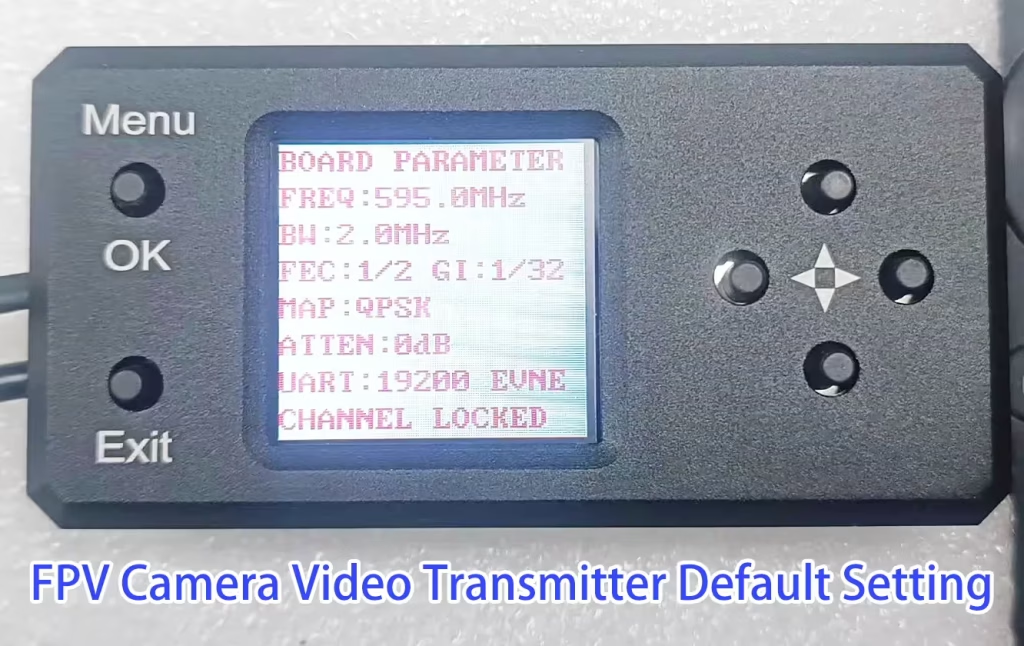
- Set the 175 MHz video transmitter to 1 W¯¯ if it’s higher.
- 怎麼做?
- How do I adjust the transmit power via the transmitter parameter configuration board?
- Please modify the 安泰信 (衰減) parameter in the transmitter settings. (see above picture). Power levels correspond to the following attenuation values:
- 0 分貝 ≈ 3-watt PA (maximum power)
- –2 dB ≈ 2-watt PA
- –4 dB ≈ 1-watt PA
- Lower power can reduce interference while maintaining sufficient video range.
2. Increase physical separation between antennas
- Use an RF extension cable to place the video transmitter antenna farther from the GPS antenna.
- Recommended layout:
- GPS antenna on the 頂部 of the drone to receive satellite signals.
- Video transmitter antenna on the 底部, pointing to the ground.
- The drone body can act as shielding to reduce interference.
3. Install a band-pass filter
- Adding a band-pass filter on the RF antenna line ensures only 175 MHz is transmitted.
- This suppresses harmonics or spurious emissions that could affect GPS.
第四季: What should I do next?
Try these steps in order: test GPS with the video system on/off, reduce power, optimize antenna placement, and consider a band-pass filter. If GPS issues persist, further adjustments or professional RF isolation may be needed.

常問問題: Will a 175 MHz Video Transmitter Interfere with GPS Frequencies via Harmonics?
Q1: What are the GPS frequencies?
Modern civilian GPS satellites operate on the following bands:
- L1: 1575.42 兆赫
- L2: 1227.60 兆赫
- L5: 1176.45 兆赫
GPS receivers are most sensitive around 1.2–1.6 GHz.
Q2: What is the second harmonic of a 175 MHz transmitter?
The second harmonic of a signal is twice its frequency:f2nd=2×175 MHz=350 MHz
The third harmonic would be:f3rd=3×175 MHz=525 MHz
Q3: Could this harmonic interfere with GPS?
- The second harmonic at 350 兆赫 and third harmonic at 525 兆赫 是 far below GPS frequencies (1.2–1.6 GHz).
- Direct interference from the second harmonic is extremely unlikely.
第四季: Could there be indirect interference?
是, but only under special circumstances:
- If a GPS receiver or antenna has strong nonlinear components (例如, low-quality amplifiers), high-power signals might generate intermodulation products that fall into GPS bands.
- Poor shielding or inadequate front-end filtering in the GPS receiver could theoretically allow some energy from the harmonics, but this is rare.
Q5: 概括
- 一個 175 MHz video transmitter will not directly interfere with GPS via its second harmonic.
- Any observed GPS interference is more likely due to receiver nonlinearity, poor shielding, or intermodulation effects rather than the transmitter’s harmonics.
問一個問題
感謝你的回應。 ✨