

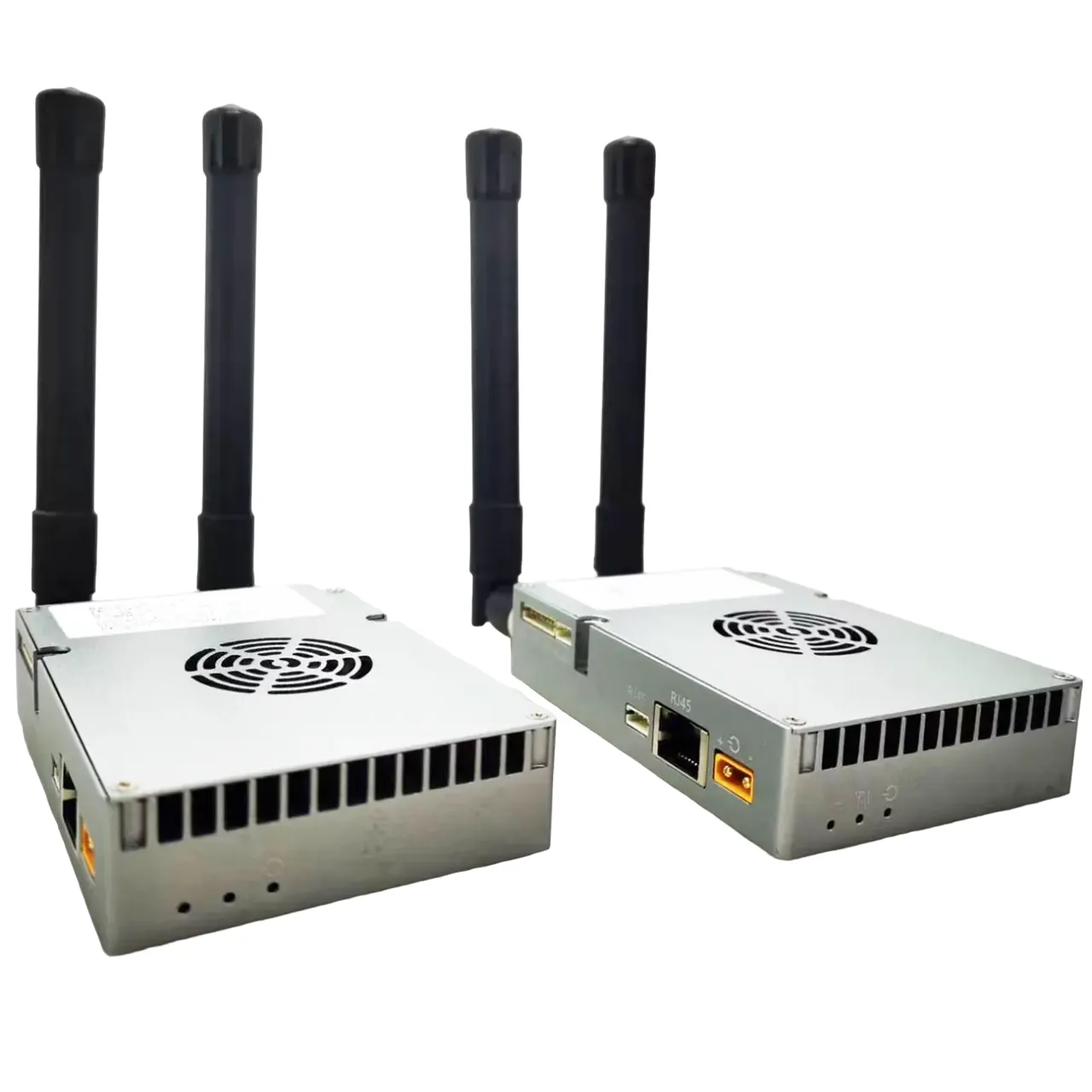


No exército, segurança, e aplicações de veículos autônomos não tripulados, choosing the right RF telemetry communication system é crítico. Two of the most widely used technologies today are Ka-band SATCOM telemetry systems e private OFDM point-to-point wireless video and data transmission systems. Each has unique strengths, limitations, and ideal use cases.
This article compares these two technologies in terms of cobertura, latência, largura de banda, confiabilidade, segurança, and deployment scenarios to help system integrators and defense users make the right technical decision.
Índice
1. Coverage Range and Deployment Model
Ka-Band SATCOM Telemetry Systems
Ka-band SATCOM systems communicate through geostationary (GEO), medium Earth orbit (MEO), or low Earth orbit (LEO) satellites.
Key characteristics:
- Global or regional coverage independent of terrain
- Ideal para beyond-line-of-sight (Blos) missões
- Works in deserts, montanhas, florestas, and maritime environments
Aplicações típicas:
- Long-range UGV/UAV missions
- Remote border surveillance
- Disaster response in areas without infrastructure
Private OFDM Point-to-Point Wireless Systems
OFDM point-to-point systems are based on direct RF links between a transmitter and receiver.
Key characteristics:
- Linha de visão (LOS) dependent
- Typical coverage range: 1–50 km (can be extended with relays)
- Requires towers, repetidores, or elevated antennas for long distances
Aplicações típicas:
- Tactical battlefield communications
- Campus, base, or city-level surveillance
- Temporary mobile networks
2. Latency Performance
SATCOM (Ka-band)
Latency is influenced by satellite orbit:
- GEO satellites: 500–700 ms round-trip
- MEO satellites: 150–300ms
- LEO satellite constellations: 30–100 ms
Even with optimization, Ka-band SATCOM generally has higher latency, which may impact real-time vehicle control.
Private OFDM Systems
OFDM-based private RF links offer:
- Latência ultrabaixa, tipicamente 10–50ms
- More suitable for real-time command and control
- Superior performance for teleoperation and autonomous navigation feedback
✅ OFDM systems clearly outperform SATCOM in latency-sensitive applications.
3. Data Throughput and Video Capability
Ka-Band SATCOM
Ka-band provides very high bandwidth, capable of:
- Uplink speeds from several Mbps to tens of Mbps
- Support for HD and even 4K video
- Simultaneous telemetry, comando, and payload data
Limitações:
- Bandwidth often depends on service subscription and satellite network congestion
Private OFDM
Typical performance:
- Real-world uplink: 1–20 Mbps
- Optimized for 720p / 1080p vídeo em tempo real
- Predictable throughput in private spectrum
✅ Both systems can support HD video, but SATCOM scales better for large data volumes.
4. Reliability and Environmental Performance
Ka-Band SATCOM
Vantagens:
- Not affected by terrain obstacles because of satellite path
- Works beyond mountains and dense forests
Desafios:
- Rain fade is a known issue in Ka-band, especially in monsoon regions such as India
- Weather mitigation requires adaptive coding, power control, and larger antennas
Private OFDM
Vantagens:
- Stable in normal weather conditions
- Less impacted by rainfall than Ka-band
Desafios:
- Highly sensitive to physical obstructions
- Performance degrades in urban clutter, florestas, or hilly terrain without relays
✅ SATCOM excels in terrain-challenged environments, while OFDM excels in controlled LOS environments.
5. Segurança e criptografia
Both systems can be designed with military-grade security.
Ka-Band SATCOM
- AES-256 hardware encryption
- Secure satellite gateways
- Military-grade authentication and key management
Private OFDM
- AES-128 / Criptografia AES-256
- Private, isolated RF networks
- Frequency hopping and COFDM anti-interference designs
✅ Both systems can meet military security requirements when properly implemented.
6. Cost and Infrastructure Requirements
Ka-Band SATCOM
Higher total cost due to:
- Satellite terminal equipment
- Antenna tracking systems
- Ongoing satellite bandwidth service fees
Private OFDM
Lower operational costs:
- No satellite airtime fees
- Infrastructure investment only for base stations and repeaters
✅ OFDM systems are significantly more cost-effective for local or regional deployments.
7. Best Use Cases
| Cenário | Recommended System |
|---|---|
| Beyond-line-of-sight (Blos) missões | Ka-band SATCOM |
| Urban or campus environments | Private OFDM |
| Real-time teleoperation | Private OFDM |
| Remote border areas | Ka-band SATCOM |
| High-mobility UGV/UAV | Private OFDM or hybrid |
Hybrid Solution: Best of Both Worlds
Many modern defense systems adopt a hybrid architecture:
- Primary link: Private OFDM low-latency RF
- Backup / long-range link: Ka-band SATCOM
This approach ensures:
- Real-time control locally
- Guaranteed connectivity when LOS RF links are blocked
Conclusão
Ka-band SATCOM telemetry systems are unmatched for global and beyond-line-of-sight communications, enquanto private OFDM point-to-point wireless telemetry systems deliver superior latência, control responsiveness, and cost efficiency.
For military and autonomous systems, the best solution is often a hybrid communications architecture that intelligently switches between OFDM and SATCOM links depending on mission profile and signal conditions.
Faça uma pergunta
Sua mensagem foi enviada