

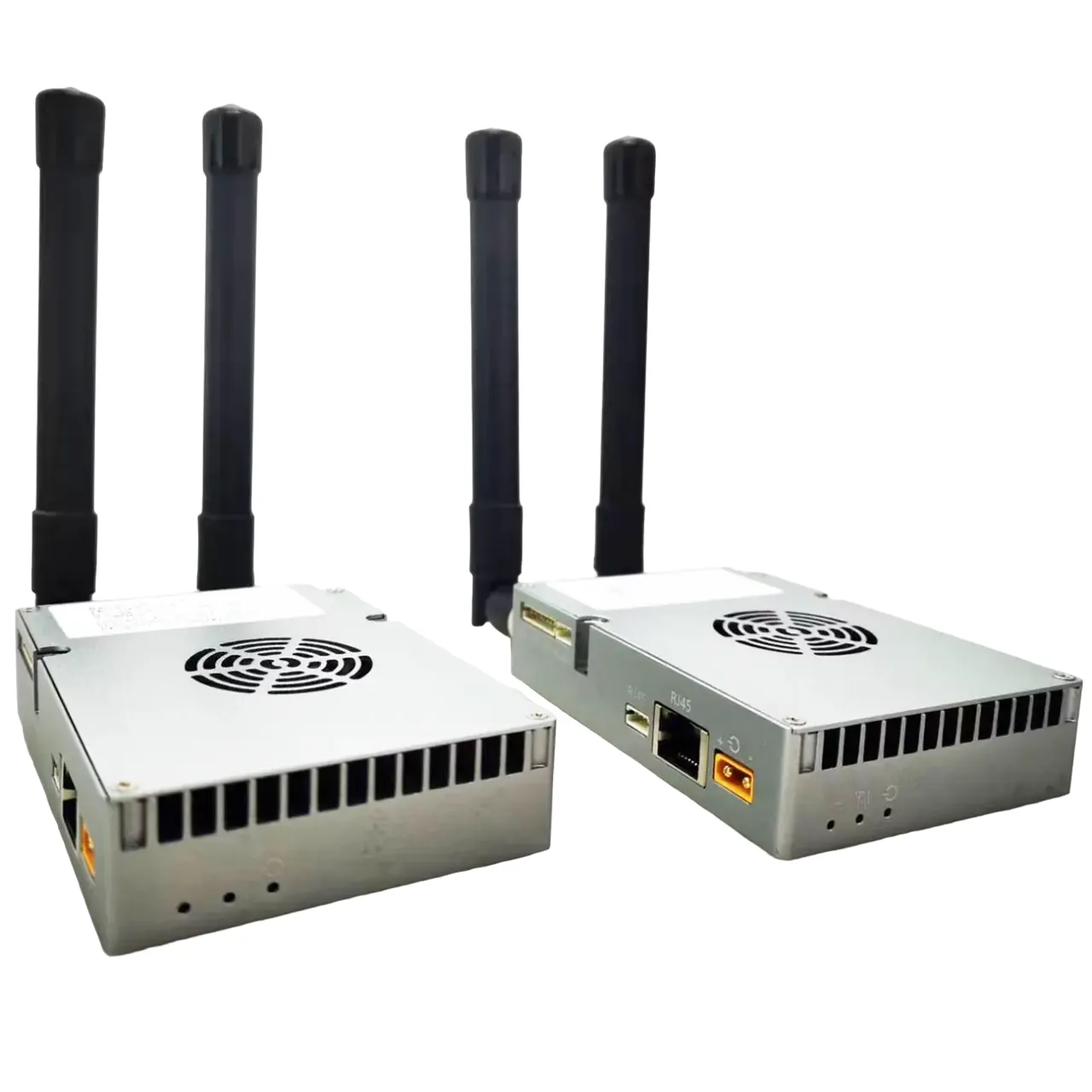
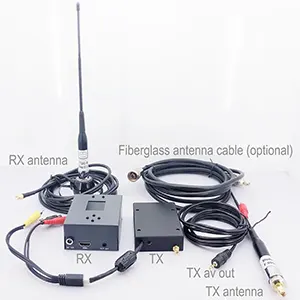


소개
In the world of wireless video transmission, power amplifiers (아니다) play a critical role. Whether the system is used for unmanned aerial vehicles (UAV), 공공 보안, or broadcast, the power amplifier ensures that the transmitted signal can travel long distances with sufficient strength and integrity.
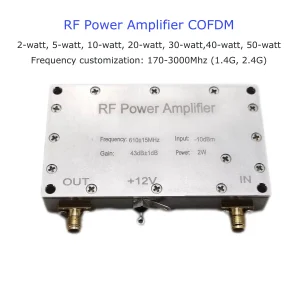
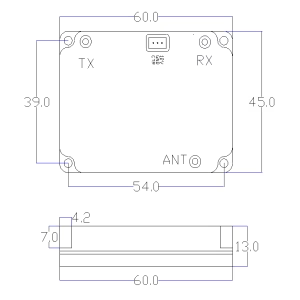
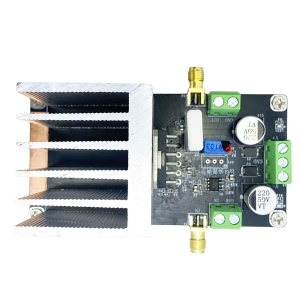
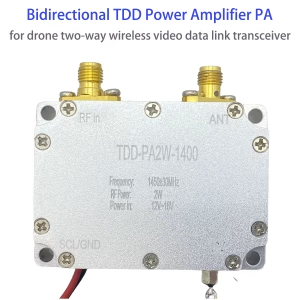
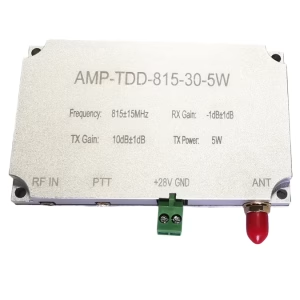
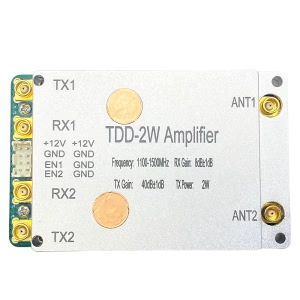


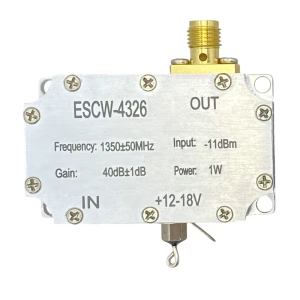

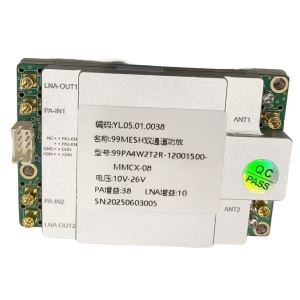
PA 전력 증폭기

하지만, not all wireless video systems are designed the same. Some rely on one-way video downlinks, where video is transmitted in a single direction (usually from UAV to ground station). Others require two-way video and data links, where the communication must be bidirectional, often using TDD (시분할 듀플렉스) technology to share the same frequency band for both uplink and downlink.
This difference in system architecture directly affects the choice of power amplifier. New users often ask: Can the same PA be used for both? The short answer is no. A one-way system and a two-way system require different amplifier designs and considerations.
이 기사에서는, 우리는 탐구할 것이다:
- The differences between one-way and two-way video transmission systems
- The corresponding types of power amplifiers used
- Key technical parameters for each
- Practical examples of usage scenarios
- Important purchasing tips for new users
By the end, you will have a clear roadmap for selecting the right PA for your project.
One-Way Video Transmission Systems
목차
What is One-Way Video Transmission?
A one-way video system is the simplest form of wireless link. 일반적으로, it transmits video from a UAV, 감시 카메라, or broadcast unit down to a receiver on the ground. No return channel is required.
예를 들어:
- A drone sending live video footage to its operator.
- A mobile camera streaming video to a base station for monitoring.
- Broadcast links for live events.
Power Amplifier Requirements
In one-way systems, the PA only needs to handle transmit power amplification. There is no need to support switching between transmit (텍사스) 그리고 수신 (RX), since receiving is done separately or not required at all.
The key requirements are:
- 높은 선형성 – Because most systems use advanced modulation schemes such as COFDM (코딩된 직교 주파수 분할 다중화), the amplifier must preserve the integrity of the signal. Non-linear amplification would distort the signal, increasing bit error rate (베르).
- Adequate Output Power – The amplifier must provide sufficient output power to cover the intended range, whether 10 km, 30 km, 또는 그 이상.
- Low Distortion – Adjacent channel interference must be minimized.
- Frequency Range Compatibility – The PA must match the operating frequency of the transmitter (예를 들어, 1.2 GHz의, 2.4 GHz의, 5.8 GHz의).
장점
- Simpler design
- 비용 절감
- Easier integration
- Typically more efficient since there is no switching overhead
Two-Way Video and Data Transmission Systems
What is Two-Way Video Transmission?
Two-way systems (often called bidirectional video and data links) support both video downlink and command/control uplink in the same frequency band. This is common in advanced UAV systems, tactical communication equipment, 및 산업 검사 드론.
These systems typically operate in TDD mode:
- Downlink slot: Transmit video/data from UAV to ground.
- Uplink slot: Transmit control/telemetry from ground to UAV.
- The same PA must handle both transmit and receive intervals with rapid switching.
Power Amplifier Requirements
Because of the duplex nature, the PA has additional responsibilities:
- Fast TX/RX Switching – The amplifier must quickly enable and disable power during transmit slots, typically within microseconds.
- 높은 격리 – The PA must not leak transmit power into the receive path, which would damage sensitive receivers.
- 높은 선형성 – Just like in one-way systems, COFDM and OFDM signals require excellent linearity to avoid distortion.
- 제어 인터페이스 (TX_EN) – The amplifier must include an enable/disable pin or control line to synchronize with the TDD timing of the system.
- Thermal Stability – Because switching is rapid and continuous, the PA design must handle additional thermal stress.
장점
- Enables full communication (동영상 + telemetry/control).
- Efficient spectrum use (same band for both uplink and downlink).
- Essential for modern UAVs and tactical systems.
도전과제
- More complex design
- 더 높은 비용
- More difficult integration
- Requires TDD synchronization between system and PA
Technical Comparison: One-Way vs. Two-Way PAs
Here is a side-by-side comparison:
| 특색 | One-Way Video PA | Two-Way Video PA (TDD) |
|---|---|---|
| System Type | Simple downlink only | 양방향 (업링크 + 다운링크) |
| Switching | Not required | Fast TX/RX switching |
| 선형성 | High linearity required | High linearity required |
| 제어 인터페이스 | None or simple power control | Must include TX_EN control |
| Complexity | 낮은 | 높은 |
| 비용 | 낮추다 | 더 높은 |
| Risk of RX Damage | 낮은 | High if not properly designed |
| 일반적인 응용 | UAV video downlink, 감시 | UAV with telemetry + 동영상, tactical comms |
Choosing the Right PA: Key Parameters
When ordering or specifying a power amplifier, engineers and buyers must consider several parameters:
- 주파수 대역
Ensure the amplifier matches the intended operating band (예를 들어, 300 MHz–900 MHz for UHF, 1.2 GHz의, 2.4 GHz의, 또는 5.8 GHz의). - 출력 전력
- Small UAV video links may use 500 mW to 2 W.
- Long-range surveillance may require 5 W or higher.
- 선형성
Expressed in terms of EVM (오류 벡터 크기) or ACPR (Adjacent Channel Power Ratio). This is critical for COFDM signals. - 능률
Impacts battery life (especially important for UAVs). - Switching Speed (for TDD PAs)
Must be fast enough to keep up with system frame timing. - 제어 인터페이스
- 편도: simple ON/OFF may suffice.
- 양방향: must support TX_EN and possibly bias control.
- Thermal Design
Adequate heat sinking is required, especially for higher power models. - 폼 팩터
Size and weight are critical for UAV applications.
Practical Purchasing Tips for New Users
When selecting a PA for your video transmission system, 다음을 고려하십시오:
- Clarify System Type First: Is your system strictly one-way downlink, or does it require two-way communication? This determines whether you need a standard linear PA or a TDD-capable PA.
- Check Linearity Specifications: If using COFDM or other complex modulations, confirm that the amplifier supports sufficient EVM/ACPR performance.
- Verify Switching Features: For two-way systems, ensure the PA has a TX_EN control input and check the specified switching speed.
- Match Power to Range: Don’t overspecify power—higher wattage increases size, 열, and cost. Choose the appropriate level for your required distance.
- Confirm Frequency Customization: Some suppliers offer custom frequency tuning. Make sure the PA covers your band.
- Ask About Thermal Management: For continuous high-power use, request details on heatsinks, 기류, and derating.
- Check Regulatory Compliance: Ensure the amplifier power level and frequency are compliant with your country’s spectrum regulations.
Example Scenarios
- Surveillance Drone with Video Downlink Only
- 체계: One-way COFDM video downlink
- 아빠: 2 W linear amplifier, 최적화된 1.4 GHz 대역
- Rationale: No TDD switching needed, focus on linearity and power efficiency.
- Industrial UAV with Video + Telemetry Link
- 체계: Two-way COFDM TDD link (uplink telemetry, downlink video)
- 아빠: 1 W TDD amplifier with TX_EN control
- Rationale: Requires rapid switching and protection of RX path.
- Tactical Communication System
- 체계: Two-way secure COFDM video + voice system
- 아빠: 5 W TDD PA with high linearity, advanced cooling
- Rationale: 장거리, heavy duty, military-grade requirements.
결론
Power amplifiers are not one-size-fits-all. While both one-way and two-way video transmission systems may use COFDM modulation, the underlying requirements are different:
- One-way systems can rely on a standard linear amplifier optimized for power and linearity.
- Two-way systems demand a TDD-capable PA with fast switching and additional isolation to protect the receiver.
For new users, understanding these distinctions is critical. When ordering from suppliers, always specify:
- The system type (one-way or two-way)
- Required frequency band
- Desired output power
- Linearity requirements
- Whether TDD switching support is needed
Armed with this knowledge, you can confidently choose the right power amplifier, avoid costly mismatches, and ensure your video transmission system performs reliably in real-world applications.
질문하기
응답해 주셔서 감사합니다. ✨