





이 모델은 양방향 무선 데이터 링크로 비디오 및 데이터 무선 전송을 위해 설계되었습니다. 약자 주파수 호핑 확산 스펙트럼, 무선 통신 시스템에서 사용되는 방식입니다., 포함 무선 비디오 데이터 송신기 및 수신기, 신호 신뢰성을 높이기 위해, minimize interference, and improve security.
목차
How FHSS Works
In an FHSS system, the transmitter and receiver continuously hop between different frequencies within a predetermined frequency range, rather than staying on a single frequency. These hops occur rapidly and are synchronized between the transmitter and receiver, ensuring that both are on the same frequency at any given time.
작동 방식은 다음과 같습니다.:
- 주파수 호핑: The system uses a sequence of frequencies, and the transmitter rapidly switches between them in a pseudorandom order, often hundreds or thousands of times per second.
- 동기화: The transmitter and receiver are synchronized to hop between the same frequencies at the same time, allowing for continuous communication without interference.
- 홉 패턴: The pattern of frequency hops is typically pre-programmed and kept secret or encrypted, so even if someone tries to intercept the signal, they won’t know the hopping sequence.
무선 비디오 데이터 시스템에서 FHSS의 이점
- 간섭 감소: By frequently changing frequencies, FHSS minimizes the risk of interference from other devices that may be using the same frequency bands, improving the reliability of the signal.
- 향상된 보안: The rapid switching between frequencies makes it difficult for unauthorized users to intercept or jam the communication, 보안 강화.
- 향상된 범위: Since the system is constantly hopping between frequencies, it is less likely to experience sustained interference, resulting in better communication range and stability.
- 혼잡한 RF 환경에서의 견고성: FHSS is effective in environments with a lot of wireless traffic or crowded radio frequencies, as it avoids staying on a single frequency that may be congested.
- Resistance to Jamming: If a jamming signal is introduced on one frequency, 시스템이 빠르게 다른 주파수로 이동합니다., making it difficult for the jammer to disrupt communication.
FHSS vs. DSSS (직접 시퀀스 확산 스펙트럼)
- 이 모델은 양방향 무선 데이터 링크로 비디오 및 데이터 무선 전송을 위해 설계되었습니다. (주파수 호핑 확산 스펙트럼) 서로 다른 주파수 사이를 홉, reducing the chances of interference and offering better security.
- DSSS (직접 시퀀스 확산 스펙트럼) spreads the signal across a wide frequency band without hopping, offering better performance in low-interference environments but being more susceptible to narrowband interference.
FHSS in Wireless Video Transmitters and Receivers
~ 안에 무선 비디오 데이터 시스템, ~와 같은 FPV 드론 또는 라이브 방송 시스템, FHSS는 다음과 같은 이유로 유용합니다.:
- Keeps the video signal clear by avoiding interference from other wireless devices.
- 지속적인 허용, stable transmission of high-quality video in environments where many devices might be operating on the same frequency bands.
- Ensures better performance in noisy RF environments (도시 지역이나 혼잡한 이벤트 공간과 같은).
전반적인, 이 모델은 양방향 무선 데이터 링크로 비디오 및 데이터 무선 전송을 위해 설계되었습니다. is a valuable technology in wireless video systems, 보다 안전한 제공, 믿을 수 있는, and interference-resistant communication for high-quality video transmission.
How does FHSS work on the drone wireless video transmitter and receiver?
FHSS is an automatic frequency modulation technology. We widely used FHSS in wireless video data transmission of drones. Because the drone’s wireless link is often subject to signal interference.
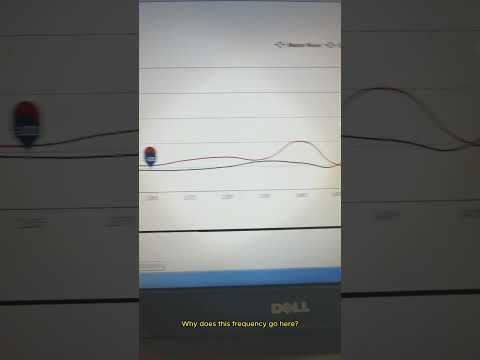
이 영상에서는, this frequency point shows the current signal strength.
그만큼 1365 we see is the current signal working frequency point of our wireless transmission equipment.
이 주파수는 왜 여기로 가나요??
Because there are other signals on the right that are interfering. 자동으로 실행됩니다.
신호가 다시 간섭을 받는 경우, 또 도망가네, choosing the frequency with the least interference.
이 프로세스는 간섭을 피하기 위한 것입니다.. 우리는 이를 FHSS 함수라고도 부릅니다..


Q1: What is the FHSS Frequency-hopping spread spectrum?
A1: 주파수 도약 확산 스펙트럼 (이 모델은 양방향 무선 데이터 링크로 비디오 및 데이터 무선 전송을 위해 설계되었습니다.) is a method of transmitting radio signals that involves rapidly changing the carrier frequency among a wide range of frequencies.
FHSS will occur automatically on both the transmitter and receiver at the same time. FHSS is used to prevent eavesdropping and interference on the long-range wireless video transmitter and receiver. When the current working frequency is jammed or interfered with, the transmitter and receiver disconnect and hop to the next available frequency to reconnect.
2분기: FHSS 기능이 필요한 이유?
A2:
1. Because the signal hops to a different frequency band, FHSS signals are highly resistant to narrow-band interference.
2. 주파수 호핑 패턴을 알 수 없는 경우, signals are difficult to intercept.
3. Jamming is also difficult if the pattern is unknown; 확산 순서를 알 수 없는 경우, the signal can only be jammed for a single hopping period.
4. With minimal mutual interference, FHSS transmissions can share a frequency band with many types of conventional transmissions. FHSS signals interfere in narrow-band communications and vice versa.
Q3: How to set the FHSS at your wireless video data transmitter and receiver?
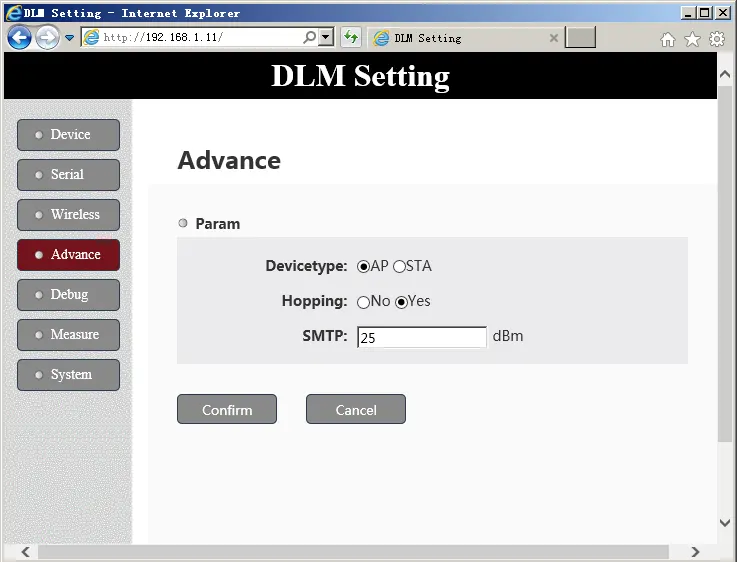
A3: 에서 웹 관리자 UI, 사전 페이지를 선택해 주세요, you can see the above picture.
https://i0.wp.com/ivcan.com/wp-content/uploads/2022/02/UI-Advance.webp
4분기: 7 tips you should know before you choose a wireless video transmitter and receiver with FHSS function.
A4:
1. TX900B-2W 지원 주파수 범위는 1420~1530MHz입니다., 사용할 대역폭은 110Mb입니다..
2. 고객은 작업 대역폭을 1.4M/3M/5M/10M/20MHz로 설정할 수 있습니다. (하지만, 1.4M/3MHz는 비디오 전송에 적합하지 않을 수 있습니다.). 그러면 TX900B-2W가 작동할 수 있습니다. FHSS 모드 (주파수 도약 확산 스펙트럼) 시스템은 자동으로 중앙 작동 주파수를 선택하고 주파수 호핑을 수행할 수 있습니다. (1420~1530MHz 사이) 일하는 동안.
3. 고객은 1420~1530MHz 전체의 주파수 채널을 사용하고 고정 주파수 채널에서도 작동하도록 장치를 설정할 수도 있습니다..
4. TX900B-2W supports the longest distance at 22km.
지원되는 주파수 범위와 가장 긴 거리를 제외하고, 육체적인 모습, 인터페이스, UI, 작업, 등, TX900B-2W는 기존 TX900B-15km-2W와 동일합니다..
5. TX900B-2W only support a frequency range is 1420~1530MHz, it does not support 800MHz and 2.4GHz frequency range.
6. 두 가지 버전이 있습니다, TX900B-2W-15km, 및 TX900B-2W-22km.
7. 다음과 같이 TX900B-2W 주파수 범위는 110Mb입니다., so if you config the working bandwidth as 10Mb, 그러면 당신은 얻을 것이다 11 호핑을 가리킨다.
Q5: FHSS의 작동 원리는 무엇입니까??
우리의 무선 비디오 트랜시버는 지능형 주파수 선택 간섭 회피를 채택합니다..
Intelligent frequency selection (간섭 회피) technology is a new anti-interference technology, 간섭을 효과적으로 방지하고 무선 전송의 신뢰성과 안정성을 극대화할 수 있습니다..
The key to our unique intelligent frequency selection (간섭 회피) technology lies in the three major processes of interference detection, decision-making, and switching execution. Interference detection refers to real-time detection of interference and background noise at each frequency point during normal communication, so as to provide basic support for decision-making. The decision-making is completed independently by each node, and the optimal frequency is selected based on the criterion of optimizing its own receiving performance. The point is used as the receiving frequency point; the switching execution occurs after the decision selects a new optimal frequency point, and the switching process will not cause data loss, 안정적이고 지속적인 데이터 전송 보장.
우리의 독특한 지능형 주파수 선택 (disturbance avoidance) 기술을 통해 각 노드는 서로 다른 주파수 네트워킹에 대해 서로 다른 최적의 주파수 지점을 독립적으로 동적으로 선택할 수 있습니다., so as to optimize the overall network performance and effectively avoid interference.
Please check the below picture, 파란색 영역은 유효 신호입니다., 과 빨간색 선은 간섭입니다. 
Q6: Does your FPV VTX support the FHSS frequency automatic jumping function to avoid interference?
FPV VTX is a one-way transmission and cannot support the FHSS frequency automatic hopping function.
FPV VTX는 단방향 전송입니다., 송신기를 통해 항공기에서 지상 수신기로 영상을 전송할 수 있는 장치.
FHSS 기능, 사용자가 신호 감도가 감소하고 있거나 장애물에 직면한 것을 발견한 경우, it will notify the transmitter and receiver to modify the frequency at the same time and find a frequency with the least interference for transmission. If only the receiver modifies the frequency without controlling the transmitter to modify the same frequency, the frequency of the transmitter and receiver will be inconsistent and the transmission will be interrupted.
Because of the above requirement of notifying the transmitter to modify the frequency, the FHSS function needs to be based on a two-way transmission system.
Or your FPV VTX can support modifying the frequency function through the serial port. When you need to modify the frequency, the operator sends a preset serial port command from the receiver to the serial port of the transmitter. After receiving this command notification, the transmitter automatically changes to the next frequency point.
This is equivalent to your wireless transmission equipment, which has both a one-way video transmission function and a two-way data transmission function, which is equivalent to your current wireless control system. So whether it supports the serial port to modify the frequency of the transmitter depends on whether your current device supports it.
Our models below support such functionality.
Vcan 1776 Vcan 1886
큐: Do you have a video data link as per the below requirement?
필요한 거리는 50 킬로미터, 주파수 호핑 기술로 (뛰어넘다 1,000 1초에 몇 번), 이상적으로는 6Ghz 이상 (다른 사람들도 고려될 수 있다, the most important thing is frequency hopping technology), and it is also necessary to transmit data, 동영상, and protect the remote control channel, preferably A set of data links (송신기 + 수화기 + 안테나) using frequency hopping technology (이 모델은 양방향 무선 데이터 링크로 비디오 및 데이터 무선 전송을 위해 설계되었습니다.)
iVcan 답장: 아니, The frequency is only 1.4G, the working frequency for 6Ghz needs custom development.
큐: Do you have any optional model to support the FHSS Frequency-hopping spread spectrum?
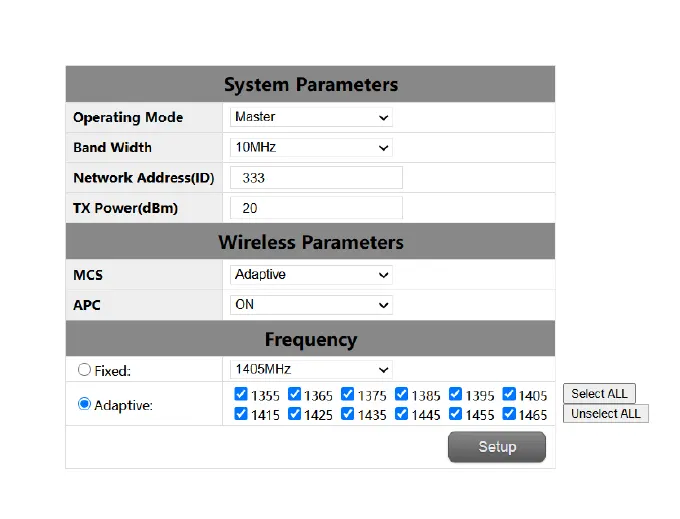
아래 그림에서, you can see that there are 12 points frequency ready for FHSS.

Real-time interference detection function
질문하기
응답해 주셔서 감사합니다. ✨