






Here are some FAQ for CVBS over IP video stream converter of drone or industrial use.

Telecamera IP AI
Il prezzo originale era: $599.00.$390.00Il prezzo attuale è: $390.00.
- Q: What is a CVBS to IP converter?
UN: A CVBS to IP converter (also calledAV encoder board ocomposite to IP encoder) encodes analogVideo composito & audio signals into digital IP streams for transmission over Ethernet networks. - Q: Can this converter turn my old CCTV cameras into IP cameras?
UN: sì! It acts as acamera to IP transformer, allowing legacyCVBS cameras to connect to modernIP-based NVRs ovideo management software.
- Q: What video resolutions does a CVBS to IP encoder support?
UN: Most supportNTSC / PAL norme (fino a720×576@25fps o720×480@30fps), Ideale peringresso video composito. - Q: Does it support audio encoding?
UN: sì! Audio over IP is enabled viaRCA audio input alongsideVideo CVBS, synced in the IP stream. - Q: What is the typical latency of a CVBS to IP converter?
UN: Grado professionaleAV encoder boards achieve <150latenza MS, Adatto perMonitoraggio in tempo reale. - Q: Can multiple encoders work on one network?
UN: sì! Assign uniqueIP addresses to each device formulti-camera IP streaming.
- Q: How do I set up a CVBS to IP converter for security cameras?
UN: CollegareCVBS camera output to the encoder’sRCA/BNC input, then link itsporta Ethernet a aPoE switch (or useDC power). - Q: Does it require special software?
UN: Many supportONVIF protocol, working withVLC, Iris blu, oMilestone NVRs without extra software. - Q: Can I power the encoder via Ethernet (Poe)?
UN: No, Nostro compact AV encoders does not support Poe.
- Q: Will this work with my analog VCR or DVD player?
UN: Assolutamente! Use it to digitizecomposite AV sources (VCR, DVD players) perdiretta streaming oarchiving over IP. - Q: Is it compatible with existing NVR systems?
UN: sì! ONVIF-compliant encoders integrate withIP NVRs like Hikvision, Dahua, or Synology.
- Q: Quali protocolli di streaming sono supportati?
UN: Common protocols includeRTSP, UDP, RTMP, eHTTP, abilitazionefeed video in diretta on websites or apps. - Q: How much bandwidth does a CVBS to IP stream use?
UN: Regolabilebitrate control (per esempio., 500Kbps–8Mbps) allows optimization fornetwork constraints. - Q: Can I access video over the internet?
UN: sì! ConfiguraPort Forwarding or useP2P cloud services permonitoraggio remoto.
- Q: Why use this for retail store surveillance?
UN: Cost-effectively upgradeanalog CCTV to IP cameras without replacing coaxial cables. - Q: Can I use this for live church broadcasts?
UN: sì! Codificarecomposite video feeds (per esempio., from mixers) perYouTube/Facebook streaming via RTMP.
- Q: Why is my video stream choppy?
UN: Controllonetwork bandwidth, reduceencoder bitrate, or enableCodifica H.265 (Se supportato) for efficiency. - Q: No video after setup – what to check?
UN: VerificareCVBS input connections, Alimentazione elettrica, eConfigurazione IP (usoARP/Ping tools).
- Q: Can I add motion detection?
UN: Some encoders includeAnalisi video permotion-triggered recording or alerts. - Q: Is two-way audio supported?
UN: scusate, this model supported only one-way audio encoder,it does not support two-wayaudio input/output perintercom systems over IP.
- Q: What’s the price range for a compact CVBS encoder?
UN: Budget encoders start at$300, mentreprofessional AV boards con4K downscaling costo$300+. - Q: Where to buy CVBS to IP converters?
UN: Our website https://ivcan.com supports shop on line. Or please click contact or WhatsApp button to get more support from us.
- Q: How to integrate with home automation (per esempio., Home Assistant)?
UN: UsoRTSP feeds inHome Assistant tramite ilGeneric Camera Platform. - Q: Does it work with wireless networks?
UN: Usa unEthernet-to-WiFi adapter perwireless IP video transmission.
- Q: Can I record video directly to an SD card?
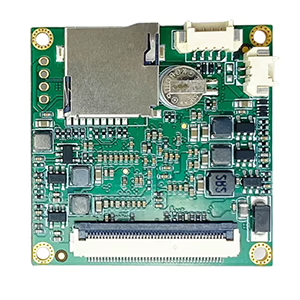
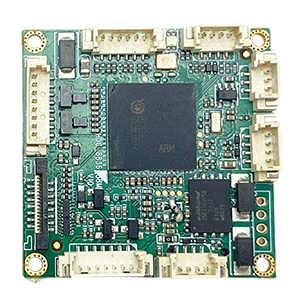
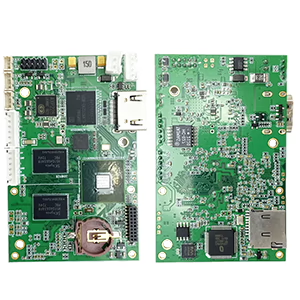
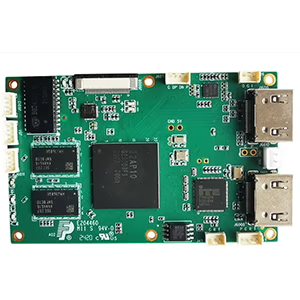
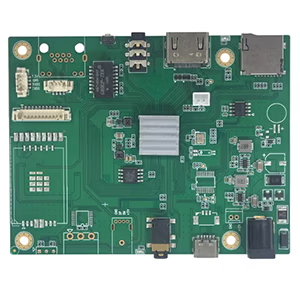
UN: Nostro AV encoder boards Vcan1746 includeremicroSD slots perstandalone recording. - Q: What’s the maximum cable length for CVBS input?
UN: Video analogico degrades beyond100m – place theencoder board near the source. - Q: Is there a web interface for configuration?
UN: sì! Access settings viaembedded web GUI using any browser. - Q: Can multiple users view the stream simultaneously?
UN: Most support10+ concurrent RTSP viewers (varies by model). - Q: Does temperature affect encoder performance?
UN: Industrial-grade-20°C~60°C operation ensuresreliable surveillance in harsh environments. - Q: How to secure the video stream from hacking?
UN: AbilitareHTTPS, IP whitelisting, and change defaultadmin passwords. - Q: Can I stream to multiple platforms at once?
UN: sì! UsoRTMP simulcasting aYouTube, Contrazione, and Facebook simultaneously. - Q: What’s the difference between a CVBS encoder and a video capture card?
UN: Encoders output Ethernet/IP streams; capture cards (per esempio., USB) connect to PCs for local processing. - Q: Do I need a static IP address?
UN: No – useDDNS services (like No-IP) perdynamic IP networks. - Q: Can I control PTZ cameras through the encoder?
UN: Only if the encoder hasRS485 ports perPTZ protocol support (per esempio., Pelco-D). If the PTZ of your camera is serial port control, you can use the transparent serial port on our CVBS over IP video stream converter (used with the codec board); if it is network port control, you can control it yourself through the wireless link without the need for a codec board. - Q: Why choose H.265 over H.264?
UN: Codifica H.265 reducesbandwidth usage by 50% at similar quality. H.264 encoding offer the super low latency if you need it for drone use. - Q: Is de-interlacing supported for analog video?
UN: sì! Auto de-interlacing convertsinterlaced CVBS aprogressive scan for smoother IP video. - Q: How many encoders can a network handle?
UN: Depends onswitch capacity – a 24-port Gigabit switch supports20+ encoders comfortably. - Q: Can I use this with a Raspberry Pi?
UN: sì! Alcuniencoder boards interface withRaspberry Pi GPIO for DIY projects. - Q: Does it output 4K video?
UN: No –ingresso CVBS èSD resolution (max 720×576). For HD, usoVcan1746-4K-HDMI encoders invece. - Q: What’s the power consumption?
UN: Tipico150mA@12V – ideal forenergy-efficient IP systems. - Q: Can I integrate with Alexa/Google Home?
UN: Via third-party tools likeHome Assistant usandoRTSP feeds. - Q: Come ripristinare le impostazioni di fabbrica?
UN: Premere ilpulsante di ripristino dell'hardware per 10 secondi (fare riferimento aencoder manual). - Q: Is there a mobile app for viewing?
UN: UsoONVIF-compatible apps (per esempio., TinyCam Pro, ONVIF Viewer) sopraiOS/Android. - Q: Can it overlay timestamps on video?
UN: sì! AbilitareOSD (Display sullo schermo) pertime/date/text overlays. - Q: What if my camera has no audio output?
UN: Add anexternal microphone to the encoder’saudio input port. - Q: Do encoders support multicast streaming?
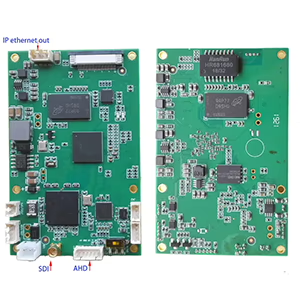
UN: Another models vcan1746 do – support Dual video streaming over IP Ethernet (CVBS+HDMI or CVBS + SDI or CVBS+AHD). - Q: How long do these devices last?
UN: Industrial-grade components garantire50,000+ ore MTBF (5+ years continuous use). - Q: Where to find SDKs for custom integration?
UN: Manufacturers provideSDKs for Linux/Windows – search“CVBS encoder SDK” for downloads.
Sommario
Fai una domanda
Grazie per la risposta. ✨