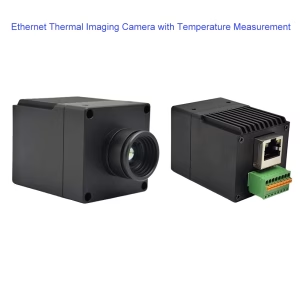
UNE capteur de caméra thermique (également appelé un capteur infrarouge ou capteur IR) is the core component of a thermal imaging device that detects infrared radiation (chaleur) emitted by objects and converts it into an electronic signal. This signal is then processed to create a visual representation of temperature differences, known as a thermogram. Unlike visible-light cameras, capteurs thermiques “voir” heat rather than light, enabling them to operate in total darkness, through smoke, brouillard, or other obscurants.
Comment ça marche
- Infrared Detection:
- All objects above absolute zero (-273° C) emit infrared radiation.
- The sensor detects wavelengths in the infrarouge à ondes longues (LWIR) spectre (8–14 μm), which corresponds to the heat emitted by most everyday objects.
- Heat-to-Signal Conversion:
- The sensor’s pixels absorb infrared radiation, causing a temperature change.
- This change is converted into an electrical signal (voltage or resistance).
- Traitement d'image:
- Signals are translated into a thermal image, with colors or grayscale representing temperature variations (par ex., red = hot, blue = cold).
Key Types of Thermal Sensors
| Type | Comment ça marche | Applications |
|---|---|---|
| Microbolometer | Uses tiny heat-sensitive resistors (pixels) that change resistance with temperature. Common in uncooled systems. | Drones, Sécurité, inspections industrielles. |
| Photon Detector | Uses semiconductor materials (par ex., InSb, HgCdTe) that generate electrons when exposed to IR. Requires cooling (cryogenic or Stirling cooler). | Militaire, scientific research, astronomy. |
| Pyroelectric | Detects rapid temperature changes (par ex., motion sensing). Not for static imaging. | Motion detectors, intruder alarms. |
Spécifications clés
- Résolution:
- Pixel count (par ex., 160× 120, 320×240, 640× 512). Higher resolution = finer detail.
- Sensibilité thermique (NETD):
- Différence de température équivalente au bruit: Lower values (<50 mk) mean better ability to detect small temperature differences.
- Gamme spectrale:
- LWIR (8–14 μm) for most consumer/industrial use; MWIR (3–5 μm) for high-temperature or gas detection.
- Fréquence d'images:
- Speed of image capture (par ex., 9 Hz for basic models, 60 Hz for high-speed applications).
- Écart de température:
- From -40°C to +2000°C+ (depends on sensor type).
Example Sensors
- Boson FLIR (Microbolometer):
- 640×512 resolution, NETD <50 mk, used in drones and handheld thermal cameras.
- Teledyne Flir tau 2 (Microbolometer):
- 640×512 resolution, ruggedized for military/industrial use.
- Seek Thermal CompactPRO (Microbolometer):
- 320×240 resolution, smartphone-compatible.
- Sofradir Quantum Well Infrared Photodetector (QWIP):
- High-end MWIR sensor for gas detection and aerospace.
Applications
- Lutte contre les incendies: Detect hotspots through smoke.
- Imagerie médicale: Screen for fevers or inflammation.
- Inspections des bâtiments: Find insulation leaks or electrical faults.
- Surveillance de la faune: Track animals at night.
- Automobile: Night vision systems for cars.
- Industriel: Monitor machinery for overheating.
Limites
- Coût: High-resolution sensors (par ex., 640× 512) are expensive.
- Interférence environnementale: Pluie, poussière, or reflective surfaces (par ex., verre) can distort readings.
- No Visible Detail: Thermal images lack texture/color seen in visible-light photos.
Radiometric vs. Non-Radiometric Sensors
- Radiometric: Provide temperature data for each pixel (used in inspections and analytics).
- Non-Radiometric: Show heat gradients but no exact temperature values (used in basic surveillance).
Cooled vs. Uncooled Sensors
| Fonctionnalité | Cooled Sensors | Uncooled Sensors |
|---|---|---|
| Méthode de refroidissement | Cryogenic or Stirling cooler (to ~-200°C). | No cooling (operate at ambient temp). |
| Sensibilité | Extremely high (detect <10 mK differences). | Modéré (50–100 mK). |
| Coût | Très élevé ($10,000+). | Abordable (500-5,000). |
| Cas d'utilisation | Militaire, gas detection, scientific research. | Consumer drones, Sécurité, HVAC inspections. |
Material Science
- Lens Material: Germanium (transmet la lumière ir) or chalcogenide glass.
- Pixel Array: Oxyde de vanadium (Vox) or amorphous silicon (a-Si) for microbolometers.
Future Trends
- Miniaturisation: Smaller sensors for smartphones and wearables.
- AI Integration: On-sensor analytics for automatic anomaly detection.
- Multi-Spectral Sensors: Combine thermal, visual, and LiDAR data.
En bref, une capteur de caméra thermique est le “eye” that sees heat, enabling machines to perceive the world beyond visible light. Its capabilities are shaped by resolution, sensibilité, and cooling requirements, making it a critical tool in fields from emergency response to energy efficiency.