





A thermal camera sensor (also called an infrared sensor or ІЧ датчик) is the core component of a thermal imaging device that detects infrared radiation (heat) emitted by objects and converts it into an electronic signal. This signal is then processed to create a visual representation of temperature differences, known as a thermogram. На відміну від камер видимого світла, thermal sensors “побачити” heat rather than light, enabling them to operate in total darkness, through smoke, туман, or other obscurants.
Як це працює
- Infrared Detection:
- All objects above absolute zero (-273°C) emit infrared radiation.
- The sensor detects wavelengths in the довгохвильове інфрачервоне випромінювання (LWIR) spectrum (8–14 мкм), which corresponds to the heat emitted by most everyday objects.
- Heat-to-Signal Conversion:
- The sensor’s pixels absorb infrared radiation, causing a temperature change.
- This change is converted into an electrical signal (voltage or resistance).
- Обробка зображень:
- Signals are translated into a thermal image, with colors or grayscale representing temperature variations (напр., red = hot, blue = cold).
Key Types of Thermal Sensors
| Тип | Як це працює | Додатки |
|---|---|---|
| Microbolometer | Uses tiny heat-sensitive resistors (пікселів) that change resistance with temperature. Common in uncooled systems. | Дрони, безпеки, промислові перевірки. |
| Photon Detector | Uses semiconductor materials (напр., InSb, HgCdTe) that generate electrons when exposed to IR. Requires cooling (cryogenic or Stirling cooler). | військовий, scientific research, astronomy. |
| Pyroelectric | Detects rapid temperature changes (напр., motion sensing). Not for static imaging. | Motion detectors, intruder alarms. |
Key Specifications
- резолюція:
- Pixel count (напр., 160×120, 320×240, 640×512). Higher resolution = finer detail.
- Теплова чутливість (NETD):
- Шумова еквівалентна різниця температур: Lower values (<50 mK) mean better ability to detect small temperature differences.
- Спектральний діапазон:
- LWIR (8–14 мкм) for most consumer/industrial use; SWIFT (3–5 μm) for high-temperature or gas detection.
- Частота кадрів:
- Speed of image capture (напр., 9 Hz for basic models, 60 Hz for high-speed applications).
- Діапазон температур:
- From -40°C to +2000°C+ (depends on sensor type).
Example Sensors
- Бозон FLIR (Microbolometer):
- 640×512 resolution, NETD <50 mK, used in drones and handheld thermal cameras.
- Teledyne FLIR Tau 2 (Microbolometer):
- 640×512 resolution, ruggedized for military/industrial use.
- Seek Thermal CompactPRO (Microbolometer):
- 320×240 resolution, smartphone-compatible.
- Sofradir Quantum Well Infrared Photodetector (QWIP):
- High-end MWIR sensor for gas detection and aerospace.
Додатки
- пожежогасіння: Detect hotspots through smoke.
- Медична візуалізація: Screen for fevers or inflammation.
- Building Inspections: Find insulation leaks or electrical faults.
- Моніторинг дикої природи: Track animals at night.
- Автомобільний: Night vision systems for cars.
- Індустріальний: Monitor machinery for overheating.
Обмеження
- Вартість: High-resolution sensors (напр., 640×512) are expensive.
- Environmental Interference: Дощ, пил, or reflective surfaces (напр., glass) can distort readings.
- No Visible Detail: Thermal images lack texture/color seen in visible-light photos.
Radiometric vs. Non-Radiometric Sensors
- Radiometric: Provide temperature data for each pixel (used in inspections and analytics).
- Non-Radiometric: Show heat gradients but no exact temperature values (used in basic surveillance).
Cooled vs. Uncooled Sensors
| Feature | Cooled Sensors | Uncooled Sensors |
|---|---|---|
| Спосіб охолодження | Cryogenic or Stirling cooler (to ~-200°C). | No cooling (operate at ambient temp). |
| Чутливість | Extremely high (detect <10 mK differences). | Помірний (50–100 mK). |
| Вартість | Very high ($10,000+). | Affordable (500–5,000). |
| Випадки використання | військовий, gas detection, scientific research. | Consumer drones, безпеки, HVAC inspections. |
Material Science
- Lens Material: Germanium (transmits IR light) or chalcogenide glass.
- Pixel Array: Vanadium oxide (VOx) or amorphous silicon (a-Si) for microbolometers.
Future Trends
- Miniaturization: Smaller sensors for smartphones and wearables.
- AI Integration: On-sensor analytics for automatic anomaly detection.
- Multi-Spectral Sensors: Combine thermal, visual, and LiDAR data.
Якщо коротко, a thermal camera sensor є “eye” that sees heat, enabling machines to perceive the world beyond visible light. Its capabilities are shaped by resolution, чутливість, and cooling requirements, making it a critical tool in fields from emergency response to energy efficiency.

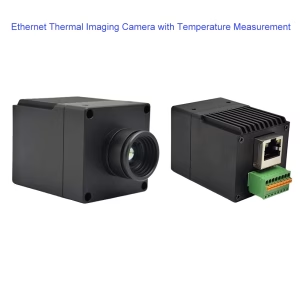

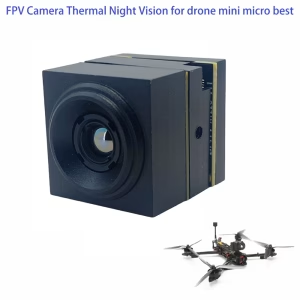

FPV camera
Плата конфігурації параметрів плати послідовного порту для інфрачервоної тепловізійної камери


AI IP-камера
Тепловізійна камера видимого світла, подвійна світлова камера, основний модуль Ethernet, IP-вихід