





Wireless Data Transmission, radio telemetry
Wireless Data Transmission
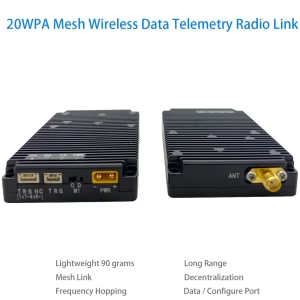
20Émetteur-récepteur de liaison radio de télémétrie de données sans fil WPA Mesh

Wireless Data Transmission
150Émetteur-récepteur de télémétrie de transmission de données sans fil km 200 km sans vidéo

Wireless Data Transmission

Wireless Data Transmission
Radio télémétrie drone télémétrie transmetteur de données sans fil avec antenne rover vcan1889

Wireless Data Transmission
Wireless data links are the backbone of UAV video, télémétrie, et systèmes de contrôle. They determine range, fiabilité, débit, and interoperability with various platforms such as drones, robots au sol, or wearable devices. Wireless links can be classified according to topologie du réseau, power amplification, scénario d'application, and data interface.
1. By Network Topology (Mode réseau)
-
Point à point (P2P)
-
Direct link between two nodes.
-
Advantage: Simple, faible latence, haute fiabilité.
-
Utilisation courante: Drone à la station au sol, remote-controlled vehicles.
-
-
Point à Multipoint (P2MP)
-
One transmitter communicates with multiple receivers.
-
Advantage: Efficient broadcasting to several ground stations or UAVs simultaneously.
-
Utilisation courante: Swarm UAV management, multi-vehicle telemetry.
-
-
Transmission par relais
-
Data is forwarded through one or more intermediate nodes to extend range or bypass obstacles.
-
Advantage: Overcomes line-of-sight limitations, suitable for long-range or urban operations.
-
-
IP Mesh (Auto-organisation, Réseau centré sur les nœuds)
-
Nodes automatically route data between each other without a central server.
-
Advantage: Highly resilient to node failure, flexible for large-scale UAV or robotic networks.
-
Utilisation courante: Multi-UAV collaborative missions, robotic swarms, disaster recovery scenarios.
-
2. By Transmission Power (Intégration PA / Output Wattage)
-
0.5 W Wireless Link
-
Short-range, low-power applications.
-
Advantage: Lower energy consumption, suitable for small drones or indoor use.
-
-
1 W Wireless Link
-
Moderate range, typical for standard UAV-to-ground links.
-
-
10 W Wireless Link
-
Longue portée, high-performance links for professional UAV operations.
-
-
20 W Wireless Link
-
Very long-range applications, can penetrate obstacles and cover several kilometers.
-
Often used in industrial, défense, ou des scénarios d'intervention d'urgence.
-
3. Par scénario d'application
-
UAV Wireless Data Transmission
-
Real-time telemetry, flight control, données du capteur, or video streaming from drones to ground stations.
-
Exigences: Faible latence, anti-interférence, haute fiabilité.
-
-
Ground Robotic Data Transmission (à l'UGV, Robotic Dogs, Mobile Platforms)
-
Télémétrie, sensor fusion, remote control signals for autonomous or semi-autonomous robots.
-
Exigences: Haute fiabilité, long endurance, adaptable to urban or rugged terrain.
-
4. By Data Interface
-
Durée de vie (Transistor-Transistor Logic)
-
Simple UART-based communication, common in microcontrollers and lightweight UAV systems.
-
-
RS232
-
Standard serial interface for industrial or professional equipment.
-
Advantage: Reliable over longer cables and noise-prone environments.
-
-
S.Bus
-
Specialized serial protocol widely used in UAV flight controllers and RC systems.
-
Advantage: Supports multiple channels on a single line for telemetry and control.
-
5. Optional Customization / Fonctionnalités avancées
-
Adjustable Transmission Power
-
Some wireless links allow customers to select PA wattage depending on required range.
-
-
Redundant or Multi-Path Networking
-
For critical missions, links may be configured with relays, mesh nodes, or multiple antennas to improve reliability.
-
-
Modular Interfaces
-
Customers can choose which serial/data interface (Durée de vie, RS232, S.Bus) to integrate depending on UAV or robot system.
-
Résumé
Wireless links for UAVs and robotic systems can be classified along these dimensions:
-
Topologie du réseau: Point à point, Point à Multipoint, Relais, IP Mesh
-
Puissance de transmission / Sortir: 0.5 W, 1 W, 10 W, 20 W
-
Scénario d'application: drone, UGV/robot, wearable systems
-
Interface de données: Durée de vie, RS232, S.Bus
-
Options de personnalisation: Adjustable PA, optional relays/mesh, modular interfaces
This classification helps system designers, UAV integrators, and industrial customers select the right wireless data link for range, fiabilité, débit, and operational scenario.