


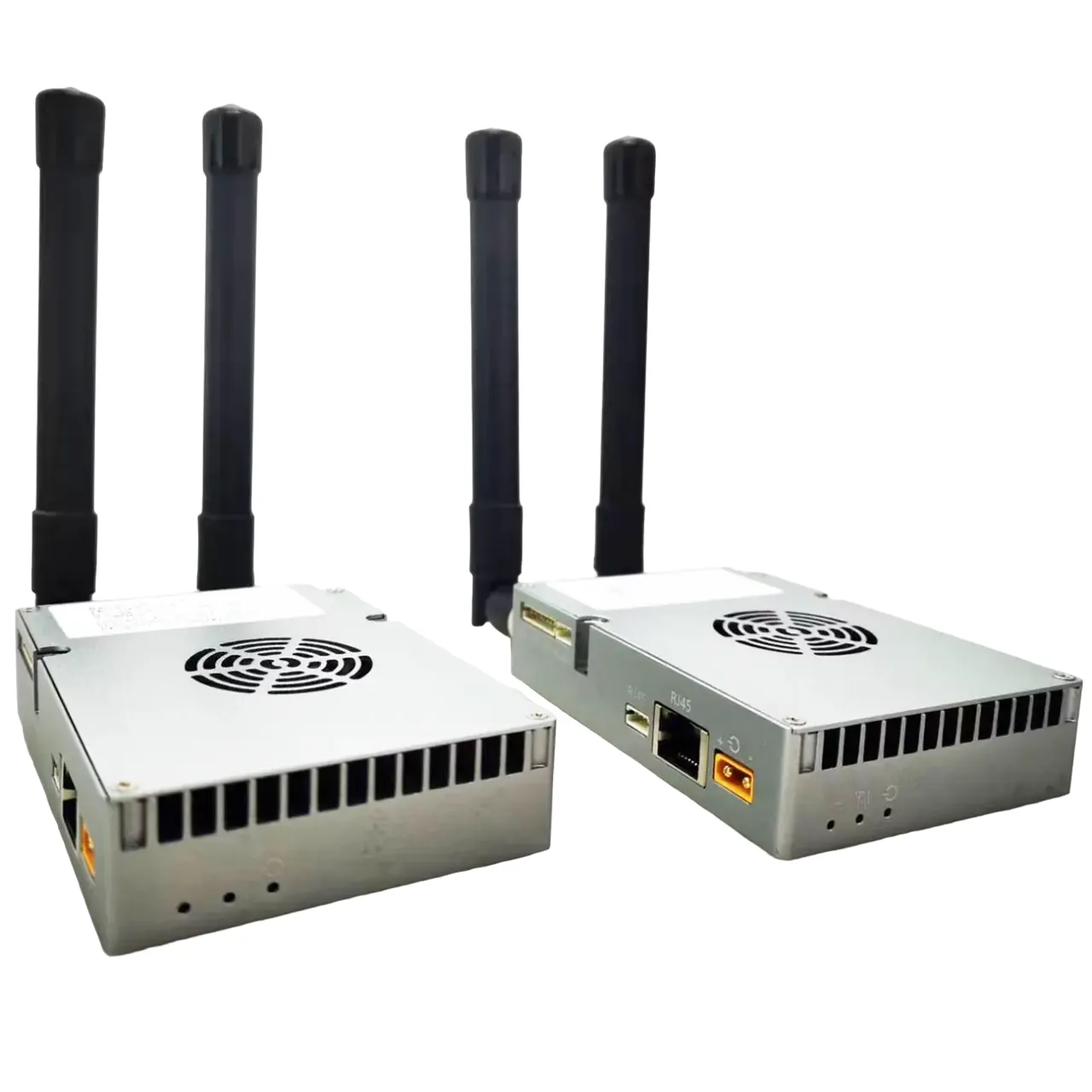
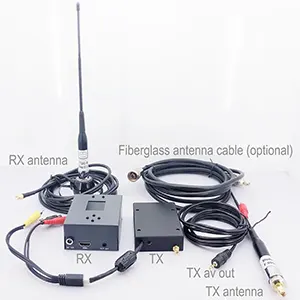


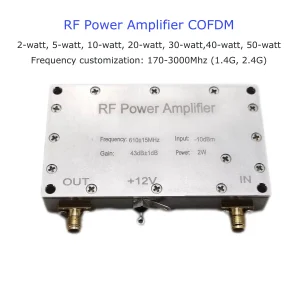
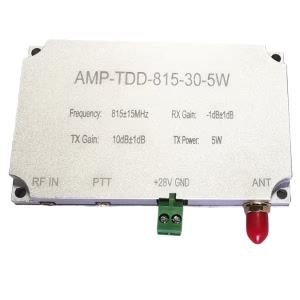
Pag uusap Tungkol sa COFDM PA Power Amplifier
COFDM PA Power Amplifier
Bilang isang propesyonal na supplier ng wireless video at data transceiver, Maraming mga customer ang magtatanong tungkol sa mga amplifier ng kapangyarihan upang madagdagan ang saklaw ng mga wireless transmitters at mapahusay ang lakas ng wireless signal. Ang power amplifier ay masasabing isang balakid na hindi maiiwasan ng maraming RF engineers. Function na, pag-uuri, Index ng Pagganap, circuit komposisyon, kahusayan pagpapabuti teknolohiya, kalakaran sa pag unlad... Alam mo ba ang lahat ng kailangan mong malaman tungkol sa RF power amplifiers? Halika gumawa ng up lessons!
Dalawang pangunahing pagtutukoy para sa RF PAs: kapangyarihan at linearity
Sa RF power amplifiers, kahusayan ng kapangyarihan (PAE) ay tinukoy bilang ang ratio ng pagkakaiba sa pagitan ng output signal power at ang input signal power sa pagkonsumo ng kapangyarihan ng DC power supply, na ang pangalan ay:
PAE = (PRFOUT - PRFIN)/PDC = (PRFOUT - PRFIN)/(VDC*IDC)
Functions of RF Power Amplifier RF PA
Radio Frequency Power Amplifier RF PA is the main part of the transmission system, and its importance is self-evident. In the pre-stage circuit of the transmitter, the RF signal power generated by the modulating oscillator circuit is very small, and it needs to go through a series of amplification-buffer stage, intermediate amplification stage, and final power amplification stage to obtain sufficient RF power before feeding radiate to the antenna. In order to obtain a sufficiently large radio frequency output power, a radio frequency power amplifier must be used. Power amplifiers are often the most expensive, most power-hungry, and least efficient components of a stationary installation or terminal.
After the modulator generates the radio frequency signal, the radio frequency modulated signal is amplified to sufficient power by the RFPA, passed through the matching network, and then emitted by the antenna.
The function of the amplifier is to amplify the input content and output it. The input and output, which we call "mga signal," are often expressed as voltages or power. Para sa isang "sistema ng" such as an amplifier, nito "contribution" is to raise a certain level of what it "absorbs" at "output" to the outside world. Ito "improvement contribution" ay ang "Ibig sabihin" of the existence of the amplifier. If the amplifier can have good performance, then it can contribute more, which reflects its own "halaga ng". If there are certain problems in the initial "mechanism design" of the amplifier, then after starting to work or working for a period of time, not only will it not be able to provide any "contribution", but some unexpected "shocks" may occur. "Pagkabigla" is disastrous to the outside world or to the amplifier itself.
Classification of RF Power Amplifier RF PA
According to different working conditions, power amplifiers are classified as follows:
The operating frequency of RF power amplifiers is very high, but the frequency band is relatively narrow. RF power amplifiers generally use frequency selection networks as load circuits. RF power amplifiers can be divided into three types of working states: A (A), B (B), and C (C) according to the current conduction angle. The conduction angle of the Class A amplifier current is 360°, which is suitable for small signal low power amplification. The conduction angle of the Class B amplifier current is equal to 180°, and the conduction angle of the Class C amplifier current is less than 180°. Both Class B and Class C are suitable for high-power working conditions, and the output power and efficiency of Class C working conditions are the highest among the three working conditions. Most RF power amplifiers work in Class C, but the current waveform of Class C amplifiers is too distorted, so they can only be used to amplify power by using a tuned circuit as a load resonance. Due to the filtering ability of the tuning loop, the loop current and voltage are still close to sinusoidal waveforms with little distortion.
In addition to the above working states classified according to the current conduction angle, there are also Class D (D) amplifiers and Class E (E) amplifiers that make electronic devices work in the switching state. The efficiency of Class D amplifiers is higher than that of Class C amplifiers.
Performance index of radio frequency power amplifier RF PA
The main technical indicators of radio frequency power amplifier RF PA are output power and efficiency. How to improve output power and efficiency is the core of the design goal of radio frequency power amplifier. Usually in the RF power amplifier, the fundamental frequency or a certain harmonic can be selected by the LC resonant circuit to realize undistorted amplification. Sa pangkalahatan, there are probably the following indicators in the evaluation of amplifiers:
- makakuha ng. This is the ratio between input and output and represents the contribution of the amplifier. A good amplifier is to contribute as much "output" as possible within its "range of its own capabilities".
-dalas ng uring. This represents the carrying capacity of the amplifier for different frequency signals.
- Uring bandwidth. This determines how much range the amplifier can "contribute". For a narrow-band amplifier, even if its own design is no problem, its contribution may be limited.
-katatagan. Every transistor has potential "regions of instability." Ang "disenyo ng disenyo" of the amplifier needs to eliminate these potential instabilities. There are two types of amplifier stability, potentially unstable and absolutely stable. The former may appear unstable under certain conditions and environments, while the latter can guarantee stability under any circumstances. The question of stability is important because instability means "oscillation", when the amplifier not only affects itself, but also outputs unstable factors.
- Pinakamataas na output kapangyarihan. This indicator determines the "capacity" of the amplifier. Para sa "big systems", it is hoped that they can output more power at the expense of certain gain.
-kahusayan. Amplifiers must consume a certain amount of "energy" and also achieve a certain amount of "contribution". The ratio of its contribution to consumption is the efficiency of the amplifier. A good amplifier is one that contributes more and consumes less.
- Linear. Linearity characterizes the correct response of the amplifier to a large number of inputs. A deterioration in linearity means that the amplifier "distorts" o "distorts" the input in the presence of excess input. A good amplifier should not exhibit this "freaky" nature.
Circuit Composition of RF Power Amplifier RF PA
There are different types of amplifiers. Pinasigla, the circuit of the amplifier can be composed of the following parts: transistors, bias and stabilization circuits, and input and output matching circuits.
1. Transistor
There are many kinds of transistors, including transistors with various structures that have been invented. Sa esensya ay, a transistor works as a controlled current or voltage source by converting the energy of an empty direct current into a "useful" output. DC energy is obtained from the outside world, and the transistor consumes it and converts it into useful components. A transistor, we can regard it as "a unit". Different "capabilities" of different transistors, such as their ability to withstand power are different, which is also due to their ability to obtain DC energy; halimbawa, their response speed is different, which determines how wide and high it can work In the frequency band; halimbawa, the impedances facing the input and output ports are different, and the external response capabilities are different, na tumutukoy sa hirap ng pagtutugma nito.
2. Bias at pagpapatatag circuit
Ang mga biasing at pagpapatatag ng mga circuit ay dalawang magkaibang circuit, ngunit dahil ang mga ito ay madalas na mahirap makilala at ang mga layunin ng disenyo ay nagsasama, pwede silang pag usapan ng magkasama.
Ang operasyon ng transistor ay kailangang nasa ilalim ng ilang mga kondisyon ng bias, na tinatawag nating static operating point. Ito ang pundasyon ng transistor at sariling "pagpoposisyon". Ang bawat transistor ay may tiyak na pagpoposisyon para sa sarili, at iba't ibang pagpoposisyon ay matukoy ang sarili nitong working mode, at may iba't ibang performances din sa iba't ibang positioning. Ang ilang mga punto ng pagpoposisyon ay may maliit na pag iiba, na angkop para sa maliit na signal work; Ang ilang mga punto ng pagpoposisyon ay may malalaking pag iiba, na angkop para sa mataas na kapangyarihan output; Ang ilang mga puntos sa pagpoposisyon ay may mas kaunting demand, puro release na, at angkop para sa mababang ingay na trabaho; ilang mga punto ng pagpoposisyon, Ang mga transistor ay palaging nag hover sa pagitan ng saturation at cutoff, sa isang lumilipat na estado. Ang isang angkop na bias point ay ang batayan para sa normal na operasyon.
Ang stabilization circuit ay dapat na bago ang pagtutugma ng circuit, dahil kailangan ng transistor ang stabilization circuit bilang bahagi ng sarili nito, at pagkatapos ay nakikipag ugnay sa labas ng mundo. Sa mata ng labas ng mundo, ang transistor na may stabilization circuit ay isang "bagong tatak" transistor. Ito ay gumagawa ng tiyak na "mga sakripisyo" upang magkaroon ng katatagan. Ang mga mekanismo na nagpapatatag ng circuit ay nagpapanatili sa mga transistor na tumatakbo nang maayos at patuloy.
3. Input at output pagtutugma circuit
Ang layunin ng pagtutugma ng circuit ay upang pumili ng isang tinatanggap na mode. Para sa mga transistor na gustong magbigay ng mas maraming pakinabang, ang diskarte ay upang tanggapin at output sa buong board. Nangangahulugan ito na sa pamamagitan ng interface ng pagtutugma ng circuit, ang komunikasyon sa pagitan ng iba't ibang transistor ay mas makinis. Para sa iba't ibang uri ng amplifier, ang matching circuit ay hindi lamang ang paraan ng disenyo na "tinanggap nang buo". Ang ilang mga maliliit na tubo na may maliit na DC at mababaw na pundasyon ay mas handa na gawin ang isang tiyak na halaga ng pag block kapag tumatanggap upang makakuha ng mas mahusay na pagganap ng ingay. Gayunman, ang pagharang ay hindi maaaring labis na gawin, kung hindi ay makakaapekto ito sa kontribusyon nito. Para sa ilang mga higanteng tubo ng kapangyarihan, kailangan mong maging maingat kapag outputting, dahil mas hindi matatag ang mga ito, at sa parehong oras, ang isang tiyak na halaga ng reserbasyon ay tumutulong sa kanila na magsikap nang higit pa "di na baluktot" energy.
Pagsasakatuparan ng katatagan ng RF Power Amplifier RF PA
Ang bawat transistor ay potensyal na hindi matatag. Magandang pagpapatatag circuits ay maaaring fused sa transistors upang bumuo ng isang "tuloy tuloy na trabaho" mode. Ang pagpapatupad ng mga circuit ng pagpapatatag ay maaaring nahahati sa dalawang uri: makitid ang bigkis at malapad ang bigkis.
Ang narrowband stabilization circuit consumes isang tiyak na halaga ng pakinabang. Ang matatag na circuit na ito ay natanto sa pamamagitan ng pagdaragdag ng ilang mga circuit ng pagkonsumo at mga piling circuit. Pinapayagan ng circuit na ito ang transistor na mag ambag lamang ng isang maliit na hanay ng dalas. Ang isa pang broadband stabilization ay ang pagpapakilala ng negatibong feedback. Ang circuit na ito ay maaaring gumana sa isang malawak na hanay.
Ang pinagmulan ng kawalan ng katatagan ay positibong feedback, at ang ideya ng makitid na banda katatagan ay upang pigilin ang ilan sa mga positibong feedback. Oo nga naman, ito rin ang sumusupil sa kontribusyon. Negatibong feedback, tapos na rin, ay may maraming karagdagang mga pakinabang na nagbibigay kasiyahan. Halimbawa, Maaaring pigilan ng negatibong feedback ang mga transistor na maitugma, hindi na kailangang itugma upang interface na rin sa labas ng mundo. Sa karagdagan, ang pagpapakilala ng negatibong feedback ay mapabuti ang linear na pagganap ng transistor.
Pagpapabuti ng Kahusayan Teknolohiya ng RF Power Amplifier RF PA
Ang kahusayan ng transistor ay may teoretikal na limitasyon. Ang limitasyong ito ay nag iiba sa pagpili ng punto ng bias (static na operating point). Sa karagdagan, kung ang peripheral circuit ay hindi mahusay na dinisenyo, ang kahusayan nito ay lubhang mababawasan. Sa kasalukuyan, Walang maraming mga paraan para sa mga inhinyero upang mapabuti ang kahusayan. Dalawa lang ang klase dito: teknolohiya sa pagsubaybay sa sobre at teknolohiya ng Doherty.
Ang kakanyahan ng teknolohiya ng pagsubaybay sa sobre ay upang paghiwalayin ang input sa dalawang uri: phase at sobre, at pagkatapos ay palakasin ang mga ito nang hiwalay sa pamamagitan ng iba't ibang mga circuit ng amplifier. Sa ganitong paraan, ang dalawang amplifier ay maaaring tumuon sa kani kanilang mga bahagi, at ang pakikipagtulungan ng dalawang amplifiers ay maaaring makamit ang layunin ng mas mataas na kahusayan paggamit.
Ang kakanyahan ng teknolohiya ng Doherty ay: gamit ang dalawang transistor na may parehong uri, isa lang ang gumagana kapag maliit ang input, at gumagana sa isang mataas na kahusayan estado. Kung ang input ay nagdaragdag, Ang parehong mga transistor ay gumagana nang sabay sabay. Ang batayan para sa pagsasakatuparan ng pamamaraang ito ay ang dalawang transistor ay dapat makipagtulungan sa bawat isa nang tacitly. Ang nagtatrabaho estado ng isang transistor ay direktang matukoy ang nagtatrabaho kahusayan ng iba pang.
Mga Hamon sa Pagsubok para sa RF PAs
Ang mga amplifier ng kapangyarihan ay napakahalagang mga bahagi sa mga wireless na sistema ng komunikasyon, ngunit ang mga ito ay likas na hindi linear, nagiging sanhi ng spectral paglago phenomena na makagambala sa mga katabing channel, and may violate statutory-mandated out-of-band emission standards. This characteristic can even cause in-band distortion, which increases the bit error rate (BER) and reduces the data transmission rate of the communication system.
Under the peak-to-average power ratio (Papr), the new OFDM transmission format will have more sporadic peak power, making the PA difficult to be segmented. This degrades spectral mask compliance and increases EVM and BER across the waveform. To solve this problem, design engineers usually deliberately reduce the operating power of the PA. Unfortunately, this is a very inefficient approach, since the PA reduces 10% of its operating power and loses 90% of its DC power.
Most of today's RF PAs support multiple modes, dalas ranges, and modulation modes, making more test items available. Thousands of test items are not uncommon. Ang paggamit ng mga bagong teknolohiya tulad ng crest factor reduction (CFR), digital predistortion (DPD) at pagsubaybay sa sobre (ET) maaaring makatulong sa pag optimize ng pagganap ng PA at kahusayan ng kapangyarihan, ngunit ang mga teknolohiyang ito ay gagawin lamang ang pagsubok na mas kumplikado at lubos na pahabain ang oras ng pagsubok. Disenyo at oras ng pagsubok. Ang pagtaas ng bandwidth ng RF PA ay magreresulta sa isang limang beses na pagtaas sa bandwidth na kinakailangan para sa mga sukat ng DPD (posibleng lumampas sa 1 GHz), lalo pang pagtaas ng pagiging kumplikado ng pagsubok.
Ayon sa uso, upang madagdagan ang kahusayan, RF PA mga bahagi at mga module sa harap (FEM) ay mas malapit na isinama, at isang solong FEM ay susuportahan ang isang mas malawak na hanay ng mga frequency band at modulation mode. Ang pagsasama ng isang ET power supply o modulator sa FEM ay maaaring epektibong mabawasan ang pangkalahatang mga kinakailangan sa espasyo sa loob ng mobile device. Ang pagtaas ng bilang ng mga puwang ng filter / duplexer upang suportahan ang isang mas malaking hanay ng dalas ng operating ay magpapataas sa pagiging kumplikado ng mga mobile device at ang bilang ng mga item sa pagsubok.
Mobile Phone RF Module Power Amplifier (PA PA) Sitwasyon sa Market
Ang larangan ng mga amplifier ng kapangyarihan ng mobile phone ay kasalukuyang isang bahagi na hindi maaaring isinama sa mga mobile phone. Pagganap ng mobile phone, bakas ng paa, kalidad ng tawag, lakas ng mobile phone, at buhay ng baterya ay ang lahat ng natutukoy sa pamamagitan ng kapangyarihan amplifier.
Paano isama ang mga power amplifier ng iba't ibang mga frequency band at pamantayan ay isang mahalagang paksa na pinag aaralan ng industriya. Sa kasalukuyan, may dalawang solusyon: isa ang fusion architecture, na integrates RF kapangyarihan amplifiers PA ng iba't ibang mga frequency; ang iba pang arkitektura ay ang pagsasama sa kahabaan ng signal chain, na ang ibig sabihin ay, the PA and the duplexer are integrated. Both schemes have advantages and disadvantages, and are suitable for different mobile phones. Converged architecture, high integration of PA, has obvious size advantage for more than 3 mga frequency band, and obvious cost advantage for 5-7 mga frequency band. The disadvantage is that although the PA is integrated, the duplexer is still quite complicated, and there is switching loss when the PA is integrated, and the performance will be affected. For the latter architecture, the performance is better. The integration of the power amplifier and the duplexer can improve the current characteristics, which can save tens of milliamperes of current, which is equivalent to extending the talk time by 15%. Kaya nga, industry insiders suggest that when there are more than 6 mga frequency band (excluding 2G, referring to 3G and 4G), isang converged architecture ay pinagtibay, at kapag mas mababa sa 4 frequency bands ang ginagamit, PAD, isang solusyon pagsasama ng PA at duplexer, ay ginagamit.
-
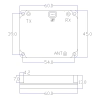 L-Band 2W TDD RF Front-End Module na may PA, LNA & High-Speed T/R Switch (1100–1500 MHz)
Orihinal na presyo ay: $750.00.$350.00Ang kasalukuyang presyo ay: $350.00.
L-Band 2W TDD RF Front-End Module na may PA, LNA & High-Speed T/R Switch (1100–1500 MHz)
Orihinal na presyo ay: $750.00.$350.00Ang kasalukuyang presyo ay: $350.00. -
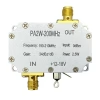 RF Power Amplifier 2 Watts 200MHz transmitter amplifier module
-
 2T2R TDD-1420-1530-2×5W RF Power Amplifier Module
Saklaw ng presyo: $480.00 sa pamamagitan ng $690.00
2T2R TDD-1420-1530-2×5W RF Power Amplifier Module
Saklaw ng presyo: $480.00 sa pamamagitan ng $690.00 -
 TDD 2T2R Power Amplifier Module 1100-1500MHz | 1300M 2W 5W 10W 30W RF PA
Saklaw ng presyo: $466.00 sa pamamagitan ng $998.00
TDD 2T2R Power Amplifier Module 1100-1500MHz | 1300M 2W 5W 10W 30W RF PA
Saklaw ng presyo: $466.00 sa pamamagitan ng $998.00 -
 FDD Radio Frequency Amplifier
Orihinal na presyo ay: $2,500.00.$950.00Ang kasalukuyang presyo ay: $950.00.
FDD Radio Frequency Amplifier
Orihinal na presyo ay: $2,500.00.$950.00Ang kasalukuyang presyo ay: $950.00. -
 20WPA 2.4G 5.8G Power Amplifier Signal Booster Para sa Drone Data Link
Saklaw ng presyo: $169.00 sa pamamagitan ng $269.00
20WPA 2.4G 5.8G Power Amplifier Signal Booster Para sa Drone Data Link
Saklaw ng presyo: $169.00 sa pamamagitan ng $269.00 -
 1WPA 1-Watt Power Amplifier ESCW-4326 MCX SMA RF 12-18V 1300-1400MHz
$192.00
1WPA 1-Watt Power Amplifier ESCW-4326 MCX SMA RF 12-18V 1300-1400MHz
$192.00 -
 TD 10 watts pa power amplifier 1420-1530MHz para sa drone ip mesh transceiver module bda bi-directional amplifier
Saklaw ng presyo: $456.00 sa pamamagitan ng $898.00
TD 10 watts pa power amplifier 1420-1530MHz para sa drone ip mesh transceiver module bda bi-directional amplifier
Saklaw ng presyo: $456.00 sa pamamagitan ng $898.00