





In real-world video surveillance and embedded systems, a CVBS to IP video converter is often more than just an encoder. Many projects require it to act as a control hub, integrating external hardware such as IR illuminators, relays, and UART-controlled devices.

En este artículo, we’ll walk through a real customer inquiry, analyze the technical requirements, and explain how these features can be implemented through custom development.
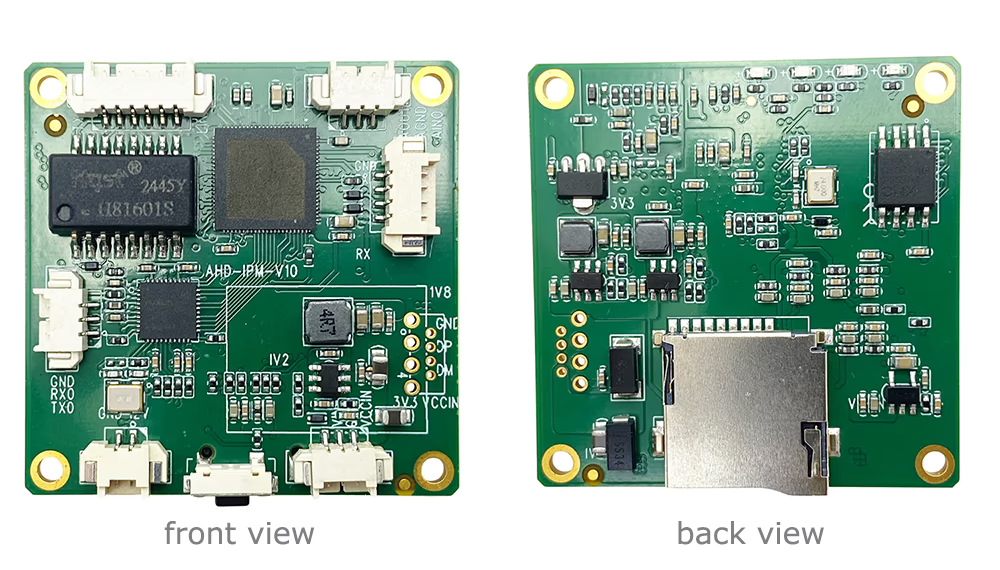
Consulta del cliente (Original Message)
A customer using our CVBS encoder board raised the following questions:
1. Alarm/control output via GPIO:
I would like to use the alarm output (GPIO) to control an external flashlight/IR illuminator. I need to be able to turn it on by sending a command (via any supported interface — HTTP API, MQTT, or other), and have it remain on until I send another command to turn it off. Is this feature supported? Is there any documentation or API reference for remote control of the alarm output?
2. UART-controlled video selector:
I can see that the web interface has a “UART Settings” section with a “UART Test” función. I am planning to connect a UART-controlled video selector to the board. All cameras connected to the selector output video in the same format (CVBS), so the board itself will not need to handle any format switching — UART commands will only change the active input on the selector.
Is it possible to remotely send UART commands to the selector (via HTTP API, MQTT, or any other supported method)? Is there any documentation for this use case?Tabla de contenido
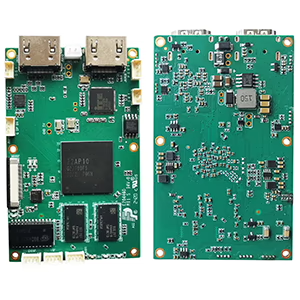
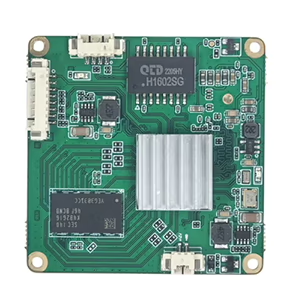
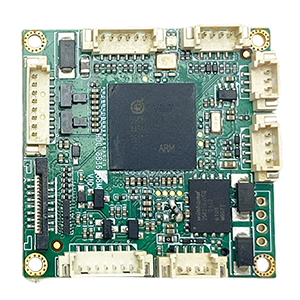
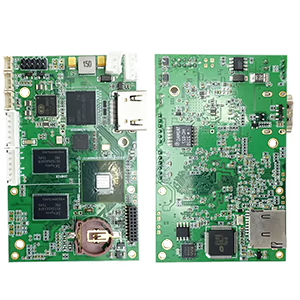
Placas de módulos codificadores
Placas de módulos decodificadores
Disponible para personalización
Nuevos productos de codificador
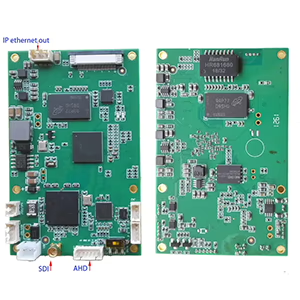
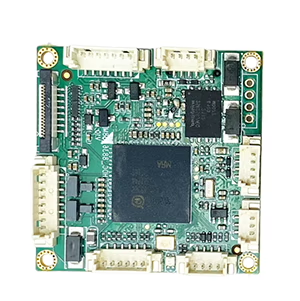
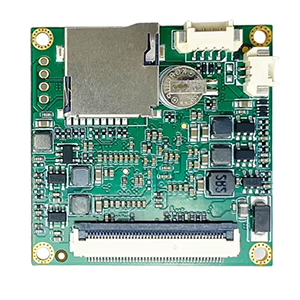
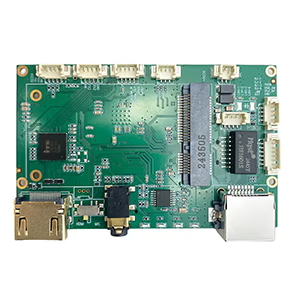
No. Nombre del producto Configuración Características clave Estado 1 Codificador de vídeo de luz visible UVC USB de doble canal 2× entrada USB Admite codificación de video de cámara dual USB, y transmisión RTSP; salida CVBS/HDMI local; switchable display modes Producción en masa 2 Codificador de doble canal (1× Luz visible USB + 1× Cámara de imagen térmica USB) 2× entrada USB Admite cámara dual USB (visible + térmico) captura, codificación, y transmisión RTSP; salida CVBS/HDMI local; switchable display modes Producción en masa 3 Módulo de pantalla HDMI/CVBS decodificador RTSP HDMI + salida CVBS Admite decodificación de flujo RTSP de hasta 4 × 1080P a 30 fps; Admite reenvío de protocolo de transmisión de video; Pantalla de salida HDMI/CVBS Muestra disponible 4 Decodificador RTSP Módulo de pantalla HDMI/CVBS con 4.3"/5" LCD Salida HDMI + pantalla LCD Admite decodificación de flujo RTSP de hasta 4 × 1080P a 30 fps; reenvío de protocolo; Pantalla de salida HDMI/CVBS Debugging 5 Codificador de doble canal (1× Luz visible USB + 1× CVBS analógico) 1× CVBS + 1× Entrada USB UVC vídeo doble (USB + CVBS), codificación y transmisión RTSP; salida CVBS/HDMI local; switchable display modes Debugging 6 Codificador de doble canal (1× USB UVC + 1× AHD analógico) 1× AHD + 1× Entrada USB UVC Captura de vídeo dual (USB + AHD), codificación y transmisión RTSP; salida CVBS/HDMI local; switchable display modes Debugging 7 Codificador de doble canal (1× CVBS + 1× Vídeo analógico AHD) CVBS + AHD 2 entrada de vídeo Captura de vídeo analógica dual, codificación y transmisión RTSP; salida CVBS/HDMI local; switchable display modes Debugging 8 Codificador de doble canal (1× Cámara CMOS + 1× Cámara de imagen térmica USB) 1× interfaz USB Soporta CMOS + Captura de cámara térmica USB, codificación y transmisión RTSP; salida CVBS/HDMI local; switchable display modes Producción en masa Para soluciones personalizadas de conversión de entrada/salida de vídeo que no figuran en nuestros productos, por favor contáctenos para soporte OEM/ODM. We can develop tailored products based on your requirements.
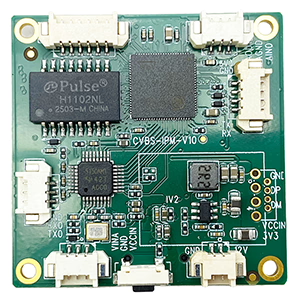
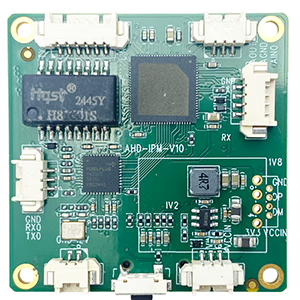
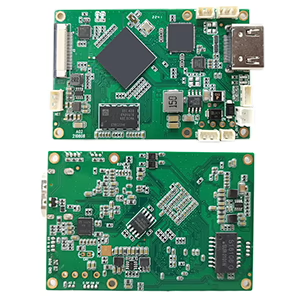
Technical Requirement Analysis
This request goes beyond basic video encoding. The customer is essentially trying to build a network-controlled embedded system with the following capabilities:
1. Remote GPIO Control (Digital Output)
The customer wants:
- Remote ON/OFF control of a GPIO pin
- Control via network interfaces (HTTP, MQTT, etc.)
- Persistent state (not just a trigger pulse)
This means the GPIO must function as a latched digital output, similar to a relay.
Los casos de uso típicos incluyen:
- IR illuminator control
- Alarm devices
- External lighting systems
2. UART over Network (Transmisión transparente)
The second requirement is more advanced.
System architecture:
Multiple Cameras → Video Selector (UART controlled) → CVBS → Encoder → IP Stream
The encoder does not switch video inputs itself. En cambio:
- UN UART-controlled video selector determines which camera is active
- The encoder must forward remote commands to UART
This requires a network-to-UART bridge capacidad.
3. API and Integration Expectations
The customer clearly expects:
- HTTP API or MQTT interface
- Command-based control
- Documentation for integration
This indicates the customer is likely:
- A system integrator
- Developing a scalable or commercial solution
What the Customer Really Needs
Summarizing the request:
- GPIO as a remotely controlled switch
- UART as a remote command channel
- The encoder acting as a control gateway, not just a video device
En otras palabras:
UN CVBS to IP video converter with remote control capabilities
Our Solution
We confirmed with our engineering team that:
✔ GPIO Remote Control
- Supported via custom firmware
- ON/OFF state can be maintained
- Can be controlled via network commands
✔ UART Remote Command Transmission
- Supported via custom firmware
- Remote commands can be sent to UART devices
- Suitable for controlling video selectors or other peripherals
Implementation Approach
To enable these features, nosotros proporcionamos custom firmware development, which includes:
- GPIO control API
- UART data transmission interface
- Protocol definition (HTTP or other)
- Integration documentation
Commercial Terms
Because these features are project-specific, a one-time development effort is required.
- Development Cost: USD X,000
- Refund Policy: Fully refundable when total order reaches 1,000 unidades
This model ensures:
- Fast customization for your project
- Cost efficiency for large-scale deployment
Why Custom Development Matters
Off-the-shelf products often cannot meet advanced integration needs such as:
- Hardware control logic
- Protocol bridging
- System-level automation
Custom firmware allows your encoder to become:
- UN smart edge device
- UN control interface hub
- UN scalable solution for deployment
Conclusión
This case highlights an important trend:
Modern video systems are no longer just about streaming — they are about control, integración, and intelligence.
With the right customization, a CVBS to IP video converter can serve as:
- A video encoder
- A hardware controller
- A communication bridge
Contáctenos
If you have similar requirements for GPIO control, UART integration, or remote device management, feel free to reach out.
We are happy to support your project from concept to mass production.
Preguntas más frecuentes
Q: I need to send binary numbers and control commands in both directions. Can your converter board support this?
UN: Sí, our converter (codificador) board fully supports bidirectional communication of binary data and control commands.
como funciona:
- The board is equipped with a standard serial interface:
Texas (Transmitir), RX (Recibir), and GND (Suelo). - It can be connected to a remote computer via an Ethernet cable (LAN).
- Through this connection, the system enables two-way transmission of serial data, including binary values and control commands.
Requisitos:
- Serial Communication Software
You will need to run a serial communication tool on your computer (P.EJ., a terminal or custom software) to send and receive commands. - IP Address Configuration
- The converter board and the computer must be configured with each other’s IP addresses.
- Proper network setup ensures reliable communication between both devices.
Características clave:
- Supports dúplex completo (bidireccional) comunicación
- compatible con binary data and command-based protocols
- Easy integration with existing serial systems
- Remote communication over standard network infrastructure
Casos de uso típicos:
- Remote device control
- Sistemas de automatización industrial
- Data acquisition and monitoring
- Embedded system communication
Q: Why is the board receiving data but TCP communication is not working correctly?
UN: Please check your TCP Server IP setting. The browser address (Por ejemplo, 192.168.1.188) is the encoder board’s IP address, but the TCP Server IP should be your computer’s IP address instead. Using the same IP for both may cause communication failure or IP conflicts.

Haz una pregunta
Gracias por tu respuesta. ✨