





Mục lục
Sự khác biệt là gì và bạn thực sự cần cái nào?
When customers inquire about our CVBS video products—such as the CVBS AV Video to Ethernet/IP Video Stream Converter Board—one of the most common questions we receive is:
“Is your system using scrambling or encryption? What algorithm does it use?”
This is an excellent question. Tuy nhiên, the terms scrambling và mã hóa are often confused, especially in analog video systems.
In this FAQ article, we’ll explain the difference in clear, simple language so you can determine which solution best fits your project.


máy ảnh FPV
Mô-đun mã hóa xáo trộn video FPV Bộ phát mô-đun mã hóa xáo trộn TX Bộ thu mô-đun giải mã giải mã RX
1️⃣ What Is Video Scrambling?
Scrambling is a method of intentionally altering a video signal so that it becomes unwatchable unless it passes through a matching descrambler.
In analog CVBS systems, scrambling is typically implemented at the hardware signal level.
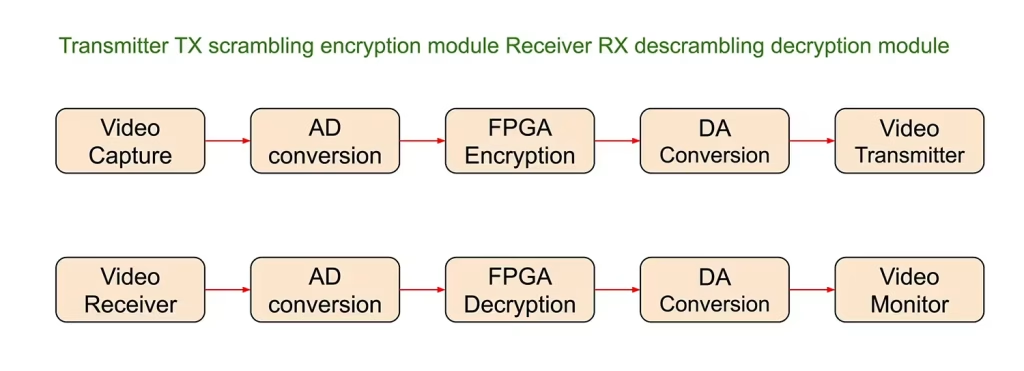
Nó hoạt động như thế nào
- The original CVBS video signal is modified.
- Sync timing, phase, or signal structure may be adjusted.
- Without the correct matching descrambler, the video appears:
- Rolling
- Distorted
- Noisy
- Completely unreadable
When the signal reaches the paired descrambler unit, the video is restored to normal.
Key Characteristics of Scrambling
✔ Hardware-based signal protection
✔ Works directly with analog CVBS
✔ Requires matched encoder/decoder pair
✔ Prevents casual or unauthorized viewing
❌ Not cryptographic security
❌ Not based on AES, CỦA, or other digital algorithms
Scrambling is commonly used in:
- RF video transmission
- Analog wireless links
- CCTV systems
- Commercial monitoring applications
Nó cung cấp practical access control, not military-grade security.

2️⃣ What Is Video Encryption?
Mã hóa, mặt khác, is a mathematical process applied to digital data.
Instead of altering signal timing or structure, encryption converts video data into coded digital information using an algorithm and a key.
Common examples include:
- AES (Tiêu chuẩn mã hóa nâng cao)
- CỦA
- IP-level TLS encryption
Nó hoạt động như thế nào
- The video is digitized.
- A cryptographic algorithm encrypts the data.
- Only receivers with the correct decryption key can restore it.
Key Characteristics of Encryption
✔ Algorithm-based security
✔ Uses cryptographic keys
✔ Suitable for internet/IP transmission
✔ High-level data protection
❌ Requires digital video format
❌ Cannot be directly applied to raw analog CVBS
Encryption is used in:
- Internet video streaming
- Secure IP camera systems
- Banking, government, và hệ thống quân sự
- Cloud-based monitoring
3️⃣ Why CVBS Systems Typically Use Scrambling (Not Encryption)
CVBS is an analog video format.
Encryption works on digital data.
If you want to encrypt a CVBS signal, the workflow must be:
CVBS → Digitize → Compress → Encrypt → Transmit → Decrypt → Decode → Display
This increases:
- System complexity
- Processing delay
- Trị giá
For many analog transmission applications, scrambling provides sufficient protection while keeping:
- Độ trễ thấp
- Low cost
- Simple hardware design
That is why products like the CVBS AV Video to Ethernet/IP Video Stream Converter Board use a proprietary scrambling method, not AES encryption.
4️⃣ Scrambling vs Encryption – Quick Comparison
| Tính năng | Scrambling | Mã hóa |
|---|---|---|
| Loại tín hiệu | Tương tự | Điện tử |
| Security Level | Basic protection | High cryptographic security |
| Requires Key? | No digital key | Vâng |
| Độ trễ | Rất thấp | Cao hơn (processing required) |
| Trị giá | Thấp hơn | Cao hơn |
| Suitable for Internet? | KHÔNG | Vâng |
5️⃣ Which One Do You Need?
Choose Scrambling If:
- You are transmitting analog CVBS.
- You want to prevent casual interception.
- You need low latency.
- You are working with RF or wired analog links.
Choose Encryption If:
- You are transmitting over the internet.
- You require strong cryptographic protection.
- You are handling sensitive or regulated data.
- You are using digital/IP video systems.
suy nghĩ cuối cùng
Scrambling and encryption serve different purposes.
- Scrambling protects analog signals from unauthorized viewing.
- Mã hóa protects digital data using mathematical algorithms and keys.
They are not the same, and neither is “better” in all cases—it depends entirely on your application.
If you are unsure which solution is appropriate for your project, feel free to contact us with your transmission method and security requirements. We are happy to recommend the most suitable solution.
Đặt một câu hỏi
Tin nhắn của bạn đã được gửi