





Jakiś Konwerter analogowo-IP do kamer is a device that transforms analog video signals from traditional cameras (np., CCTV, analog security cameras) into digital IP (Protokół internetowy) data streams. This enables analog cameras to integrate with modern IP-based surveillance systems, allowing video transmission over Ethernet or wireless networks for remote monitoring, składowanie, and analysis. Below is a detailed breakdown of its functionality and components:
1. Core Functionality
- Analog-to-Digital Conversion (ADC): Converts analog video signals (np., NTSC/PAL formats) into digital data. This involves sampling the analog signal at a specific resolution (np., 8-bit to 24-bit) and encoding it into a digital format like H.264 or H.265.
- IP Encapsulation: Packages the digitized video into IP packets for transmission over networks using protocols such as RTSP (Protokół przesyłania strumieniowego w czasie rzeczywistym) or ONVIF (Open Network Video Interface Forum).
2. Kluczowe komponenty
- ADC Module: Utilizes high-resolution ADCs (np., 24-fragment) to ensure minimal quantization errors during signal conversion, critical for maintaining video quality.
- Encoder/Compression Engine: Compresses the digital video to reduce bandwidth usage. Na przykład, Sigma-Delta ADCs or oversampling techniques may be employed to enhance signal accuracy before compression.
- Interfejs sieciowy: Supports Ethernet, Wi-Fi, or PoE (Zasilanie przez Ethernet) for seamless integration into IP networks. Some devices include protocols like Modbus or RS-485 for industrial applications.
3. Aplikacje
- Surveillance System Upgrades: Allows legacy analog cameras to function in modern IP-based security systems without replacing existing hardware.
- Zdalne monitorowanie: Enables real-time video streaming to cloud platforms or centralized management software via IP networks.
- Industrial Imaging: Used in scenarios like digital X-ray systems or sensor networks where analog signals from imaging devices require digitization.
4. Względy techniczne
- Resolution and Frame Rate: Higher bitwidth ADCs (np., 16-bit or 24-bit) improve dynamic range, essential for low-light or high-contrast video.
- Opóźnienie i przepustowość: Techniques like oversampling and digital filtering (np., Sigma-Delta modulation) reduce noise and aliasing, ensuring smooth video playback.
- Zarządzanie energią: Integrated ADCs in microcontrollers (MCUs) can operate in low-power modes, ideal for battery-powered or IoT-enabled devices.
5. Example Devices
- Industrial ADCs: Products like the EV12AQ600 (quad-core ADC) lub AS5850B (16-bit charge-to-digital converter) highlight high-speed, multi-channel capabilities suitable for video processing.
- Embedded Solutions: Microchip’s PIC/AVR MCUs with on-chip ADCs simplify integration for cost-effective camera systems.
Wyzwania
- Signal Integrity: Analog signals are prone to noise during transmission, necessitating robust shielding and error-correction algorithms.
- Zgodność: Ensuring interoperability with diverse IP protocols and legacy camera formats requires adaptive firmware.
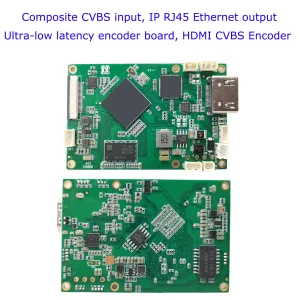
CVBS HDMI do enkodera IP
$399.00

Zakres cen: $118.00 Poprzez $178.00
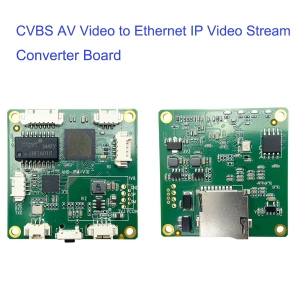
CVBS HDMI do enkodera IP
Zakres cen: $98.00 Poprzez $158.00

Oryginalna cena była: $199.00.$98.00Obecna cena to: $98.00.