

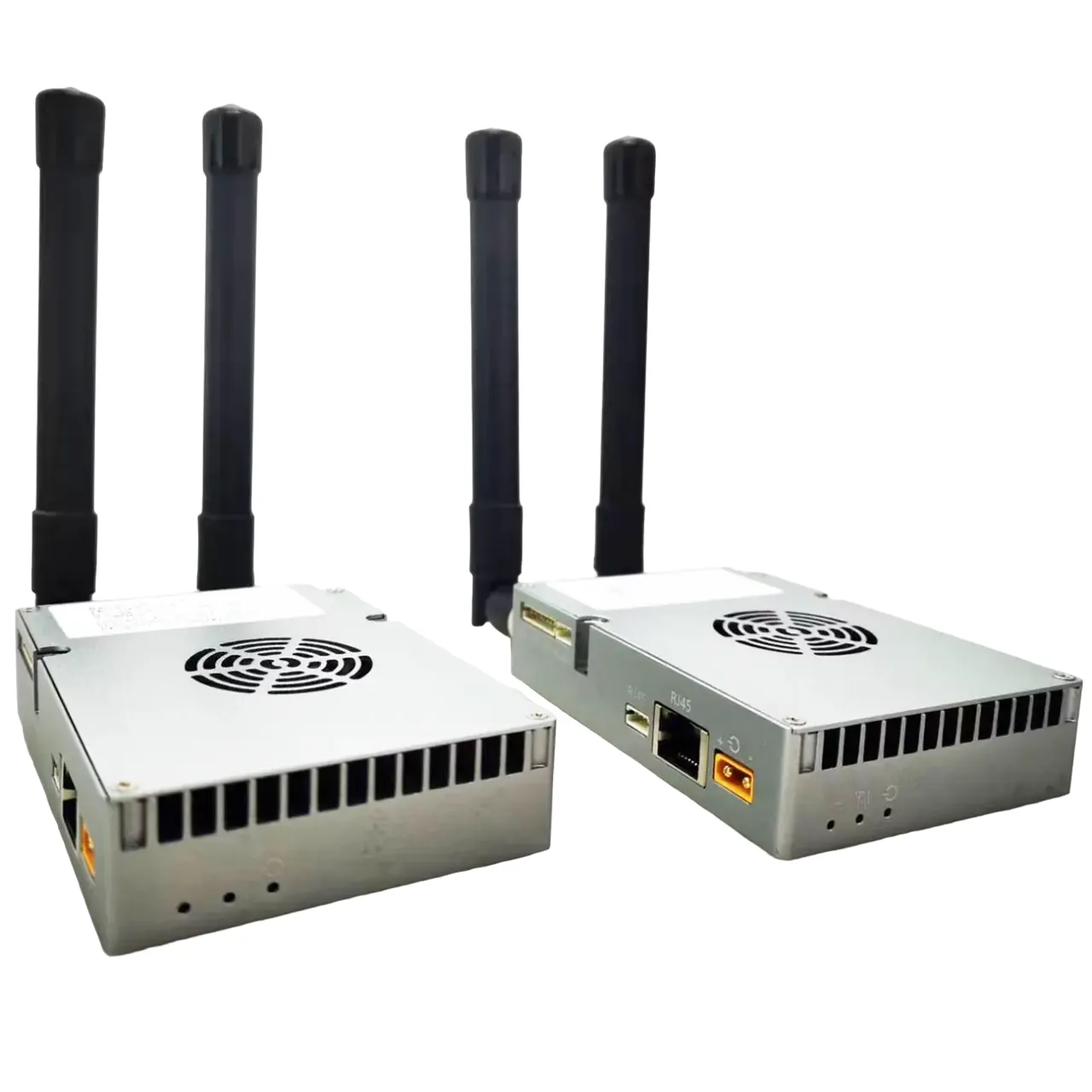
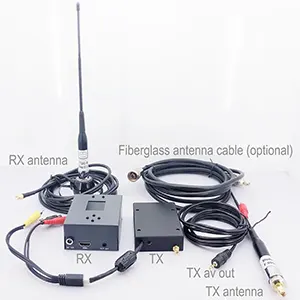


Here is a client’s demand for L S band 100Mbps 200km 2x20WPA drone video data transceiver.
Requirment:
L and S band
2x20w PA
2 input LAN (RJ45)
1 RS232 input (bidirezionale)
Airborne design
Datarate: 100 Mbit/s
Max Range: 200km
drone has 8pc IP-Cameras Video + data Type with UDP protocol.
This information is all entered into one network switch.
If we want to get this information inside the Ground control station, che è 150 km away, what would you suggest?
Drone Transmitter Side:
- Telecamera IP (2M pixel)
- Telecamera IP (2M pixel)
- Telecamera IP (2M pixel)
- Telecamera IP (2M pixel)
- Telecamera IP (2M pixel)
- Telecamera IP (2M pixel)
- Telecamera IP (2M pixel)
- Telecamera IP (2M pixel)
- UDP Data (10KB)
- UDP Data = 4Mbps
- Network switch
- Allineare: 100~150 km
GCS Side: Stazione di controllo a terra
- 2 Hdmi Monitor for Video
- 1 Computer For Data
- We want to connect to Aviation ip cameras.
- And also PING all aviation Ip address
Attualmente, the one that can basically meet customer needs is Vcan1806-100Mbps-2x10WPA.
Table of Contents
FAQ
Q1: Whether a directional antenna is required for optimal signal reception. or omni antenna?
A1: It is better to use one fiberglass omnidirectional antenna and one antenna direzionale a pannello piatto.

1. Frequency Band Requirements
- Banda L & S-band Support
- Dual-band operation is required, likely for satellite communications, radar, or airborne datalinks.
- Clarify specific frequency ranges (per esempio., Banda L: 1–2GHz, S-band: 2–4GHz) and ensure coexistence mechanisms (per esempio., filters/duplexers) to prevent inter-band interference.
2. Amplificatore di potenza (PA) Specifications
- 2×20W RF Output
- Dual-channel architecture with independent 20W amplification per channel, enabling redundancy or simultaneous dual-band transmission.
- Critical considerations: Thermal management (for airborne environments), PA efficiency optimization (per esempio., GaN technology), and EMI/EMC compliance.
3. Interface Configuration
- Network Interfaces
- 2× RJ45 ports: Support 100 Mbps Ethernet throughput; verify protocol compatibility (per esempio., TCP/IP, VLAN tagging if needed).
- Comunicazione seriale
- 1× bidirectional RS232 port: Ensure full-duplex operation for control commands or low-rate data transmission.
4. Performance Metrics
- Velocità dati: 100 Mbit/s
- Requires high-efficiency modulation (per esempio., 256-QAM, OFDM) and sufficient RF channel bandwidth.
- Max Range: 200 km
- Perform detailed link budget analysis: Account for Tx power (20Nella PA), guadagno dell'antenna, receiver sensitivity, free-space path loss, and atmospheric/terrain attenuation (critical for L/S-band over 200 km).
5. Airborne Design Constraints
- Environmental Compliance
- Meet DO-160 standards for vibration, shock, temperatura (-40°C fino a +70°C), and EMI/EMC.
- Physical Integration
- Compatto, lightweight design compliant with aviation form factors (per esempio., ARINC 600). Prioritize heat dissipation and power efficiency.
6. Key Challenges & Open Questions
- Application Context
- Clarify use case (militare, commercial UAV, or manned aircraft). Are encryption or anti-jamming capabilities required?
- Certificazione
- Confirm regulatory needs: FAA/EASA certifications (per esempio., DO-254/178C) or military standards (per esempio., MIL-STD-810).
- Integrazione
- Define interface compatibility (per esempio., ARINC 429, MIL-STD-1553) with existing avionics systems.
- Antenna Design
- Specify antenna type (directional vs. omnidirezionale) and mounting constraints.
Technical Recommendations
- RF Link Optimization
- Use adaptive modulation (AMC) and forward error correction (FEC) to balance data rate and range.
- Thermal Management
- Implement GaN-based PAs for high efficiency and integrate active cooling (per esempio., liquid cooling or forced airflow).
- Ridondanza & Affidabilità
- Design dual-channel redundancy for mission-critical airborne operations.
- Prototyping & Test
- Conduct field trials to validate 200 km range under real-world conditions (per esempio., altitudine, interferenza).
Riepilogo
The customer requires a dual-band, high-power airborne communication system optimized for long-range (200 km), ad alta velocità (100 Mbit/s) trasmissione dei dati. Success hinges on balancing thermal performance, peso, and RF efficiency while meeting stringent aviation standards. A phased approach—starting with detailed link budget modeling and prototype testing—is recommended to mitigate risks.
Ask A Question
Grazie per la risposta. ✨