









Inalámbrica de transmisión de vídeo
300-500Transceptor Mhz COFDM IP RJ45 con antena con filtro PA de 10W

Inalámbrica de transmisión de vídeo
Transmisor y receptor de vídeo inalámbrico FPV 175Mhz COFDM Digital VTX VRX
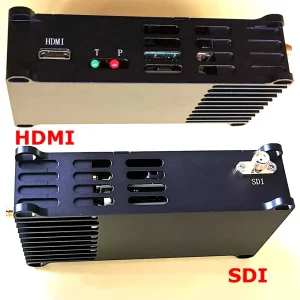
COFDM
2.5WPA 830-845-860MHz COFDM Video Transmitter-Receiver French bicycle competitions live sports
Transmisión robótica


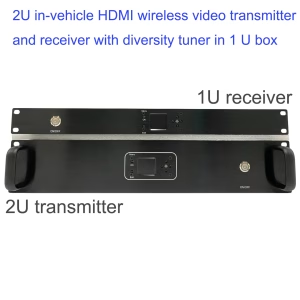
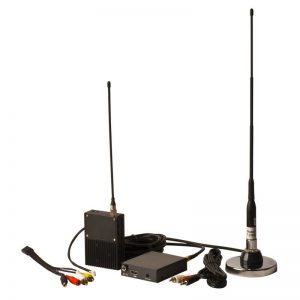
transmisor de vídeo

COFDM
10Transmisión de largo alcance del transmisor de video inalámbrico HDMI-AV de W-20 vatios COFDM

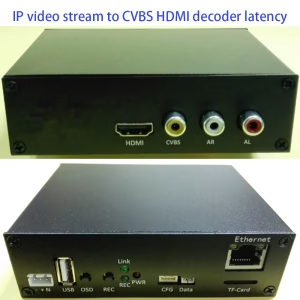
CVBS HDMI al codificador IP
Transmisión unidireccional de vídeo o datos COFDM para transmisor y receptor de protocolo UDP

COFDM Classification in Wireless Transmission
COFDM (Multiplexación por división de frecuencia ortogonal codificada) is one of the most reliable transmission technologies for UAVs, unmanned vehicles, and wearable systems. Its strong anti-multipath capability, support for NLOS (sin línea de visión) transmisión, and adaptability across wide frequency ranges make it a cornerstone in wireless video, audio, and data links.
In UAV wireless transmission, COFDM systems can be classified according to several standards:
1. By Device Type
-
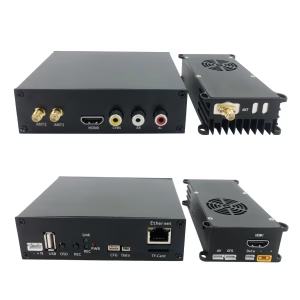
COFDM Transmitters
-
Devices dedicated to sending video, audio, and data streams.
-
Typical use: UAV airborne modules, body-worn transmitters, vehicle-mounted transmitters.
-
-
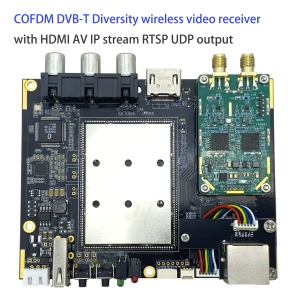
COFDM Receivers
-
Devices for decoding and outputting signals (HDMI, CVBS, IP, or recording).
-
Common in ground stations, mobile command centers, or monitoring systems.
-
-
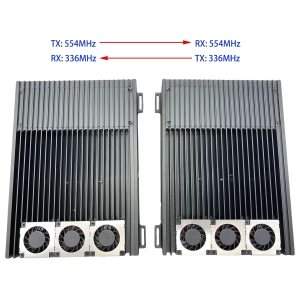
COFDM Transceivers
-
Proporcionar bidirectional communication: enlace descendente de vídeo + telemetry or control uplink.
-
Essential for advanced UAV applications requiring integrated command and monitoring.
- The uplink and downlink can be set to different operating frequencies.
-
2. By Transmission Direction
-
Unidirectional COFDM
-
One-way transmission, P.EJ., video from UAV to ground.
-
Lower complexity and cost, often used for FPV video or broadcast.
-
-
Bidirectional COFDM
-
Two-way link supporting both enlace descendente de vídeo y telemetry/control uplink.
-
Enables full integration of video, flight data, and control feedback in one system.
-
-
Unidirectional Video and Bidirectional Data
-
One-way video transmission and two-way data transmission, mainly used for ground robots and remote control vehicles.
-
-
COFDM Relay / Repeater between Transmitter and Receiver
-
A COFDM relay receives, amplifies, and retransmits the signal between the transmitter and receiver to enhance its strength and coverage.
-
3. By Transmission Content
-
COFDM Video Transmitters
-
Focused on sending live video from UAV cameras.
-
-
COFDM Video + Telemetry Data Transmitters
-
Combine vídeo en tiempo real con GPS, sensor, and flight control data.
-
Common in surveillance drones, inspection UAVs, and defense applications.
-
-
COFDM Audio Transmitters
-
Designed for voice communication or audio-only streams.
-
Can be used standalone or in parallel with video systems.
-
4. By Signal Input Interface
-
HDMI Input COFDM Transmitters
-
Connect directly to HD/4K cameras with HDMI output.
-
-
SDI Input COFDM Transmitters
-
Professional-grade, supporting HD-SDI/3G-SDI cameras for broadcast and cinema drones.
-
-
CVBS Input COFDM Transmitters
-
Legacy analog video interface (DE).
-
Used in cost-sensitive or backward-compatible UAV systems.
-
-
AHD Input COFDM Transmitters
-
Compatible with Analog High Definition cameras (720p/1080p).
-
Often used in security and industrial UAV setups.
-
-
Red (IP) Input COFDM Transmitters
-
Accept IP streams from network cameras or encoders.
-
Flexible for UAVs carrying thermal imagers, AI vision modules, or IP PTZ cameras.
-
-
Audio Input COFDM Transmitters
-
Dedicated for microphone/line-in sources for real-time voice communication.
-
5. By Frequency Band
-
Low-to-Mid Band COFDM (170–860MHz)
-
Strong penetration and long-distance coverage.
-
Useful for NLOS UAV operations in urban or forest environments.
-
-
High Band COFDM (860 MHz–6 GHz)
-
Higher bandwidth for HD/4K video.
-
Requires frequency down-converters for cofdm video receiver.
-
Common ranges: 1.2 GHz, 2.4 GHz, 3.3GHz, 5.8 GHz.
-
6. By Form Factor / Housing
-
Mount Metal box – CNC customize, 1U or 2U chassis for ground stations or integrated command centers.
-
Module-Only – customers provide their own enclosure, Pensilvania, and cooling solutions.
7. Customization Options
- Pensilvania (Amplificador de poder) – built-in or external
- How many watts of amplifier – 1-watts, 2-vatios, 5-vatios, 10-vatios, 20-vatios, 50-vatios
-
Filtrar – low-pass, band-pass, or custom filters; can be applied to transmitters, receivers, or both.
- Enclosure Type – 1U, 2U rack, or custom housings for UAV/vehicle/wearable integration
8. By Deployment Platform
-
UAV-Mounted COFDM Transmitters
-
Compacto, ligero, optimized for airborne use.
-
Características clave: bajo consumo de energía, vibration resistance, efficient cooling.
-
-
UGV-Mounted COFDM Transmitters
-
Installed on unmanned ground vehicles or robots.
-
Focus on long endurance and high-penetration communication.
-
-
Body-Worn COFDM Transmitters
-
Designed for soldiers, journalists, or rescue teams.
-
Provide live video/audio streaming while being mobile.
-
Resumen
COFDM in UAV wireless transmission can be classified by:
-
Device type (transmisor, receptor, transceiver),
-
Directionality (one-way vs. bidireccional),
-
Transmission content (video only, vídeo + telemetria, audio only),
-
Input type (HDMI, IDE, CVBS, AHD, IP, audio),
-
Banda de frecuencia (170–860 MHz vs. 860 MHz–6 GHz),
-
Customization Options ( Amplificador de poder, Filtrar, Enclose Type),
-
Deployment platform (UAV, UGV, body-worn).
This layered classification makes COFDM highly adaptable across industries: UAV aerial surveillance, transmisión, defensa, respuesta de emergencia, robótica, and wearable communication systems.