





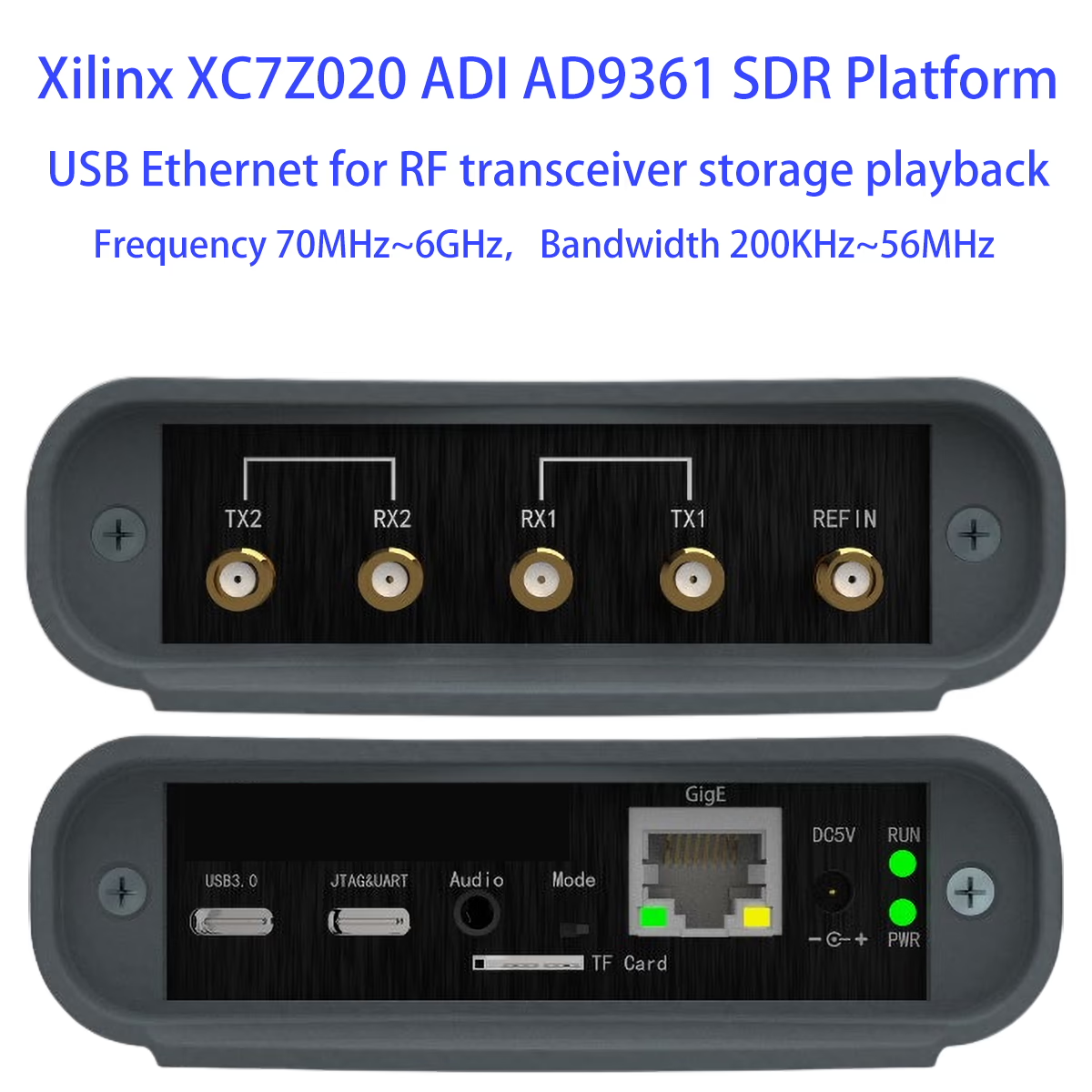
Xilinx XC7Z020 ADI AD9361 SDR Platform USB Ethernet for RF transceiver storage playback 70MHz~6GHz 200KHz~56MHz
Mục lục
Mô tả sản phẩm
This versatile software-defined radio (SDR) platform is built on the Xilinx XC7Z020 SoC and integrates the ADI AD9361 wideband RF transceiver, making it ideal for wireless communication research, tạo mẫu, and academic teaching. It covers a broad frequency range from 70 MHz đến 6 GHz with an adjustable analog bandwidth between 200 kHz and 56 MHz, enabling support for a wide variety of communication standards and custom signal designs.
The platform is fully compatible with MATLAB, Simulink, and Xilinx Vivado, allowing rapid design, simulation, and hardware implementation of communication systems. It can operate as a flexible RF front end for signal acquisition, kho, phát lại, and transceiver applications. Data exchange with a host computer is supported via high-speed USB 3.0 and Gigabit Ethernet interfaces, while the embedded ARM processing system also allows standalone operation as a fully independent SDR solution.
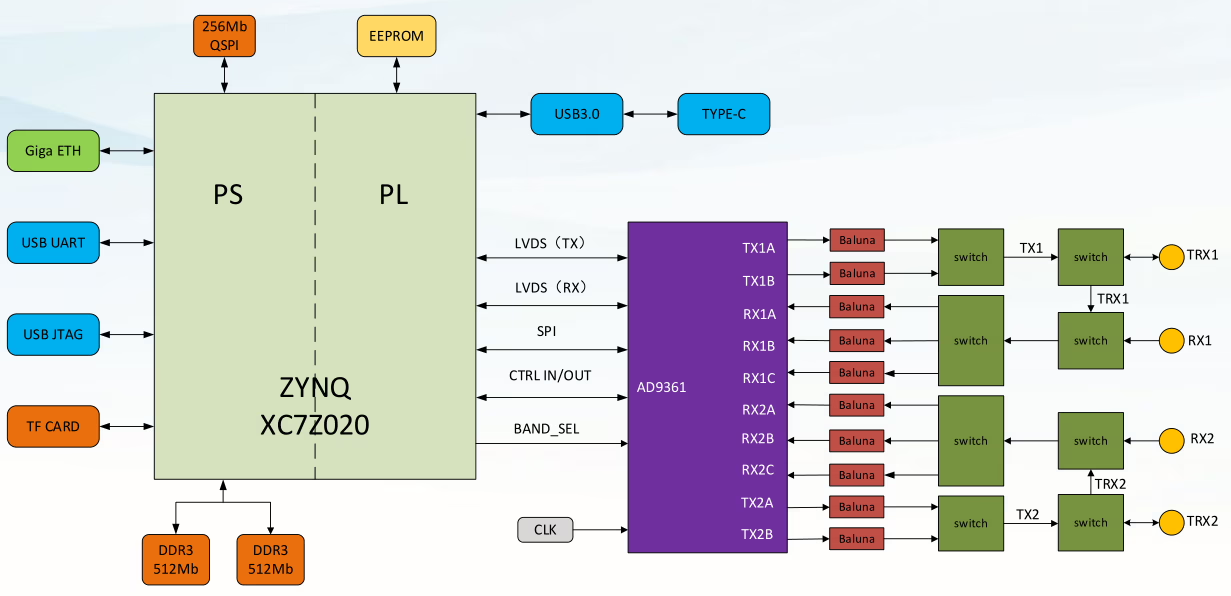
System Block Diagram
Indicator characteristics
| SOC main processor: XC7Z020-2CLG484I | RFIC processor: AD9361BBCZ |
| kênh RF: 2 receive and 2 truyền tải | Signal bandwidth: 200KHz~56MHz |
| Supported frequency band: 70MHz~6GHz | Transmitting frequency error: ±1ppm |
| Truyền tải điện:
TX1 power @6GHz @TX Gain 0dB : -0.3dBm TX2 power @6GHz @TX Gain 0dB : -0.2dBm |
LO leakage:
TX1&TX2 @6GHz attenuation 20dB: -50 dBm RX1&RX2 @6GHz : -60dBFs |
| Sự cách ly:
TX1&RX1 @6GHz @TX/RX Gain 0dB : -60dB TX1&RX2 @6GHz@TX/RX Gain 0dB : -58dB |
Từ chối hình ảnh:
TX1&TX2 @6GHz : -45dB RX1&RX2 @6GHz : -45dB |
| High-speed ADC: 12-chút, kênh đôi, 122.88MSPS | High-speed DAC: 12-chút, kênh đôi, 122.88MSPS |
| Clock stability: ±0.1ppm | Transmit EVM: <2% |
| Giao diện dữ liệu:
USB3.0, thẻ TF, Gigabit Ethernet, UART, JTAG, Âm thanh |
Storage Space:
PS side DDR 1GB, 256Mb Flash, EEPROM 2Kb |
| Synchronous interface: supports reference clock input | Tiêu thụ điện năng: <15W |
| Nguồn điện: DC 5V or USB3.0 | Kích cỡ: 140mm * 100mm * 40mm |
| Nhiệt độ làm việc: -40℃~60℃ | Working humidity: 2% ĐẾN 95% (25°C), không ngưng tụ |
Tính năng
| project | Functional Description | |
| Số lượng kênh | 2-channel receiving, 2-channel sending, support multi-channel phase synchronization function | |
| Chế độ làm việc | FDD/TDD mode | |
| Communication bandwidth | 200kHz ~ 56MHz | |
| Local oscillator configuration frequency range | 70M-6GHz | |
| External Reference | Support external reference clock input | |
| Giành quyền kiểm soát | Supports AGC and MGC
RX gain control range: 0dB ~ 71dB, step 1dB TX attenuation control range: 0dB ~ -89.75dB, step 0.25dB |
|
| Signal acquisition | Hỗ trợ 1-2 arbitrary channel data collection and upload, with SDR Studio software | |
| Receive sampling rate | Support dynamic sampling rate configuration
Phạm vi: 208.33kHz ~ 61.44MHz, 1Hz step |
|
| Playback sampling rate | Support dynamic sampling rate configuration
Phạm vi: 208.33kHz ~ 61.44MHz, 1Hz step |
|
| Signal playback | Hỗ trợ 1-2 arbitrary channel data playback, with SDR Studio software | |
| Signal Source | Supports single-tone, multi-tone, LÀ, FM, BPSK, QPSK, QAM and other signal transmission, and requires our DR VSG software | |
| Spectrum Analysis | Supports simple spectrum analysis display, compatible with SDR Studio software | |
| Data storage | Hỗ trợ 1-2 channel data acquisition and storage, with SDR Studio software | |
| Communication Simulation | Supports Matlab communication simulation, with single-tone and typical waveform transmission and reception cases | |
| Cổng Gigabit Ethernet | One 10/100/1000Mbps adaptive Ethernet interface | |
| USB | One USB3.0 interface | |
Lợi thế
Support Matlab & Simulink for wireless system simulation
MATLAB is a programming environment for algorithm development, data analysis, visualization, and numerical computation. Using MATLAB, technical computing problems can be solved faster than with traditional programming languages such as C, C++, and Fortran. Simulink is a platform for multi-domain modeling and design of dynamic systems. It provides an interactive graphical environment and a library of customizable blocks that can be extended for specific applications. It can be used to design, simulate, implement, and test a variety of time-varying systems, including communications, điều khiển, xử lý tín hiệu, xử lý video, and image processing. MATLAB and Simulink can be connected to this SDR platform product via a USB 3.0 giao diện, providing a radio circuit design and simulation environment. With the support package (Communications System Toolbox and USRP radio), MATLAB and Simulink can be used to design and verify real-world SDR systems.
Daily low-cost vector signal generator use
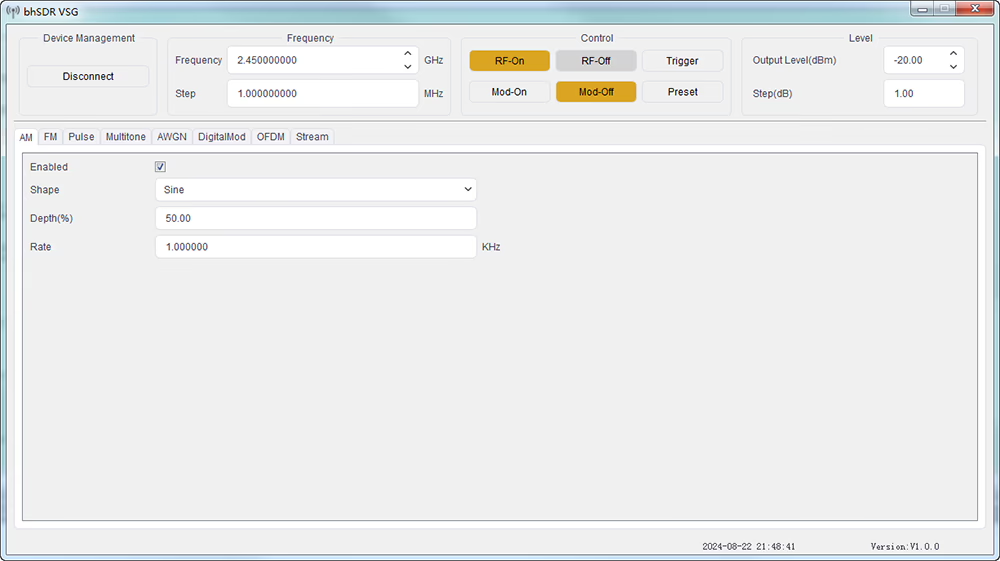
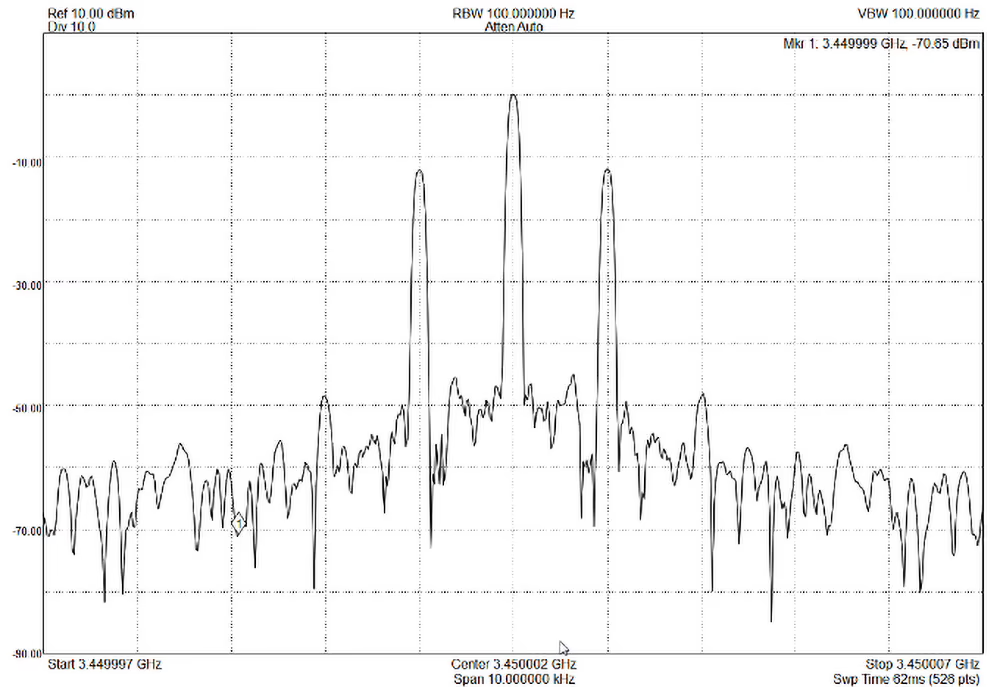
It provides a portable vector signal source function based on software radio technology. It can generate single-tone signals and modulated signals, bao gồm: LÀ, FM, Pulse, Multi Tone, AWGN, điều chế kỹ thuật số (BPSK, QPSK, QAM16, QAM64), OFDM and other programmable modulation methods.
Support RF data collection and playback
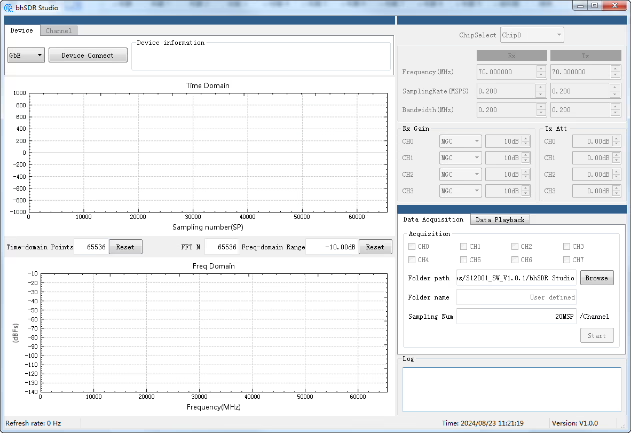
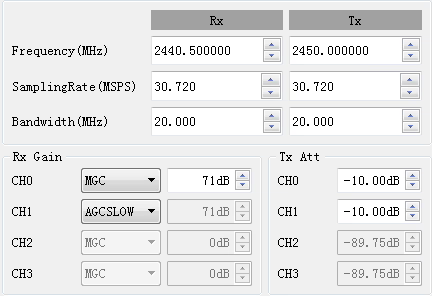
In scientific research and verification, it is often necessary to upload or download baseband IQ data to a general-purpose RF terminal. Using SDR Studio software, in addition to configuring RF components and viewing time-frequency waveforms, IQ data can be stored in files at the configured sampling rate or retrieved via a host computer API. Data can also be distributed and played back.

Support ADI official IIO SCOPE for RFIC testing
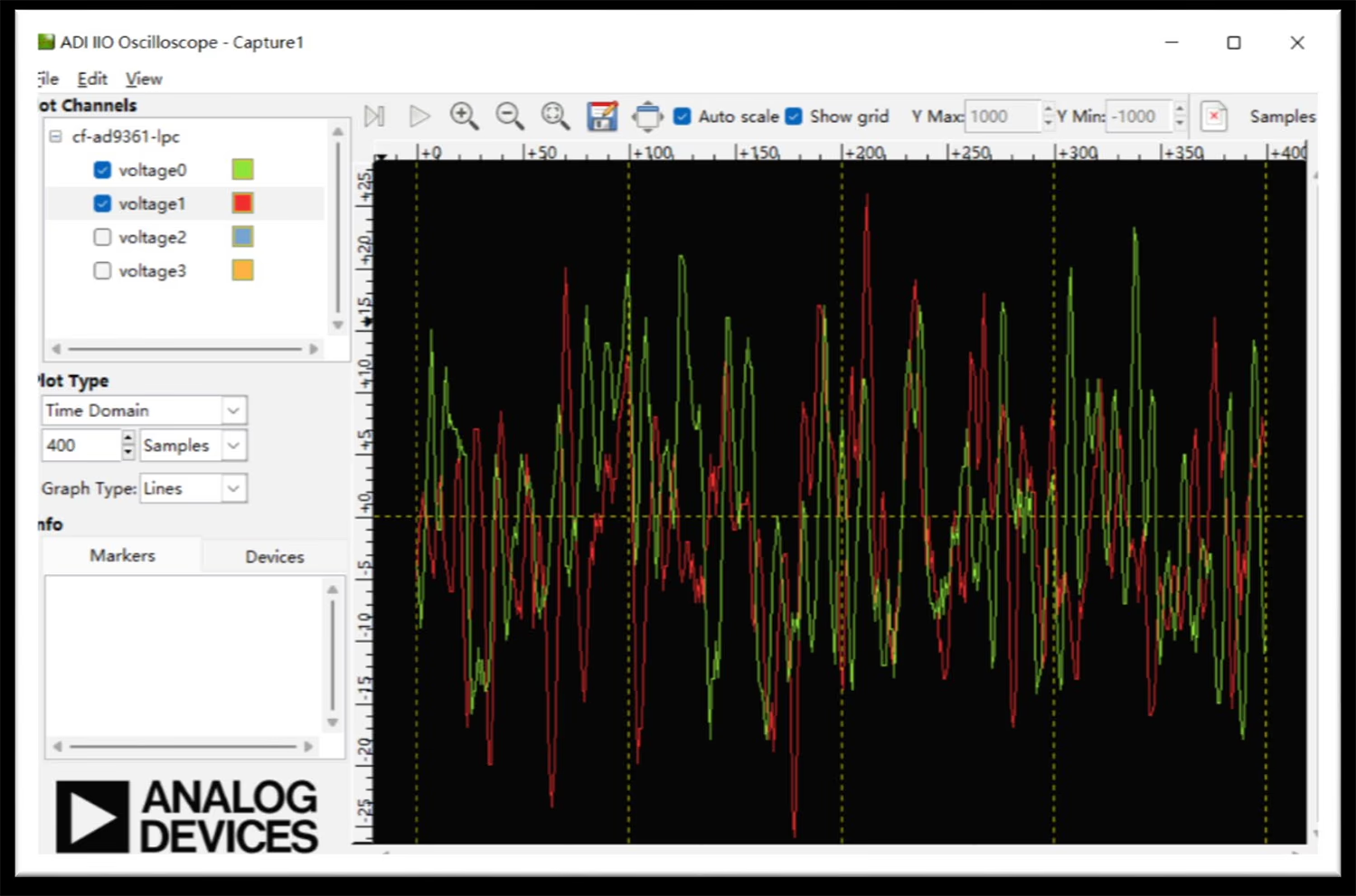
IIO SCOPE is a cross-platform GUI application officially provided by Analog Devices that can be used to test various ADI zero-IF architecture chips. The application supports plotting time domain, spectrum, constellation, and cross-correlation graphs of acquired data, and can view and configure multiple RF device settings, bao gồm cả tần số, băng thông, sampling rate, và đạt được.
Hỏi đáp
1. What is the Xilinx XC7Z020 ADI AD9361 SDR Platform used for?
This SDR platform is designed for wireless communication research, tạo mẫu, giáo dục, and testing. It supports RF transceiver applications, data acquisition, kho, và phát lại.
2. What frequency range does the ADI AD9361 SDR platform cover?
It covers a wide frequency range from 70 MHz đến 6 GHz, making it suitable for multiple communication standards.
3. What bandwidth does this SDR platform support?
The analog bandwidth is adjustable from 200 kHz to 56 MHz, offering flexibility for various RF applications.
4. Is this SDR platform based on FPGA technology?
Vâng, it is powered by the Xilinx XC7Z020 SoC FPGA, providing high performance for real-time signal processing.
5. How many RF channels are supported?
The SDR supports 2 transmit channels and 2 receive channels, enabling MIMO and synchronized multi-channel experiments.
6. Can I use this SDR platform with MATLAB and Simulink?
Vâng, the device is fully compatible with MATLAB and Simulink, ideal for system simulation and real-time testing.
7. What is the main RF transceiver chip used in this board?
The platform integrates the ADI AD9361 wideband RF transceiver, known for its flexibility and performance.
8. Does the SDR platform support standalone operation?
Vâng, thanks to its ARM processor system, it can operate as an independent SDR without a PC.
9. What data interfaces are available?
Nó hỗ trợ USB 3.0, Gigabit Ethernet, UART, JTAG, thẻ TF, and audio interfaces.
10. What is the maximum transmit power?
Tại 6 GHz with 0 dB TX gain, TX1 outputs -0.3 dBm và TX2 outputs -0.2 dBm.
11. Can this SDR be used for spectrum analysis?
Vâng, nó hỗ trợ spectrum analysis with the provided SDR Studio software.
12. What kind of signals can it generate?
It can generate single-tone, multi-tone, LÀ, FM, BPSK, QPSK, QAM, OFDM, and other modulation schemes.
13. Is it suitable for educational purposes?
Vâng, it is widely used in universities and research labs for communication system teaching.
14. What type of ADC and DAC are included?
Nó có tính năng 12-bit dual-channel ADC and DAC with a sampling rate of 122.88 MSPS.
15. How stable is the clock system?
It has a ±0.1 ppm clock stability, ensuring accurate signal transmission and reception.
16. Can this SDR platform store IQ data?
Vâng, nó hỗ trợ IQ data storage and playback using SDR Studio software.
17. Does it support external reference clocks?
Vâng, MỘT external reference clock input được hỗ trợ.
18. What is the gain control range of the receiver?
The RX gain can be adjusted from 0 dB đến 71 dB in 1 dB steps.
19. What is the TX attenuation range?
The TX attenuation ranges from 0 dB đến -89.75 dB in 0.25 dB steps.
20. Can it be used for OFDM experiments?
Vâng, the platform supports OFDM signal generation and testing.
21. What operating systems are compatible?
It can be used with Windows and Linux systems for development and testing.
22. Does the SDR support IIO Scope from ADI?
Vâng, it works with the official ADI IIO Scope tool for RFIC testing.
23. Can I use it as a vector signal generator?
Vâng, it functions as a low-cost SDR-based vector signal generator (VSG).
24. What storage options are available on the device?
It includes 1 GB DDR, 256 Mb Flash, và 2 Kb EEPROM.
25. What is the power consumption?
Power consumption is less than 15W, làm cho nó tiết kiệm năng lượng.
26. Cần nguồn điện gì?
It can be powered by DC 5V or USB 3.0.
27. What are the physical dimensions of the device?
Kích thước là 140mm × 100mm × 40mm, compact enough for lab and field use.
28. What is the supported sampling rate for reception?
Nó hỗ trợ 208.33 kHz to 61.44 MHz, có thể điều chỉnh trong 1 Hz steps.
29. What is the supported sampling rate for playback?
The playback rate also ranges from 208.33 kHz to 61.44 MHz.
30. Can this SDR platform be used for UAV or drone communication?
Vâng, its wide frequency coverage makes it suitable for UAV data links and telemetry.
31. Is the SDR compatible with GNU Radio?
Vâng, it can be used with GNU Radio for custom SDR development.
32. What modulation schemes are supported?
Supported modulations include LÀ, FM, BPSK, QPSK, QAM, and OFDM.
33. Can I use this SDR for satellite communication experiments?
Vâng, cái 70 MHz–6 GHz frequency range allows satellite band testing.
34. Does it support full-duplex communication?
Vâng, the platform supports FDD and TDD modes.
35. Is it suitable for 5G prototyping?
Vâng, it can be used for 5G NR signal testing and prototyping.
36. What is the transmit error margin?
các transmitting frequency error is within ±1 ppm.
37. Can the SDR be synchronized across multiple boards?
Vâng, nó hỗ trợ multi-channel phase synchronization.
38. Does it support SDR Studio software?
Vâng, SDR Studio is provided for signal acquisition, phát lại, and spectrum analysis.
39. Can it generate noise signals like AWGN?
Vâng, nó hỗ trợ AWGN noise generation để thử nghiệm.
40. What humidity conditions can it operate in?
It can work in 2% ĐẾN 95% humidity (không ngưng tụ) at 25°C.
41. What is the supported working temperature range?
It operates between -40°C đến +60°C.
42. Can it be used for IoT wireless testing?
Vâng, it is excellent for IoT and LPWAN protocol experiments.
43. Does it support Ethernet streaming?
Vâng, nó hỗ trợ high-speed streaming via Gigabit Ethernet.
44. Can I develop custom FPGA code for it?
Vâng, với Xilinx Vivado, you can program custom FPGA logic.
45. Can it capture real-world signals?
Vâng, it can capture and analyze real RF signals in real time.
46. Is this SDR suitable for academic research papers?
Vâng, it is widely used in academic publications and PhD research projects.
47. Can the platform work with SDRangel or other SDR apps?
Vâng, it can integrate with third-party SDR applications.
48. What kind of users benefit most from this SDR platform?
Đó là lý tưởng cho researchers, kỹ sư, educators, and advanced SDR hobbyists.
49. Does it support MIMO experiments?
Vâng, cái dual TX and RX channels make it suitable for MIMO research.
50. Why should I choose this SDR platform over others?
Because it combines Xilinx FPGA processing power, AD9361 RF transceiver, MATLAB/Simulink support, dải tần rộng, and multiple interfaces in one powerful, cost-effective solution.





iVcan.com –
I have been using the Xilinx XC7Z020 ADI AD9361 SDR platform for my wireless communication projects, và nó đã vượt quá mong đợi của tôi. The wide frequency range from 70 MHz đến 6 GHz and flexible bandwidth make it perfect for testing different standards and custom signals. I really appreciate the seamless integration with MATLAB and Simulink, which allows me to quickly design, simulate, and implement my ideas. The USB 3.0 and Gigabit Ethernet interfaces ensure fast data transfer, while the stable performance and compact design make it reliable for both lab use and field experiments. This SDR platform is an excellent choice for researchers, kỹ sư, and students.