

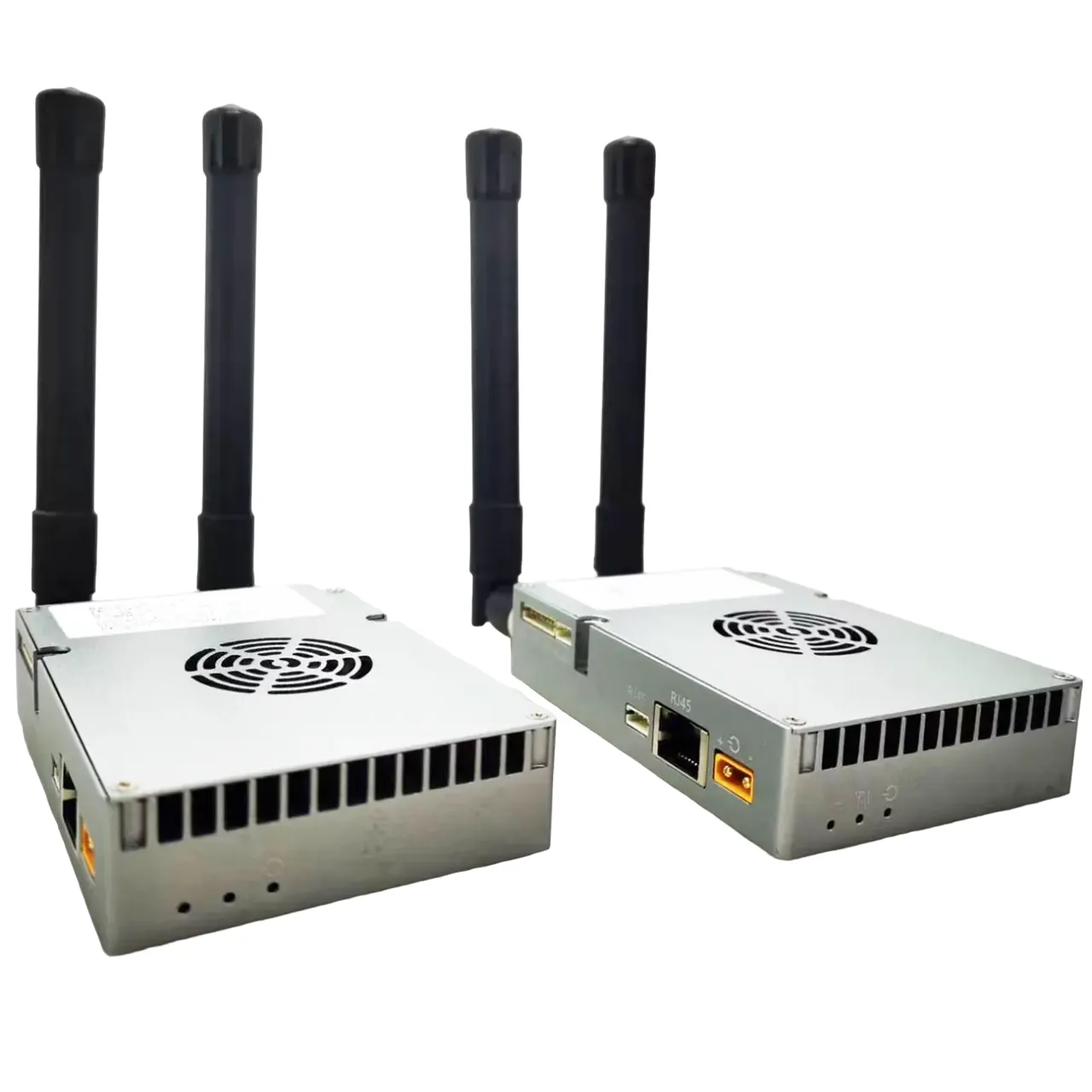


Выбор устройств связи для БПЛА: Анализ требований клиентов к ячеистой системе бортовой радиосвязи MIMO
As unmanned aerial vehicle (БПЛА) technology continues to evolve, communication systems have become one of the most critical components in ensuring reliable flight operations, real-time data transmission, autonomous networking, and anti-interference capability.
Недавно, a customer provided the following technical requirements for an Airborne Radio MIMO Mesh communication solution:
“Currently, I am working on the development of an unmanned aerial vehicle. Could you please help us choose communication devices for unmanned aerial vehicles?»
The customer’s detailed modem requirements are listed below:
- Группа:2700-2900МГц
- Получить чувствительность:-103дБм при полосе пропускания 5 МГц
- Пропускная способность канала:5/10/20 МГц
- Скорость передачи данных: 100 Mbps
- Режим модуляции:ТД-КОФДМ, BPSK/QPSK/16QAM/64QAM/256QAM/1024QAM Adaptive
- Выходная мощность РЧ:4Ватт×2,Support TPC, transmission power control
- Режим защиты от помех:Ручной выбор канала сканирования спектра, Intelligent frequency channel Selection/Autonomous frequency hopping/Roaming mode
- Шифрование:АЕС128/256
- Rich Interface, Сетевой порт, Последовательный порт, Вход постоянного тока
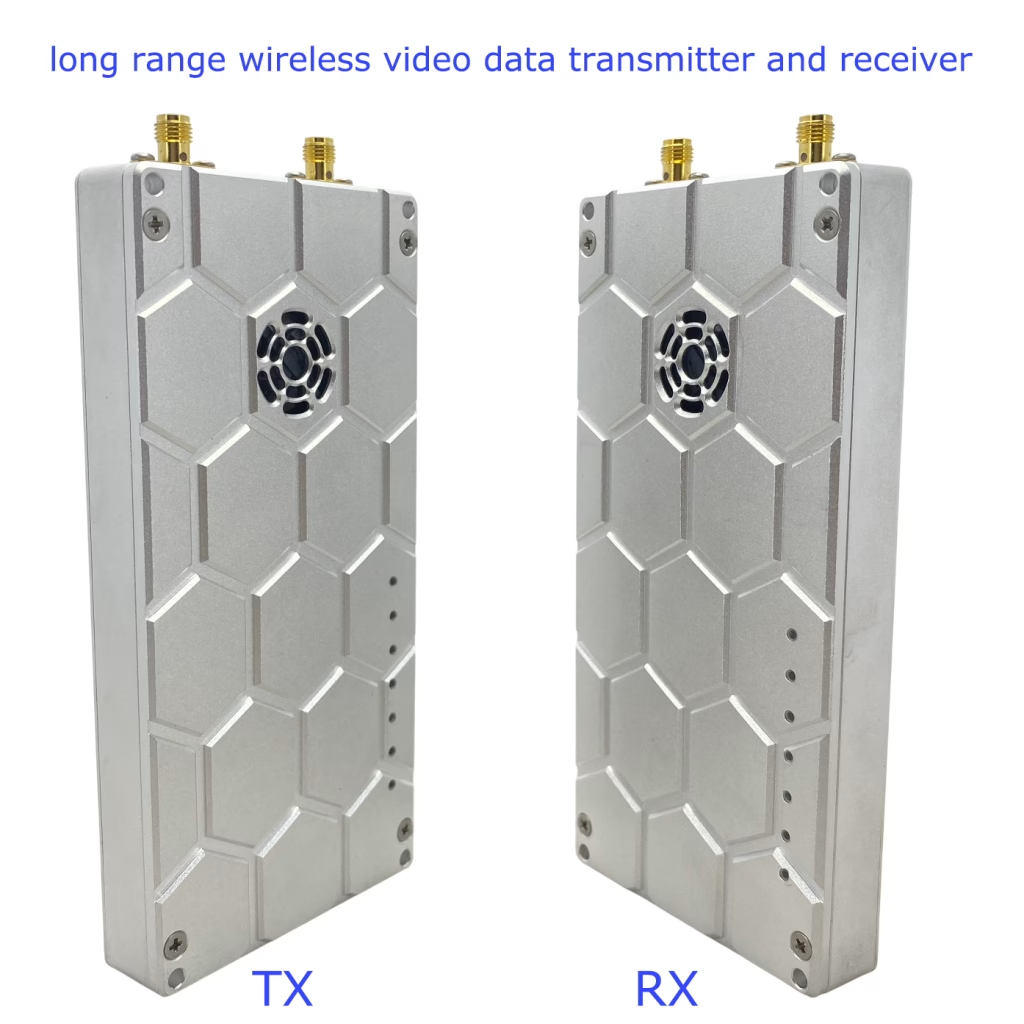
Airborne Radio mimo mesh
This article analyzes these requirements in detail and explains what kind of UAV communication equipment would best meet the customer’s expectations.
Оглавление
1. Understanding the Application Scenario
The requested specifications strongly suggest that the customer is developing a high-performance UAV platform предназначен для:
- Long-range communication
- Real-time HD video transmission
- Autonomous networking
- Anti-jamming operations
- Multi-node airborne mesh networking
This is not a simple point-to-point drone datalink. Вместо, the requirements point toward a military-grade or industrial-grade MIMO Mesh radio system подходит для:
- Tactical UAVs
- Дроны наблюдения
- Border patrol UAVs
- Emergency response systems
- Swarm drone applications
- Autonomous robotic networks
The mention of “Airborne Radio MIMO Mesh” is especially important because it indicates the need for a самоисцеление, multi-hop wireless network architecture.
2. Frequency Band Analysis: 2700–2900 MHz
The customer specifies:
“Band:2700-2900MHz”
This frequency range belongs to the S-band spectrum, which offers a good balance between:
- Расстояние передачи
- Penetration capability
- Размер антенны
- Data throughput
Advantages of S-Band for UAV Communications
Moderate Propagation Loss
Compared with 5.8 Системы ГГц, the 2.7–2.9 GHz range provides better propagation performance and more stable links in complex environments.
Compact Antenna Design
The wavelength is short enough to support compact airborne antennas suitable for UAV payload integration.
Lower Congestion
This spectrum is generally less crowded than common ISM bands such as 2.4 ГГц.
Suitable for Mesh Networking
The S-band performs well in dynamic mesh topology environments where airborne nodes are constantly moving.
3. Receiver Sensitivity Requirement
The customer requests:
“Receive Sensitivity:-103dBm@5MHz BW”
This is an excellent sensitivity target for a broadband airborne modem.
Why Receiver Sensitivity Matters
Receiver sensitivity directly impacts:
- Дальность связи
- Signal reliability
- Performance in weak signal conditions
- Resistance to interference
A sensitivity of -103 dBm at 5 MHz bandwidth indicates that the system is expected to maintain stable communications even at long distances or under non-line-of-sight conditions.
For UAV applications, this is particularly important because airborne platforms often experience:
- Быстрое движение
- Signal fading
- Terrain blockage
- Multipath interference
4. Bandwidth and Throughput Requirements
The customer specifies:
“Channel Bandwidth:5/10/20 MHz”
и
“Data Rate: 100 Mbps”
This indicates the system must support adaptive bandwidth allocation and high-throughput transmission.
Why Flexible Bandwidth Is Important
Different missions require different trade-offs between:
- Диапазон
- Пропускная способность
- Spectrum efficiency
- Interference resistance
Например:
| Пропускная способность | преимущество |
|---|---|
| 5 МГц | Больший диапазон, better sensitivity |
| 10 МГц | Сбалансированная производительность |
| 20 МГц | Maximum throughput |
А 100 Mbps data rate suggests support for:
- HD/4K video streaming
- Телеметрия
- AI sensor payloads
- Real-time command and control
- Multi-UAV coordination
5. Modulation Technology Analysis
The customer requires:
“TD-COFDM, BPSK/QPSK/16QAM/64QAM/256QAM/1024QAM Adaptive”
This is one of the most critical parts of the specification.
TD-COFDM for UAV Applications
ж(т)=∑k=0N−1akej2πfkt
ТД-КОФДМ (Time Division – Coded Orthogonal Frequency Division Multiplexing) is widely used in advanced wireless communication systems because it offers:
- Excellent multipath resistance
- High spectral efficiency
- Strong mobility performance
- Stable video transmission
- Robust anti-interference capability
It is particularly suitable for UAV operations in urban, гористый, or battlefield environments.
Адаптивная модуляция
The inclusion of:
- БПСК
- КФСК
- 16QAM
- 64QAM
- 256QAM
- 1024QAM
indicates the customer expects adaptive modulation and coding (AMC) способность.
This means the radio dynamically changes modulation schemes according to channel quality:
| модуляция | Characteristic |
|---|---|
| БПСК | Highest reliability |
| КФСК | Robust performance |
| 16QAM | Balanced throughput |
| 64QAM | High-speed transmission |
| 256QAM | Very high efficiency |
| 1024QAM | Maximum spectral efficiency |
Adaptive modulation is essential for UAVs because signal conditions constantly change during flight.
6. RF Power and MIMO Architecture
The requirement states:
“RF Output Power:4Watts×2”
This strongly suggests a 2×2 MIMO architecture.
Benefits of MIMO in UAV Systems
МИМО (Несколько входов Несколько выходов) significantly improves:
- Пропускная способность
- Link stability
- Anti-fading performance
- Spatial diversity
- Communication reliability
A 4W ×2 design provides substantial transmission capability while still remaining feasible for airborne deployment.
Transmission Power Control (TPC)
Заказчик также требует:
“Support TPC, transmission power control”
TPC is important because it enables:
- Reduced power consumption
- Lower electromagnetic interference
- Improved coexistence
- Dynamic link optimization
For battery-powered UAVs, efficient power management is critical.
7. Anti-Interference Capability
The customer specifies several advanced anti-jamming features:
“Manual spectrum scanning channel selection”
“Intelligent frequency channel Selection”
“Autonomous frequency hopping”
“Roaming mode”
This clearly indicates the system must operate in contested RF environments.
Key Anti-Interference Technologies
Spectrum Scanning
Allows operators to manually identify cleaner channels.
Intelligent Channel Selection
Automatically switches to optimal frequencies based on interference conditions.
Скачкообразная перестройка частоты
fn=f0+nΔf
Frequency hopping enhances survivability against:
- Jamming
- Interception
- Congestion
Roaming Mode
Supports seamless node switching within a mesh network.
This is especially important for:
- UAV swarms
- Мобильные системы управления
- Multi-node airborne relays
8. Security Requirements
The customer requests:
“Encryption:AES128/256”
AES encryption is currently one of the most widely accepted standards for secure wireless communication.
Why Encryption Matters in UAV Systems
Modern UAVs often transmit sensitive information such as:
- Surveillance video
- GPS-координаты
- Control commands
- Tactical data
AES-256 provides stronger protection for high-security deployments.
9. Interface Requirements
The customer requires:
“Rich Interface, Сетевой порт, Последовательный порт, DC Input”
This indicates the modem must integrate with multiple onboard systems.
Typical UAV Integration Interfaces
| Интерфейс | Цель |
|---|---|
| Ethernet-порт | Video and IP data |
| Последовательный порт | Flight controller telemetry |
| Вход постоянного тока | UAV power integration |
| USB/UART | Debugging and configuration |
A flexible interface design simplifies integration with:
- Autopilots
- Камеры
- Наземные станции управления
- AI processors
10. Recommended Communication System Architecture
Based on the specifications, the ideal solution should include:
Recommended Features
2×2 MIMO Mesh Radio
Поддерживает:
- Self-healing networking
- Многоскачковая связь
- Динамическая маршрутизация
TD-COFDM Broadband Modem
Ensures:
- Stable airborne transmission
- Long-range communication
- High-speed data transfer
Adaptive Frequency Hopping
Improves:
- Anti-jamming capability
- Spectrum survivability
AES-256 Security
Обеспечивает:
- Secure command links
- Encrypted video transmission
High Throughput Ethernet
Поддерживает:
- HD-видео в реальном времени
- IP networking
- Edge computing applications
11. Заключительные мысли
The customer’s requirements describe a highly advanced UAV communication system designed for demanding operational environments.
The key priorities are:
- High data throughput
- Сильная защита от помех
- Reliable airborne networking
- Безопасная связь
- Flexible integration
- Autonomous mesh networking
In practical terms, the ideal solution would be a military-grade or industrial-grade S-band airborne MIMO mesh radio with TD-COFDM waveform support and adaptive networking capabilities.
As UAV technology continues to move toward autonomous swarms and intelligent airborne networks, communication systems like this will become increasingly important in the future of unmanned operations.
Задайте вопрос
Спасибо за ответ. ✨