





Understanding Uplink and Downlink Allocation in UAV Communication Systems
The rapid evolution of Unmanned Aerial Vehicles (UAV) has transformed industries ranging from defense and law enforcement to agriculture, topografía, radiodifusión, and disaster response. At the heart of every UAV operation is its communication system, which ensures reliable command and control as well as real-time data transfer. This communication framework is typically divided into two critical components: el enlace ascendente (ground-to-UAV) y el enlace descendente (UAV a tierra). Each plays a unique role in mission success, requiring careful allocation of frequency, ancho de banda, and transmission methods. En este artículo, we will explore how uplink and downlink are allocated, why the distinction matters, and how companies like IVCAN design solutions optimized for UAV applications.
Tabla de contenido
1. The Basics of UAV Communication
A UAV communication system can be visualized as a two-way street:
- Enlace ascendente (Ground → UAV): Carries pilot commands, flight path adjustments, configuration updates, and payload control signals.
- Enlace descendente (UAV → Ground): Delivers real-time telemetry (altitud, posición, estado de la batería) y, more importantly, high-bandwidth payload data such as video feeds or sensor readings.
Both directions require high reliability and low latency, but they differ in terms of bandwidth demands, signal strength requirements, y frequency preferences.
2. Uplink Allocation
The uplink is the lifeline of UAV control. Losing uplink connectivity could result in mission failure or, worse, loss of the aircraft. To prevent this, uplink systems prioritize reliability over bandwidth.
Características clave:
- Data Volume: Low — typically limited to control signals and telemetry acknowledgments.
- Bandwidth Requirement: Pequeño (from a few kilobits to hundreds of kilobits per second).
- Latency Requirement: Very low — control signals must be instantaneously received.
- Frequency Choices:
- 433 MHz y 900 MHz bands are commonly used for long-range control due to their superior penetration and lower susceptibility to environmental interference.
- 2.4 bandas de GHz are sometimes employed when the control and data links are integrated, although this increases congestion risks.
- Power Levels: Generally lower than downlink, since uplink transmits less data.
Practical Example:
IVCAN offers long-range COFDM transmitters that can be configured for uplink communication with narrowband settings, ensuring robust command links even in environments with interference. By focusing on reliability, uplinks maintain constant control of the UAV, even at extended distances.
3. Downlink Allocation
The downlink is the data-rich channel of UAV operations. It provides the ground operator with live insights into the UAV’s performance and environment, most notably through real-time video streams.
Características clave:
- Data Volume: High — especially when transmitting high-definition (alta definición) or ultra-high-definition (HD) video.
- Bandwidth Requirement: Medium to large (que van desde 2 Mbps to over 20 Mbps for HD video).
- Latency Requirement: Low — particularly for applications such as FPV drone racing, vigilancia, or military reconnaissance where video feedback must be immediate.
- Frequency Choices:
- 2.4 GHz y 5.8 bandas de GHz are popular due to their capacity for higher bandwidth.
- 1.2 GHz o 1.4 bandas de GHz can be used for mid-range video downlink with better penetration than 5.8 GHz.
- C-band or Ku-band allocations are sometimes used for professional or military systems requiring high data throughput.
- Power Levels: Higher than uplink to ensure data integrity across longer distances and potential obstructions.
Practical Example:
IVCAN’s H.265 COFDM UAV video transmitter delivers ultra-low latency (tan bajo como 30 Sra) for downlink video. Such systems balance compression efficiency and bandwidth usage, enabling real-time HD video delivery over challenging environments.
4. Division of Responsibilities: Why Separation Matters
Allocating uplink and downlink to different frequency bands or carefully coordinated time slots (in TDD systems) avoids interference and maximizes system performance.
- Avoiding Self-Interference: If uplink and downlink operated on the same frequency without isolation, the signals would interfere, reducing reliability.
- Optimized Performance: Low-frequency bands (enlace ascendente) excel at penetrating obstacles and maintaining control. High-frequency bands (enlace descendente) provide the bandwidth needed for video.
- Cumplimiento normativo: Many countries regulate UAV communication bands, requiring separation between uplink and downlink to prevent spectrum congestion.
5. Frequency Division vs. Time Division
Dúplex por división de frecuencia (FDD):
- Uplink and downlink operate on separate frequencies.
- Ventajas: Continuous, simultaneous transmission in both directions.
- Drawbacks: Requires more spectral resources.
Dúplex por división de tiempo (TDD):
- Uplink and downlink share a single frequency band but alternate in time slots.
- Ventajas: Spectrally efficient.
- Drawbacks: May introduce latency and reduce real-time responsiveness.
Professional UAV systems, such as those supported by IVCAN COFDM modules, often employ FDD for mission-critical applications, ensuring continuous control and data transfer.
6. Bandwidth and Power Allocation Strategy
- Enlace ascendente: Minimal bandwidth, minimal power, optimized for reliability and low latency.
- Enlace descendente: Significant bandwidth, moderate-to-high power, optimized for video quality and low delay.
Por ejemplo, an operator might allocate:
- Enlace ascendente: 433 megahercio, 100 kHz bandwidth, 100 mW power.
- Enlace descendente: 2.4 GHz, 8 ancho de banda MHz, 1 potencia W.
This asymmetry reflects the very different roles of uplink and downlink.
7. Estudio de caso: UAV Systems Powered by IVCAN
IVCAN provides a range of UAV communication solutions designed specifically with uplink/downlink optimization in mind:
- IVCAN H.265 COFDM Transceiver Module: Offers ultra-low latency downlink video with dual-input options (HDMI, DE, IDE). Its robust design ensures smooth video streams even in challenging conditions.
- IVCAN Long-Range Narrowband Uplink Systems: Reliable control channels with excellent penetration, supporting mission-critical UAV operations.
- Customizable Dual-Link Solutions: Combining narrowband uplink and broadband downlink modules in one integrated system, ensuring both stable control and rich data transfer.
By balancing uplink and downlink priorities, IVCAN’s solutions demonstrate how communication allocation directly enhances UAV performance.
8. Future Trends in UAV Link Allocation
- 5G Integration: Promises ultra-low latency and network slicing, enabling flexible uplink and downlink allocation on public infrastructure.
- AI-Assisted Link Management: Intelligent systems can dynamically allocate bandwidth and power between uplink and downlink based on mission needs.
- Multi-Band Operation: Advanced UAVs may simultaneously operate on several bands for redundancy and capacity (P.EJ., uplink on 900 megahercio, downlink on 5.8 GHz and Ku-band).
- MIMO & Formación de haces: Technologies that improve throughput and reliability for downlink video without demanding higher bandwidth.
Conclusión
The allocation of uplink and downlink in UAV communication is not arbitrary — it is a carefully engineered balance between control reliability and data richness. Uplink channels prioritize robustness, operating at lower frequencies with minimal bandwidth, while downlink channels maximize bandwidth and video quality, often using higher frequencies. By separating and optimizing these links, UAV systems achieve stable control and high-quality real-time data transfer.
Companies like IVCAN are at the forefront of developing professional-grade COFDM-based solutions that exemplify these principles, enabling UAVs to operate effectively in real-world scenarios where reliability and performance cannot be compromised.
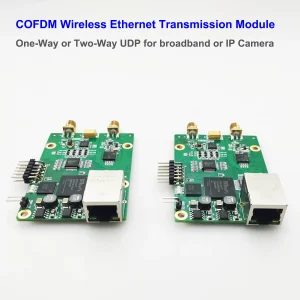
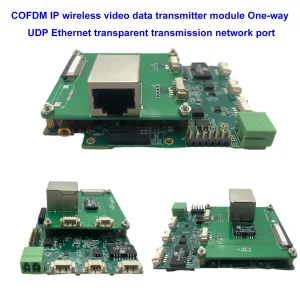


Inalámbrica de transmisión de vídeo
300-500Transceptor Mhz COFDM IP RJ45 con antena con filtro PA de 10W
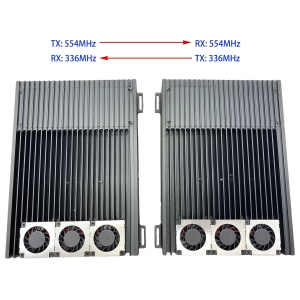

Inalámbrica de transmisión de vídeo

CVBS HDMI al codificador IP
Transmisión unidireccional de vídeo o datos COFDM para transmisor y receptor de protocolo UDP
Haz una pregunta
Gracias por tu respuesta. ✨