




ASIC Image Processing Chips: The Hidden Power Behind Modern Visual Intelligence
Cámara IP con IA
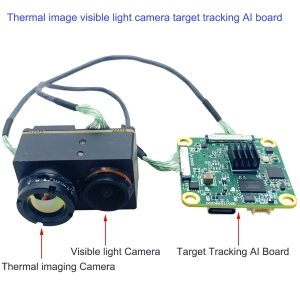
Tablero AI de seguimiento de objetivos de cámara de luz visible de imagen térmica para Betaflight
Introducción
In today’s digital era, the world is increasingly visual. From drones capturing breathtaking aerial footage to autonomous vehicles navigating complex traffic scenarios, image processing has become the backbone of countless technologies. At the heart of these applications lies a category of specialized hardware: ASIC image processing chips.
ASIC, corto para Application-Specific Integrated Circuit, refers to chips designed for a narrow, highly specialized purpose. Unlike general-purpose CPUs or even flexible GPUs, ASICs are tailored from the ground up to execute specific functions with extraordinary efficiency. When applied to image processing, ASICs transform how raw pixels from cameras are converted into meaningful, high-quality images, compressed for transmission, or analyzed for insights.
This article explores the world of ASIC image processing chips—what they are, why they matter, their unique advantages, applications in industries such as drones and autonomous vehicles, comparisons with GPUs and FPGAs, and the future trends shaping this technology.
1. What Is an ASIC Image Processing Chip?
Un ASIC image processing chip is a semiconductor device engineered to handle image or video processing tasks efficiently. While CPUs and GPUs rely on general-purpose architectures, ASICs embed dedicated circuits optimized for functions such as:
- Video compression and decompression (H.264, H.265/HEVC, AV1)
- Mejora de imagen (denoising, HDR, color correction)
- Geometric transformations (corrección de distorsión, stabilization)
- Computer vision (feature extraction, detección de objetos)
- Real-time signal encoding for wireless transmission
Because the hardware is specifically designed for these algorithms, ASIC chips achieve levels of performance-per-watt, estado latente, and integration that are unmatched by other solutions.
2. Why ASICs for Image Processing?
The demand for ASIC-based image processing stems from several critical needs:
Tabla de contenido
2.1 Bajo consumo de energía
In mobile and embedded systems such as drones, wearables, or surveillance cameras, power is a scarce resource. ASICs consume far less energy than GPUs or FPGAs for the same workload, often achieving an order of magnitude better energy efficiency.
2.2 Rendimiento en tiempo real
When transmitting live video from a drone or running advanced driver assistance systems in a vehicle, milliseconds matter. ASIC chips deliver deterministic low-latency processing, ensuring that video frames are processed in real-time without bottlenecks.
2.3 Cost Efficiency at Scale
Although designing and manufacturing ASICs is expensive, once mass-produced, their per-unit cost drops significantly. For consumer electronics and automotive applications, where millions of units are shipped, ASICs become the most cost-effective choice.
2.4 Compact Integration
ASICs often integrate multiple modules—such as an ISP (Image Signal Processor), video codec, and AI acceleration—into a single chip, reducing the overall system size and complexity.
3. Applications of ASIC Image Processing Chips
3.1 Drones and UAVs
Drones rely heavily on real-time video transmission and autonomous navigation. An ASIC-based image processing system can:
- Encode HD or 4K video using H.265 compression with latency as low as 30ms.
- Perform electronic image stabilization (EIS) to smooth out shaky footage.
- Process visual data for SLAM (Simultaneous Localization and Mapping) in autonomous navigation.
- Reduce power draw to extend flight time.
Ambarella’s CV series, widely used in DJI drones, is a prime example of ASIC image processors enabling advanced UAV applications.
3.2 Surveillance and Security Cameras
Security cameras require 24/7 codificación de vídeo, often with AI-based analytics. ASIC chips power:
- Multi-channel video encoding with low bitrates.
- AI-enhanced recognition tasks like facial recognition, license plate detection, and anomaly detection.
- Alto rango dinámico (HDR) processing for day/night monitoring.
Companies like HiSilicon and Novatek have long dominated this segment with ASIC-based solutions.
3.3 Automotive Applications
Autonomous and semi-autonomous vehicles demand ultra-reliable vision systems. ASIC image processors handle:
- Lane detection and object tracking.
- Real-time video stitching for 360° surround-view systems.
- Driver monitoring systems (DMS) for safety.
- Low-light and HDR imaging for night driving.
Ambarella, sony, and Socionext provide ASIC image processors optimized for automotive-grade reliability.
3.4 Consumer Electronics
From smartphones to action cameras, ASICs enable compact devices to deliver high-quality video with limited thermal envelopes. Apple’s A-series SoCs, por ejemplo, integrate ASIC-based image signal processors that power features like Smart HDR and real-time AR rendering.
3.5 Industrial and Military Systems
In defense and industrial robotics, ASICs ensure rugged, reliable image transmission under challenging conditions. With encryption and error correction embedded at the hardware level, they guarantee secure, interference-resistant communication.
4. ASIC vs. CPU vs. GPU vs. FPGA
To understand why ASICs are indispensable, it’s useful to compare them with other processing platforms:
| Característica | UPC | GPU | FPGA | ASIC |
|---|---|---|---|---|
| Flexibilidad | muy alto | Alto | Medio | Muy bajo |
| Actuación | Medio | Alto | Alto | muy alto |
| Estado latente | Alto | Medio | Bajo | Muy bajo |
| Power Efficiency | Bajo | Bajo | Medio | muy alto |
| Development Cost | Bajo | Medio | Alto | muy alto |
| Best Use Case | General computing | Parallel processing, AI | Creación de prototipos, niche hardware | Mass-market, fixed-function tasks |
ASICs win in power efficiency, estado latente, and integration—but sacrifice flexibility. This trade-off makes them ideal when algorithms are well-defined and unlikely to change rapidly, como video codecs or standard ISP functions.
5. Example ASIC Image Processing Chips
5.1 Hola silicio (Huawei)
- Widely used in surveillance cameras.
- Integrated video encoding, ISP, and AI accelerators.
- Optimized for low bitrates and smart analytics.
5.2 Ambarella CV Series
- Powers DJI drones and automotive systems.
- Includes image signal processing, H.265/AV1 encoding, and CVflow™ AI engine.
- Extremely low latency and power consumption.
5.3 Sony Image Signal Processors (ISPs)
- Integrated in Sony camera sensors.
- Specialized in color accuracy, HDR processing, and low-light imaging.
- Preferred in professional imaging and automotive-grade solutions.
5.4 Novatek and MStar
- Consumer-grade ISPs for dashcams, action cameras, and TVs.
- Offer low-cost yet efficient video pipelines.
5.5 Socionext Milbeaut
- Originally developed by Fujitsu.
- Used in DSLR cameras for RAW processing and high-quality JPEG output.
6. Challenges in ASIC Image Processing
While ASICs excel in performance and efficiency, their use comes with limitations:
- High Development Cost
- NRE (non-recurring engineering) costs for design and tape-out can reach millions of dollars.
- Long Development Cycle
- ASIC projects can take 12–24 months from design to production, making them risky in fast-moving industries.
- Lack of Flexibility
- Once taped out, ASICs cannot be reprogrammed. If standards change (P.EJ., video codecs), the chip becomes obsolete.
- Market Concentration
- ASIC production is dominated by a handful of companies (TSMC, Samsung, SMIC), creating supply chain risks.
7. The Future of ASIC Image Processing Chips
7.1 AI-Driven ASICs
Future ASICs will increasingly integrate AI accelerators for tasks like object detection, segmentation, and scene understanding. Instead of merely pre-processing pixels, chips will handle end-to-end perception pipelines.
7.2 In-Sensor Processing
Emerging research, como in-sensor computing, integrates ASIC logic directly into image sensors. This reduces data transfer overhead and enables ultra-low-power vision applications.
7.3 Edge Computing and IoT
With IoT devices proliferating, ASICs will power billions of low-cost, low-power vision nodes, enabling smart cities, monitoreo industrial, and home automation.
7.4 Security and Reliability
Future ASICs will embed stronger encryption, fault tolerance, and radiation-hardened designs for use in defense, aeroespacial, and automotive environments.
Conclusión
ASIC image processing chips are the silent enablers of modern visual intelligence. Combinando specialized efficiency, bajo consumo de energía, and real-time performance, they power the cameras, drones, carros, and IoT devices that shape our digital lives.
While their inflexibility and high development costs pose challenges, the sheer scale of visual applications—from consumer smartphones to industrial surveillance—ensures ASICs remain central to the future of image processing.
As AI becomes inseparable from imaging, tomorrow’s ASICs will evolve beyond simple image signal processors into vision intelligence chips, bridging the gap between raw pixels and actionable insights.
In the end, the story of ASIC image processing chips is a story of optimization: building the perfect hardware to transform light into understanding, and doing so faster, cheaper, and smarter than ever before.
Haz una pregunta
Gracias por tu respuesta. ✨